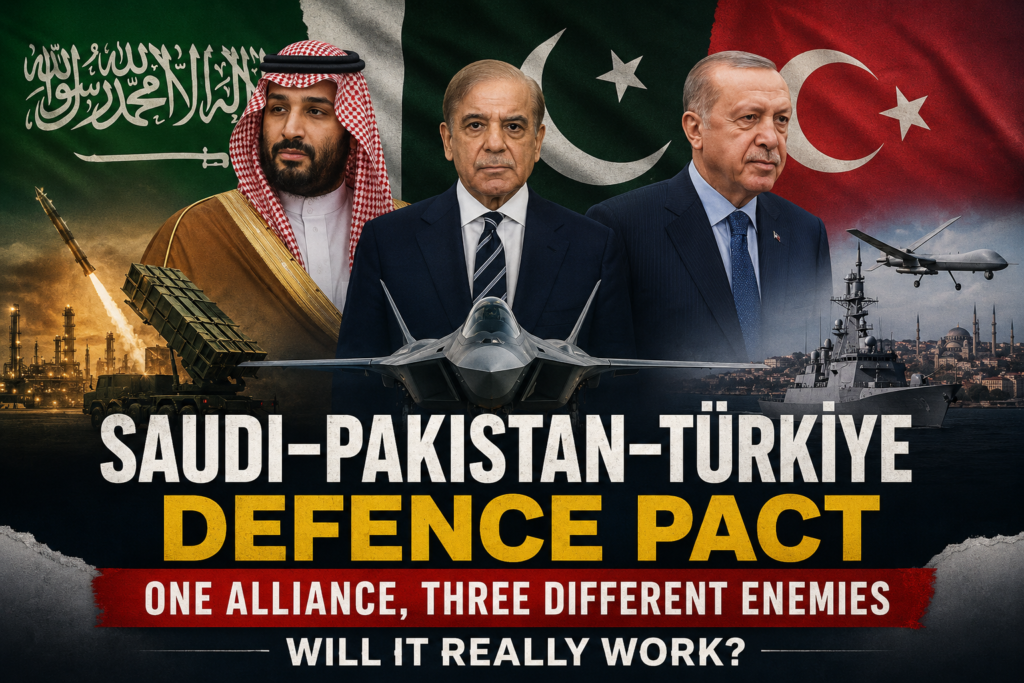
The Mecca Joint Defence Agreement combines Saudi financial power, Pakistan’s nuclear-armed military and Türkiye’s expanding defence industry. But beneath the headline lies a fundamental problem: the three partners face different enemies, different economic pressures and very different consequences if they are ever asked to fight one another’s wars.
By Pulse India News Desk
Saudi Arabia, Pakistan and Türkiye have signed a new mutual-defence agreement with language powerful enough to immediately draw comparisons with NATO: an armed attack against one member is to be regarded as an attack against all three.
The Mecca Joint Defence Agreement, signed on August 7, comes at a time of intense instability across the Middle East. Saudi Arabia faces renewed threats from Iranian-aligned forces, Pakistan remains deeply focused on its rivalry with India, and Türkiye continues to balance security challenges stretching from Syria and Iraq to Greece, Cyprus and the wider Eastern Mediterranean.
On paper, the combination is formidable.
Saudi money. Pakistani manpower and nuclear deterrence. Turkish defence technology.
But military alliances are not ultimately tested by signatures, ceremonies or the number of weapons their members possess.
They are tested when one government asks another to accept political, military and economic costs that may directly conflict with its own national interests.
That is why the most important question surrounding the new pact is not how powerful the three militaries look together.
It is whether Saudi Arabia, Pakistan and Türkiye are genuinely prepared to inherit one another’s enemies.
One alliance – but three different enemies
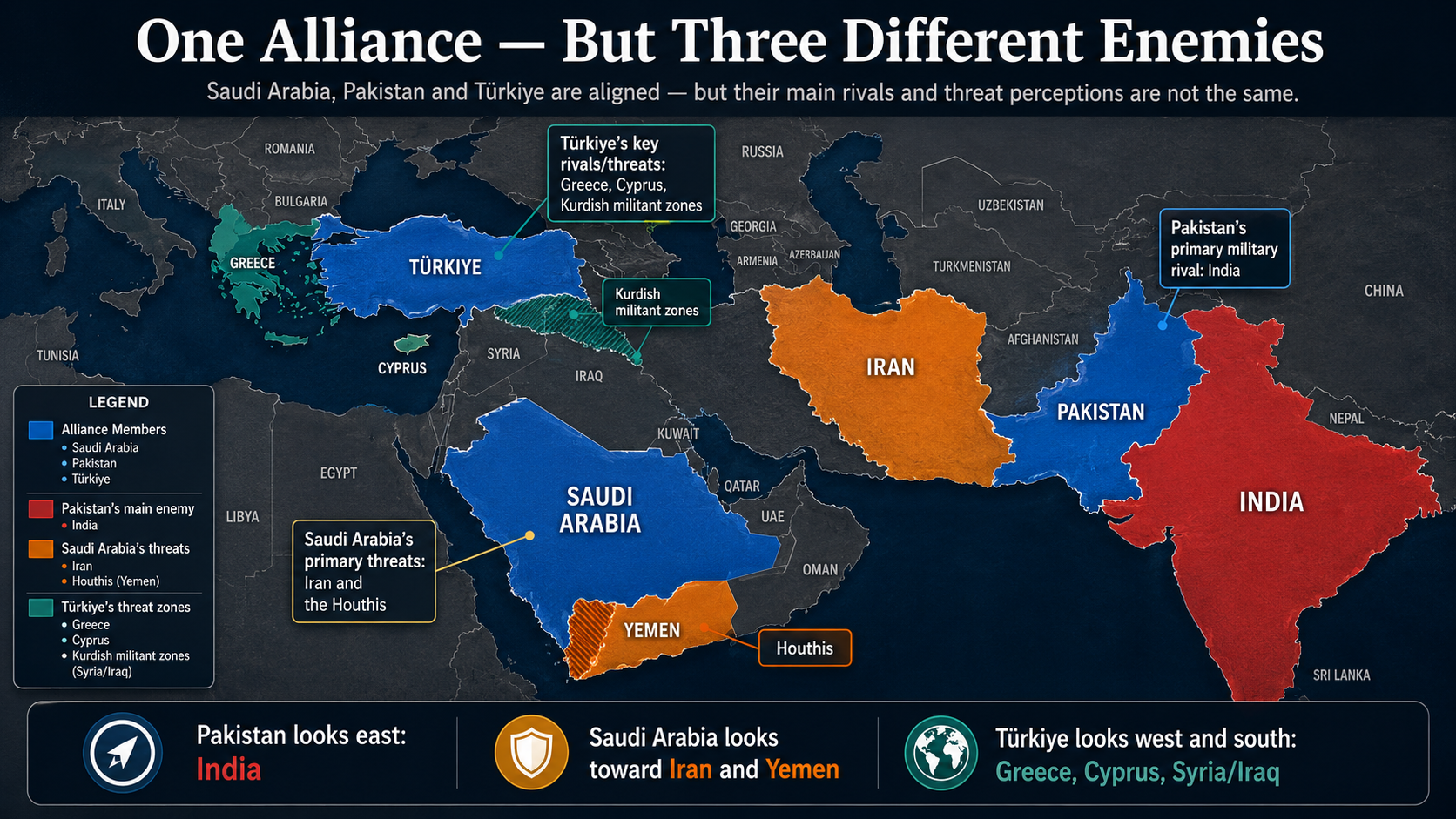
This may be the pact’s biggest structural weakness.
Pakistan’s military establishment remains overwhelmingly focused on India. Its force deployment, missile programme, nuclear deterrence and decades of strategic planning have been shaped by the possibility of another confrontation with New Delhi.
Saudi Arabia operates in an entirely different security environment.
Riyadh’s immediate concerns are centred on Iran, Iranian-backed militias and Yemen’s Houthis, particularly threats involving missiles, drones, oil infrastructure, ports, airports and other critical facilities.
Türkiye’s threat map is different again.
Ankara is concerned about Kurdish militant organisations, instability in Syria and Iraq, security along its southern frontier and longstanding disputes involving Greece and Cyprus in the Aegean and Eastern Mediterranean.
An alliance can survive different priorities. But a collective-defence alliance becomes difficult when an existential threat to one member is viewed by another member as a conflict it would rather avoid.
What does “an attack on one is an attack on all” actually mean?
The phrase is powerful, but the public details released so far leave several crucial questions unanswered.
Would an Indian strike inside Pakistan automatically require Saudi Arabia to enter a conflict against India?
Would an Iranian missile strike on Saudi territory require Pakistani aircraft to attack Iran?
If Turkish and Greek forces clashed in the Eastern Mediterranean, would Pakistan and Saudi Arabia be expected to participate militarily?
And what happens if the attack comes not from another state, but from a militia, drone network, cyber operation or proxy group?
These are not minor legal details. They determine whether the pact eventually becomes a genuinely integrated collective-defence alliance or primarily functions as a framework for deterrence, military deployments, intelligence sharing, joint exercises and defence-industrial cooperation.
Pakistan already faced the Saudi dilemma
Pakistan’s behaviour during the wider Iran conflict offers an early indication of how Islamabad may approach such obligations.
It would be inaccurate to say Pakistan simply remained silent when Saudi Arabia came under attack.
Islamabad publicly condemned attacks on the Kingdom and repeatedly stressed that Saudi security was important to Pakistan.
More importantly, Pakistan eventually provided substantial military support.
Reuters reported in May 2026 that Pakistan had deployed around 8,000 troops, a squadron of JF-17 fighter aircraft, drone squadrons and a Chinese HQ-9 air-defence system to Saudi Arabia under the existing bilateral defence arrangement.
That was far beyond symbolic support.
But Pakistan still tried to preserve another distinction: defending Saudi Arabia is not necessarily the same as launching an unrestricted offensive war against Iran.
That distinction may become one of the most important unwritten rules governing the new three-country pact.
Would Pakistan really fight Iran for Saudi Arabia?
Iran is not a distant adversary for Pakistan.
The two countries share a long border, and Islamabad must manage security challenges along that frontier while simultaneously maintaining its military concentration towards India.
A full-scale confrontation with Iran could therefore expose Pakistan to pressure on both its eastern and western fronts.
There are also energy, trade, domestic security and sectarian considerations.
For Islamabad, deploying defensive systems inside Saudi Arabia may be strategically manageable. Conducting prolonged strikes deep inside Iran would be an entirely different proposition.
Saudi Arabia may therefore discover that Pakistani assistance is strongest when the mission involves protecting Saudi territory, but considerably more complicated when Riyadh seeks offensive action against an adversary Pakistan would prefer not to permanently alienate.
Pakistan also has an economic problem
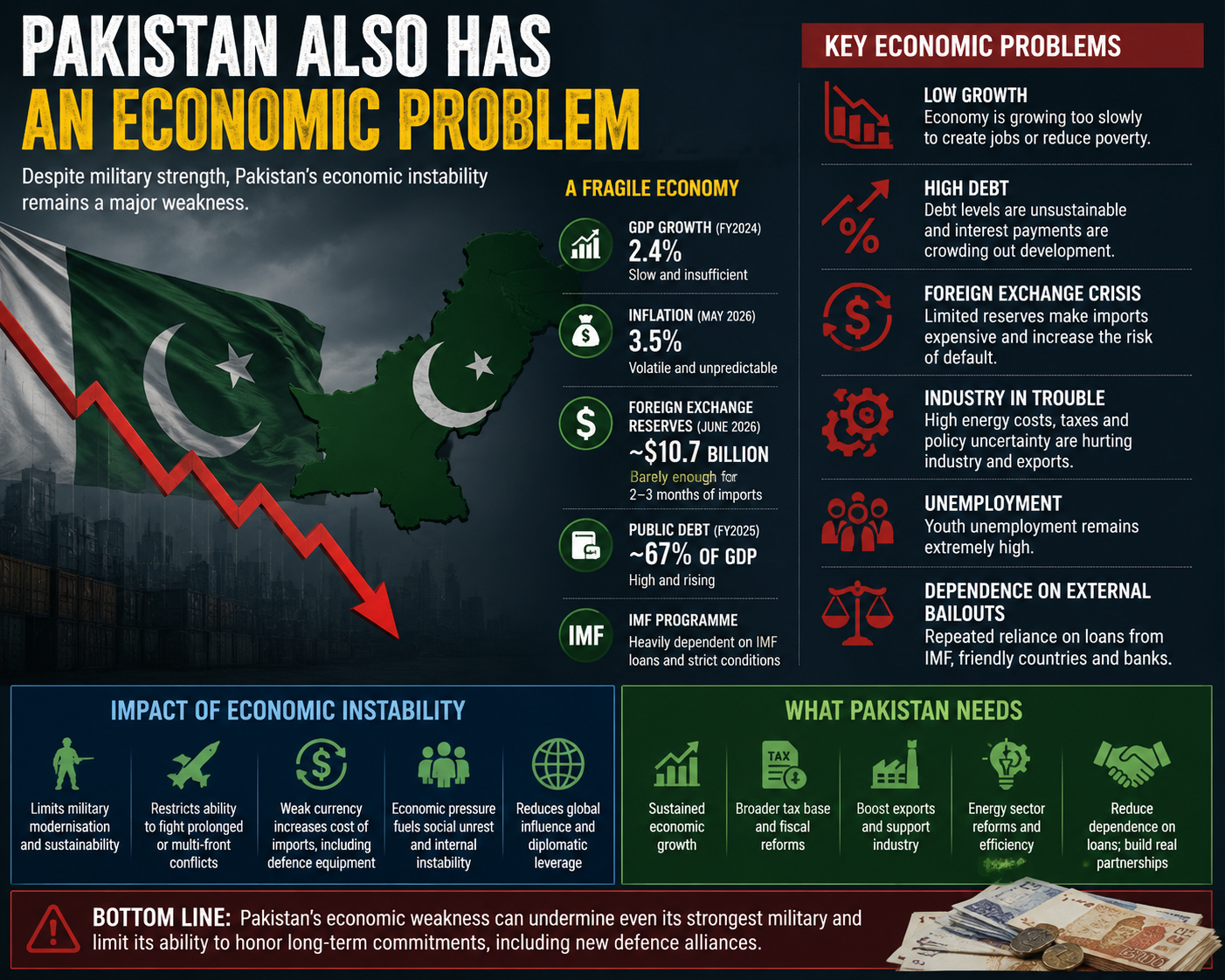
Pakistan’s military capability cannot be separated from the condition of its economy.
The country remains under an IMF-supported reform programme. In May 2026, the IMF completed another review that allowed Pakistan to access roughly $1.1 billion under the Extended Fund Facility and about $220 million under its Resilience and Sustainability Facility.
The IMF said Pakistan had made progress in stabilising the economy and rebuilding reserves, but also stressed the importance of maintaining fiscal discipline, strengthening public finances, reforming state-owned enterprises and improving the viability of the energy sector.
This creates an unusual strategic equation.
Pakistan possesses nuclear weapons, a large professional military and extensive combat experience.
But prolonged overseas military operations are expensive.
Fighter aircraft consume fuel and require continuous maintenance. Air-defence interceptors must be replenished. Overseas troops require logistics, accommodation, transportation and support. Destroyed or depleted equipment must eventually be replaced.
For Saudi Arabia, Pakistan offers military manpower and strategic depth.
For Pakistan, Saudi Arabia remains an important financial and economic partner.
That mutual dependence can strengthen the alliance — but it also raises an uncomfortable question:
How much of another country’s war can Pakistan economically afford to fight?
Then comes the Operation Sindoor question
Pakistan’s military relationship with China adds another layer to the discussion.
A substantial portion of Pakistan’s modern combat inventory includes Chinese-origin fighters, missiles, radar systems and air-defence platforms.
Operation Sindoor in May 2025 gave many analysts an unusual opportunity to examine the performance of Pakistani military infrastructure and air defences under actual combat conditions.
Claims that Chinese weapons “completely failed” should be treated cautiously. Battlefield performance depends on far more than the country that manufactured a particular weapon.
Training, deployment, electronic warfare, intelligence, command-and-control systems and tactics all influence the outcome.
However, India officially stated on May 8, 2025 that its forces had targeted Pakistani air-defence radars and systems and that an air-defence system at Lahore had been neutralised.
India later also highlighted strikes against Pakistani military infrastructure, including important airbases.
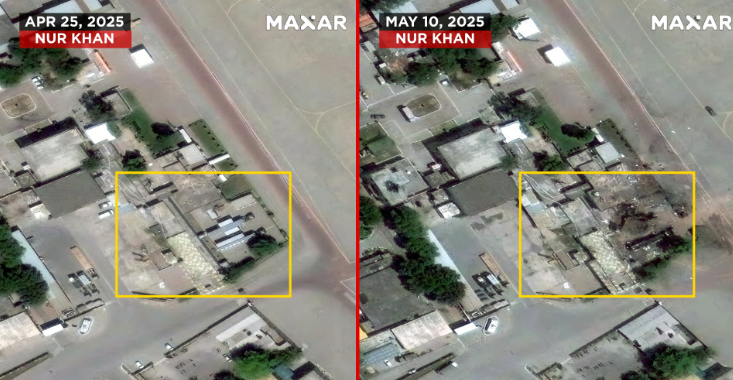
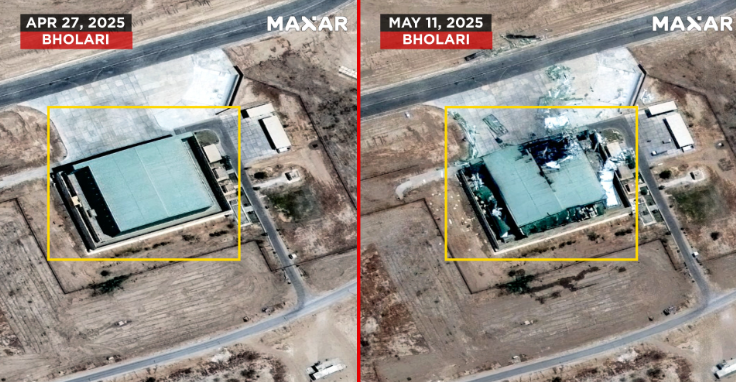
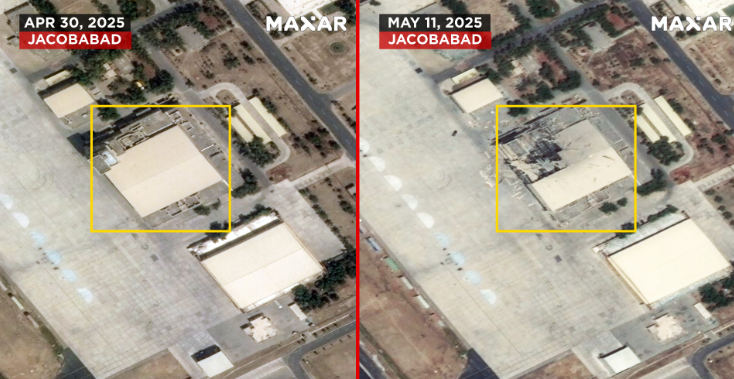
None of this proves that every Chinese-origin Pakistani system is ineffective.
But it demonstrates an important reality for Saudi planners: no air-defence network is invulnerable simply because its advertised specifications appear impressive.
That is particularly relevant because Pakistan’s Saudi deployment reportedly included Chinese-origin HQ-9 air-defence equipment.
Saudi Arabia is therefore likely to continue maintaining a diversified network of American, European and other defence systems rather than becoming dependent on any single supplier.
Saudi Arabia cannot simply inherit Pakistan’s rivalry with India
This is potentially the most important limitation on any attempt to portray the new alliance as automatically anti-India.
Pakistan sees India as its principal conventional military rival.
Saudi Arabia does not.
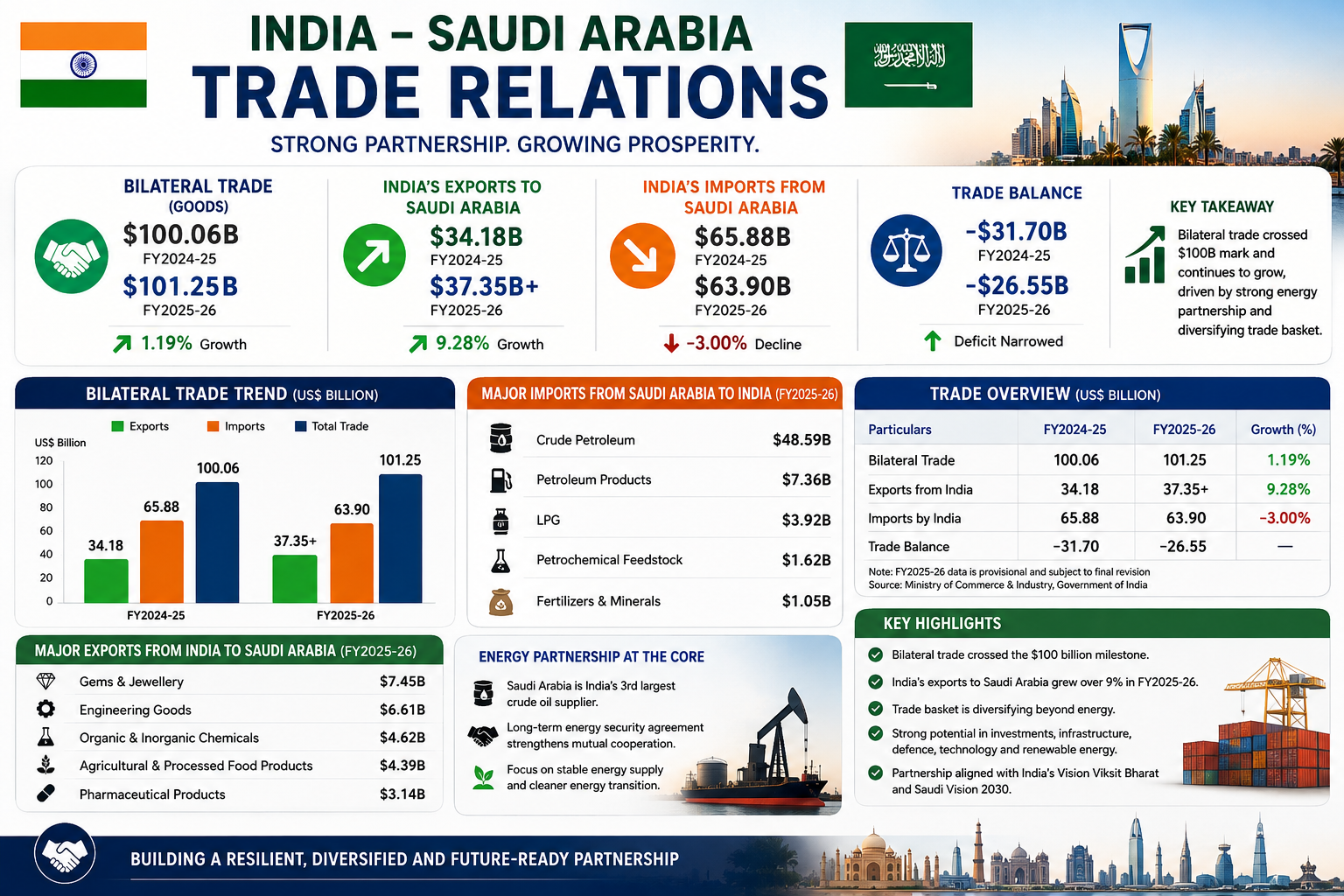
Official Indian government figures show that India-Saudi bilateral trade reached $41.88 billion in FY2024-25, with Indian exports worth $11.76 billion and imports from Saudi Arabia worth $30.12 billion.
India is Saudi Arabia’s second-largest trading partner, while Saudi Arabia is among India’s biggest trading partners and a major energy supplier.
Saudi investment linked to its sovereign wealth fund and Saudi companies in India has also reached around $10 billion, while thousands of Indian companies operate in the Kingdom.
This relationship matters because modern Saudi foreign policy increasingly favours strategic flexibility rather than rigid blocs.
Riyadh simultaneously maintains important relationships with Pakistan, India, China, the United States and Europe.
Pakistan may therefore be an exceptionally important Saudi military partner without Saudi Arabia automatically adopting Pakistan’s entire strategic rivalry with India.
Would Saudi Arabia really go to war with India for Pakistan?
Consider another limited India-Pakistan confrontation.
Pakistan is struck and invokes the collective-defence agreement.
Saudi Arabia would then face an extraordinary choice.
A direct military confrontation with India could threaten tens of billions of dollars in annual trade, energy cooperation, investment relationships and years of strategic engagement.
Unless Pakistan faced an existential threat, Saudi Arabia would have enormous incentives to act as a mediator rather than become another combatant.
Riyadh could provide political support, intelligence, logistics or financial assistance depending on the circumstances.
But Saudi aircraft attacking Indian targets would represent an entirely different level of escalation.
This is one of the clearest examples of the difference between the language of collective defence and the practical reality of national interest.
Türkiye brings military technology – and economic constraints
Türkiye adds capabilities neither Pakistan nor Saudi Arabia can easily replicate.
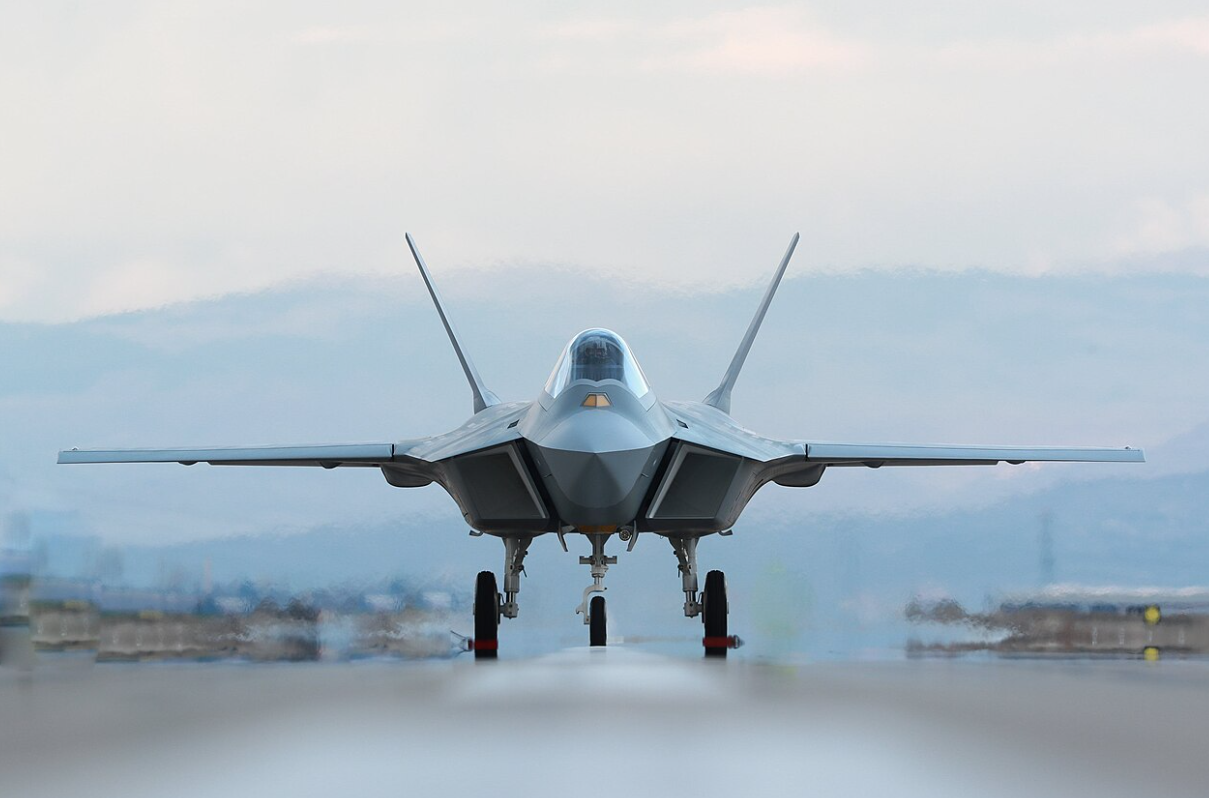
Its defence industry now produces internationally recognised drones, missiles, naval platforms, armoured vehicles and sophisticated electronic-warfare systems.
Türkiye is also NATO’s second-largest military by personnel.
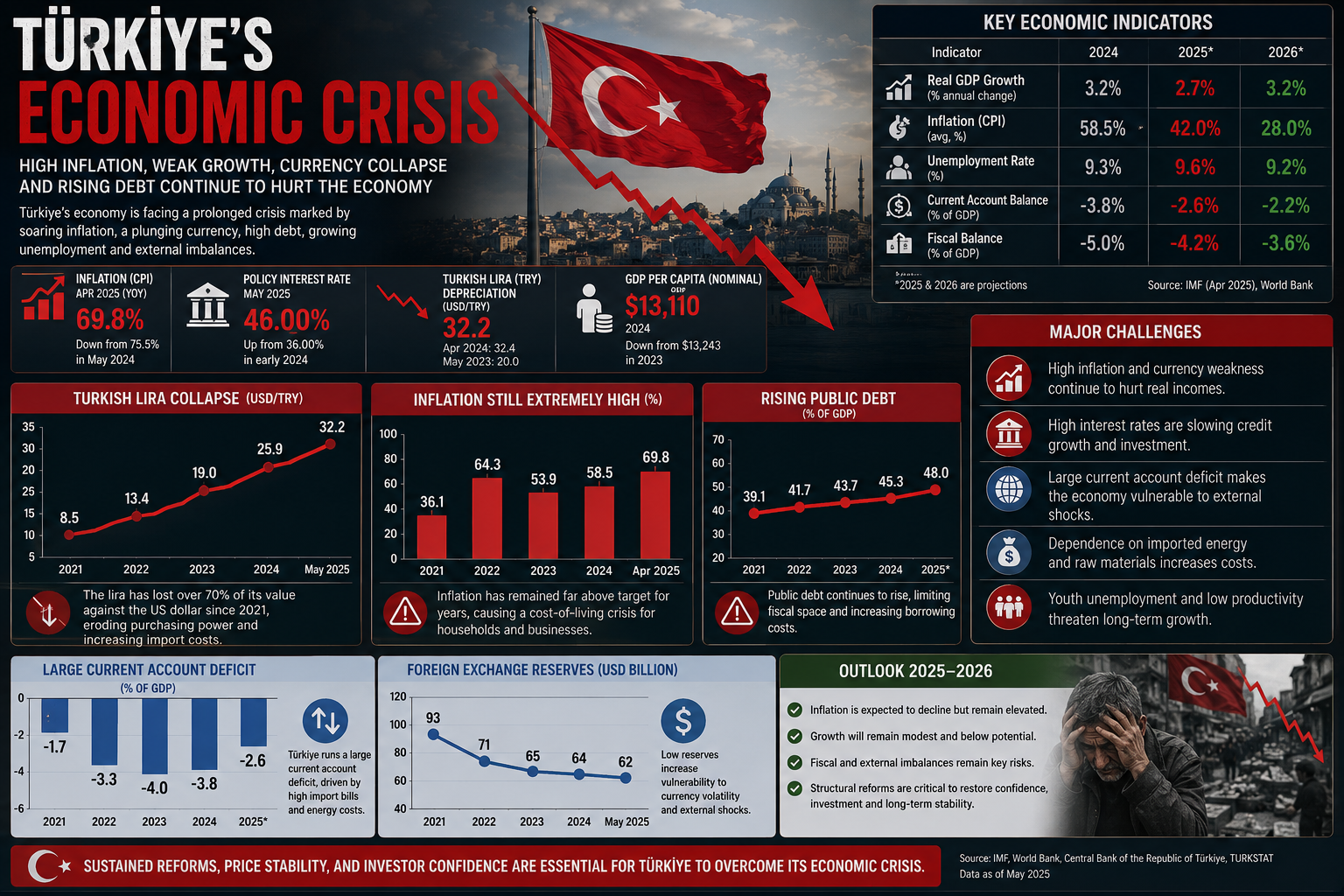
But Ankara has economic constraints of its own.
Türkiye has faced years of inflation, currency pressure and high financing costs. In July 2026, the country’s manufacturing PMI stood at 47.7, remaining below the 50-point threshold separating expansion from contraction.
That does not mean Türkiye lacks economic or industrial power.
It means that prolonged foreign military campaigns still carry costs that Ankara cannot simply ignore.
Türkiye may have strong incentives to sell weapons, establish joint-production facilities and expand military influence across the Gulf and South Asia.
Whether it would automatically enter every Pakistani or Saudi conflict is a much more complicated question.
Türkiye already belongs to another collective-defence alliance
Türkiye is also unique within the pact because it already belongs to NATO.
That creates another layer of complexity.
NATO’s Article 5 does not mean that every conflict Türkiye chooses to enter automatically becomes a NATO war.
If Ankara participated in military action because Pakistan or Saudi Arabia invoked the Mecca agreement, NATO members would still have to assess their own treaty obligations and the circumstances of the conflict.
Overlapping alliances therefore have the potential to create strategic uncertainty rather than automatically expanding deterrence.
India is strengthening ties near Türkiye’s western strategic neighbourhood
For India, Türkiye’s growing defence relationship with Pakistan is being watched closely.
But New Delhi does not necessarily have to respond by treating the entire Saudi-Pakistan-Türkiye arrangement as a single hostile bloc.
Instead, India has several strategic options.
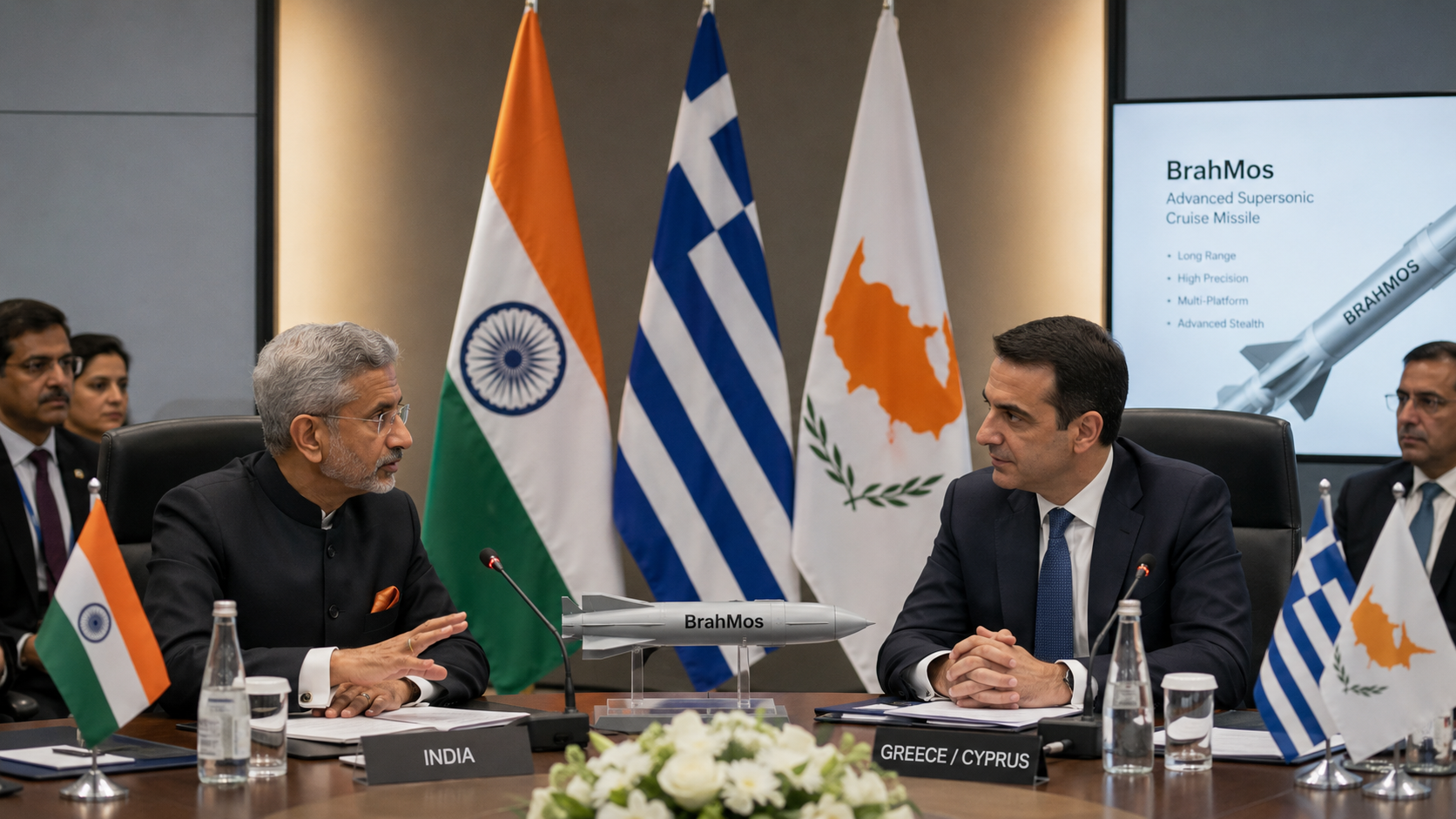
It can deepen its economic and political relationship with Saudi Arabia while simultaneously expanding military ties with countries in the Eastern Mediterranean.
India and Greece signed a Military Cooperation Programme for 2026 in January, with the two sides agreeing to strengthen bilateral military cooperation and explore areas including innovation and special operations.
That development becomes particularly interesting when viewed geographically.
Türkiye develops defence influence close to India through Pakistan.
India develops strategic relationships close to Türkiye through Greece and the Eastern Mediterranean.
This does not mean India is militarily encircling Türkiye, nor does normal India-Greece defence cooperation automatically constitute an anti-Turkish alliance.
But it does provide New Delhi with additional diplomatic and strategic leverage if Türkiye continues expanding military support for Pakistan.
India may benefit from treating the three partners differently
The biggest mistake for Indian strategy would be to assume Saudi Arabia, Pakistan and Türkiye have suddenly become one unified anti-India bloc.
They have not.
India’s relationship with Pakistan is fundamentally adversarial.
Its relationship with Türkiye has become increasingly difficult because of Ankara’s political and defence support for Islamabad.
But India’s relationship with Saudi Arabia is built around trade, energy, investment, technology, connectivity and wider strategic cooperation.
New Delhi therefore has strong incentives to deepen that relationship rather than push Riyadh closer to Islamabad by treating the Kingdom as an adversary.
At the same time, India can continue developing ties with Greece, Cyprus, France and other Mediterranean partners.
That strategy exploits the new pact’s central weakness:
The three members may cooperate militarily, but they do not have identical geopolitical interests.
The nuclear question
Pakistan’s nuclear arsenal inevitably gives the agreement additional strategic significance.
Pakistan is the only nuclear-armed member of the three-country framework.
That has fuelled speculation over whether Saudi Arabia has effectively gained access to a Pakistani nuclear umbrella.
However, the publicly announced trilateral agreement has not established a nuclear-sharing mechanism.
Officials have described the pact as defensive and rejected suggestions that it is designed to advance nuclear ambitions.
It would therefore be premature to state that Pakistani nuclear weapons have automatically been extended to Saudi Arabia or Türkiye.
Still, Pakistan’s nuclear status inevitably influences deterrence calculations surrounding any military alliance in which Islamabad participates.
What each country actually gains from the pact
Saudi Arabia: additional manpower, air-defence support, military depth and stronger deterrence as Gulf infrastructure remains exposed to missile and drone threats.
Pakistan: deeper access to Saudi financial support, defence investment, strategic relevance in the Middle East and possible opportunities for military exports.
Türkiye: a larger market for its defence industry, greater influence in Gulf security and opportunities for joint weapons development and technology cooperation.
These objectives are realistic and could make the agreement successful even if the alliance never evolves into a NATO-style organisation.
Joint exercises, integrated air-defence planning, intelligence sharing, training, weapons manufacturing and technology transfers could all deepen significantly.
So, will the Saudi-Pakistan-Türkiye pact succeed?
The answer depends entirely on how success is defined.
If the objective is stronger military cooperation, greater defence-industrial integration, additional Saudi deterrence and closer intelligence coordination, the agreement has a realistic chance of becoming an important regional security framework.
Pakistan can provide personnel and military expertise.
Türkiye can contribute technology and defence production.
Saudi Arabia can provide financing, infrastructure and strategic access.
That combination could be highly effective.
But if the agreement is expected to operate like a Middle Eastern NATO – where every major attack automatically produces a unified military response, its future is much less certain.
The real test will come when national interests collide
The pact will not truly be tested during another summit or military exercise.
It will be tested when one member asks the other two to take an action that directly damages their own interests.
Would Saudi Arabia risk its strategic and economic relationship with India during another India-Pakistan war?
Would Pakistan risk a prolonged confrontation with neighbouring Iran because Saudi Arabia was attacked?
Would Saudi Arabia and Pakistan become militarily involved if Türkiye entered a major confrontation with Greece?
Would Türkiye join Pakistan against India if doing so carried major economic and diplomatic costs?
And would the three governments interpret a drone strike, militia attack, cyberattack or missile launch in exactly the same way?
Those questions matter far more than the wording signed in Mecca.
The Saudi-Pakistan-Türkiye defence pact brings together three substantial military and geopolitical powers and could become a significant new security structure linking the Middle East and South Asia.
But its strength will depend on whether cooperation survives the moment one member’s security priorities conflict with another member’s economic or diplomatic interests.
Pakistan looks towards India. Saudi Arabia worries about Iran and Iranian-aligned forces. Türkiye has its own disputes stretching from Syria to the Eastern Mediterranean. They have agreed that an attack on one is an attack on all, but they have not yet proved that they are prepared to inherit one another’s enemies.
Editorial note: Some images used in this analysis are editorial infographics or representational illustrations. They should not be interpreted as photographs documenting meetings or events unless specifically identified as such.