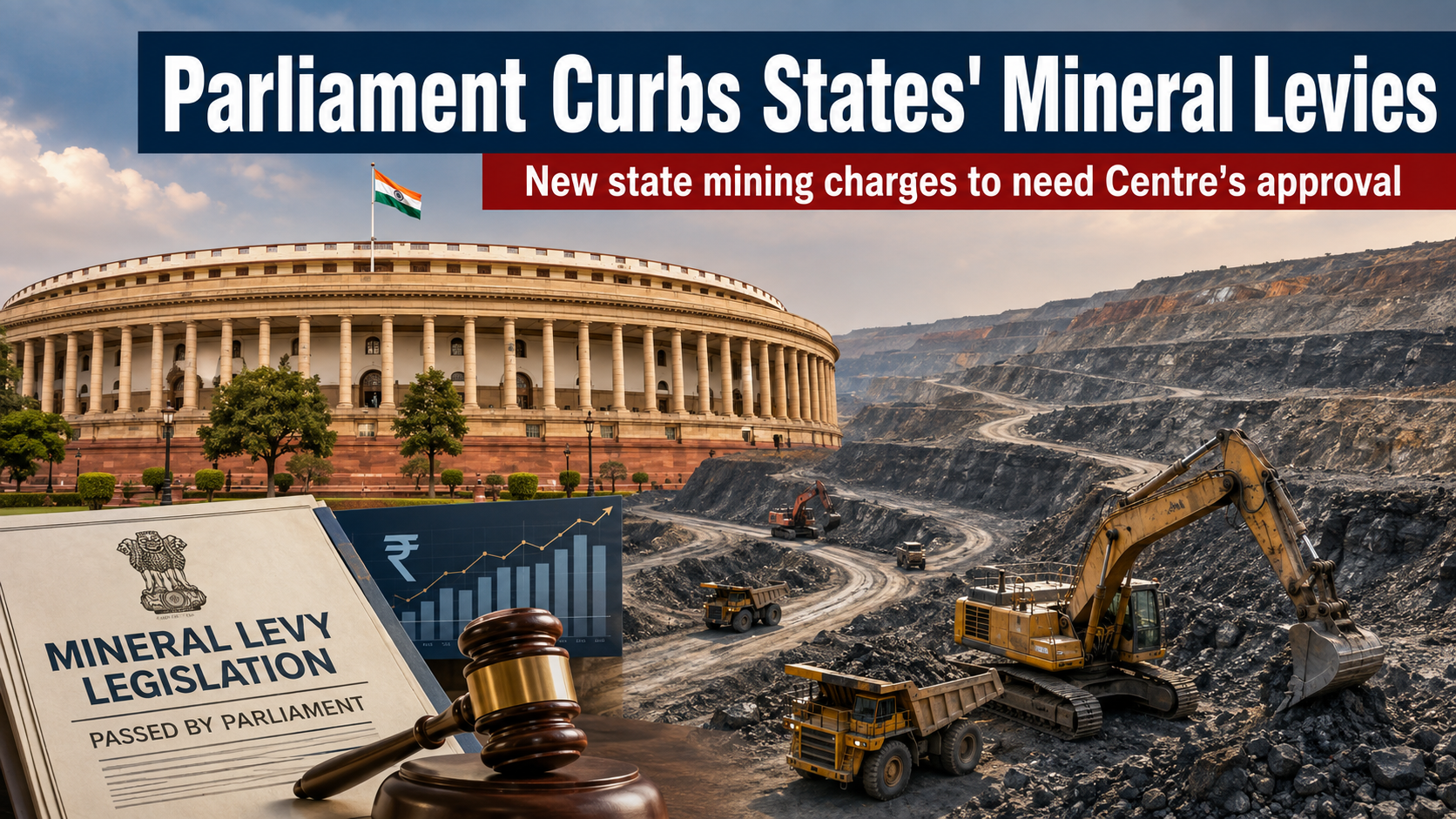
India has moved to significantly reshape how mineral-related taxes are imposed across the country after Parliament passed the Mines and Minerals (Development and Regulation) Amendment Bill, 2026. The legislation could affect the revenues of mineral-rich states while giving mining companies greater certainty over future project costs.
By Pulse India News Desk
Parliament’s approval of the MMDR Amendment Bill 2026 introduces a new framework governing how state governments can impose taxes, cesses and similar levies on mineral rights and mineral-bearing land.
Under the amended framework, such state-level charges will have to comply with conditions or restrictions prescribed by the Central Government.
The move has opened a wider debate over three major questions: how much taxation freedom mineral-producing states should retain, whether mining companies need greater protection from unpredictable levies, and how India’s constitutional balance between the Centre and states should apply to valuable natural resources.
What is the MMDR Amendment Bill 2026?
The Mines and Minerals (Development and Regulation) Amendment Bill, 2026 amends the Mines and Minerals (Development and Regulation) Act, 1957, which is one of India’s principal laws governing mines and mineral development.
One of its most important provisions is the insertion of a new Section 9D.
Under the new provision, a state government cannot impose a tax, cess or similar levy on mineral rights, or on mineral-bearing land when the levy is calculated with reference to factors such as:
- the quantity of minerals extracted;
- the value of the mineral;
- royalty payable;
- mineral production or dispatch; or
- another comparable mineral-linked basis.
Such levies will have to comply with conditions or restrictions prescribed by the Central Government.
The Bill also extends the central regulatory framework to cover mineral-bearing lands, with the Centre empowered to prescribe how such land will be defined using mineral-content parameters.
What is the purpose of the Bill?
The Centre’s central argument is that India’s mineral-taxation environment has become increasingly difficult for companies to predict because states can introduce different taxes, cesses and levies at different stages of a mining project’s life.
Mining projects often require very large upfront investments and can operate for decades.
A company deciding whether to develop a mine must calculate royalty payments, auction premiums, statutory contributions, environmental obligations, rehabilitation costs, infrastructure expenditure and taxes before deciding whether the project is commercially viable.
If a state later introduces a significant additional levy, those calculations can change even after investments have already been committed.
The Centre’s concerns include:
• High cumulative fiscal burdens on mining operations.
• Different tax structures across mineral-producing states.
• New state levies being introduced after mines become operational.
• Multiple taxes linked to mineral production, value or dispatch.
• Retrospective tax demands that can change the economics of existing projects.
The government’s position is that a more predictable national framework could reduce investment uncertainty and make domestic mining projects more competitive.
The Supreme Court judgment behind the new law
The amendment follows a landmark Supreme Court ruling delivered in July 2024 concerning taxation of mineral rights.
The Court held that royalty paid by mining companies is not itself a tax.
It also recognised that states possess legislative competence to tax mineral rights under the Constitution.
However, the Court noted that Parliament may impose limitations on the states’ power to tax mineral rights under Entry 50 of the State List.
That distinction is central to the 2026 legislation.
There is, however, a potentially important constitutional issue concerning mineral-bearing land.
PRS Legislative Research has noted that the Supreme Court differentiated taxation of mineral rights from taxation of land under Entry 49 of the State List.
This distinction could become important if states challenge parts of the 2026 law before the courts.
Why mining states are watching closely
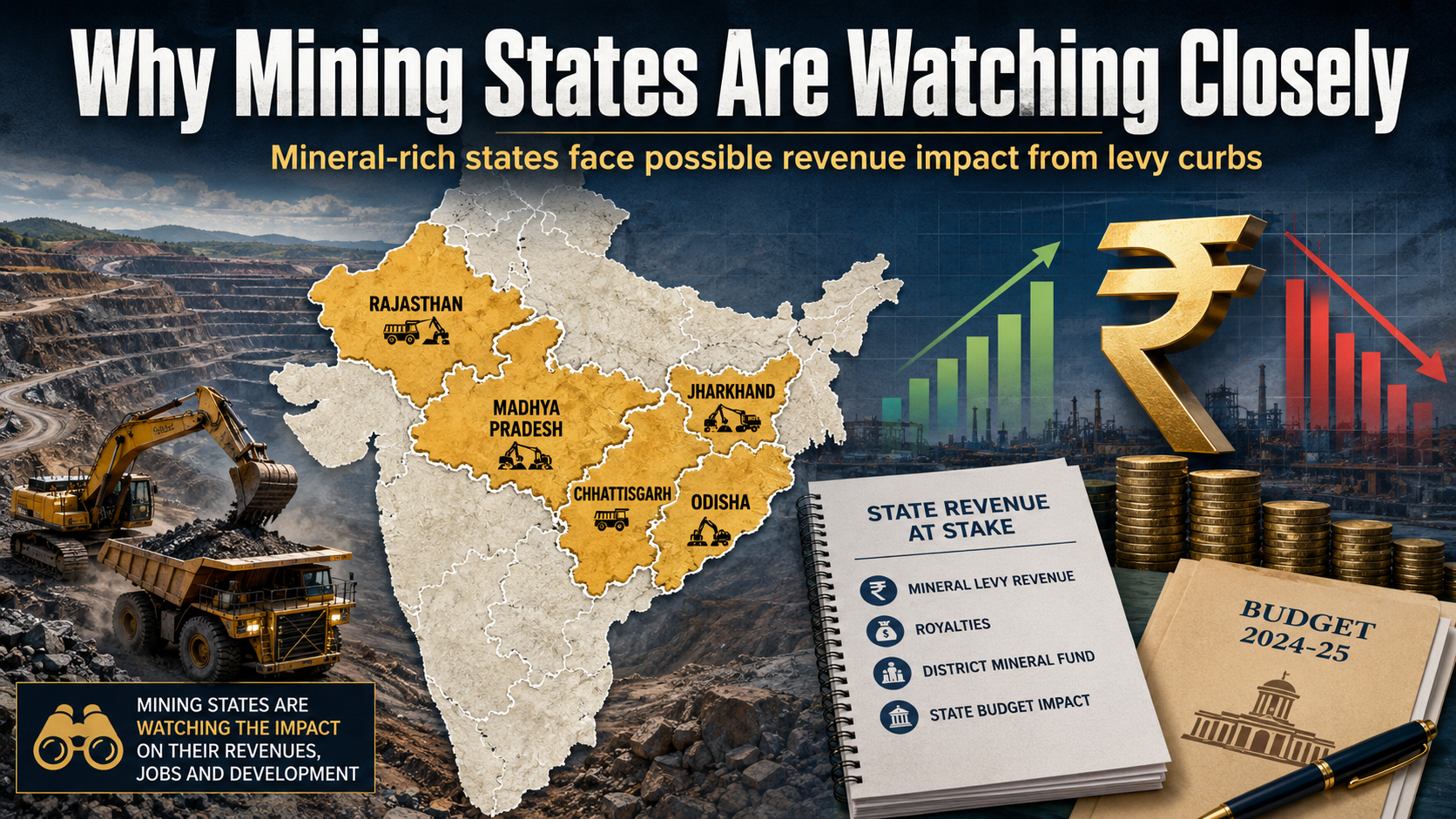
The legislation matters most for states where coal, iron ore, bauxite and other minerals form a major part of the local economy and government revenue base.
Among the states particularly exposed to developments in mining taxation are Odisha, Jharkhand and Chhattisgarh.
The cleanest comparable state-level series is mining-related non-tax revenue, rather than a mineral-bearing-land cess for every state.
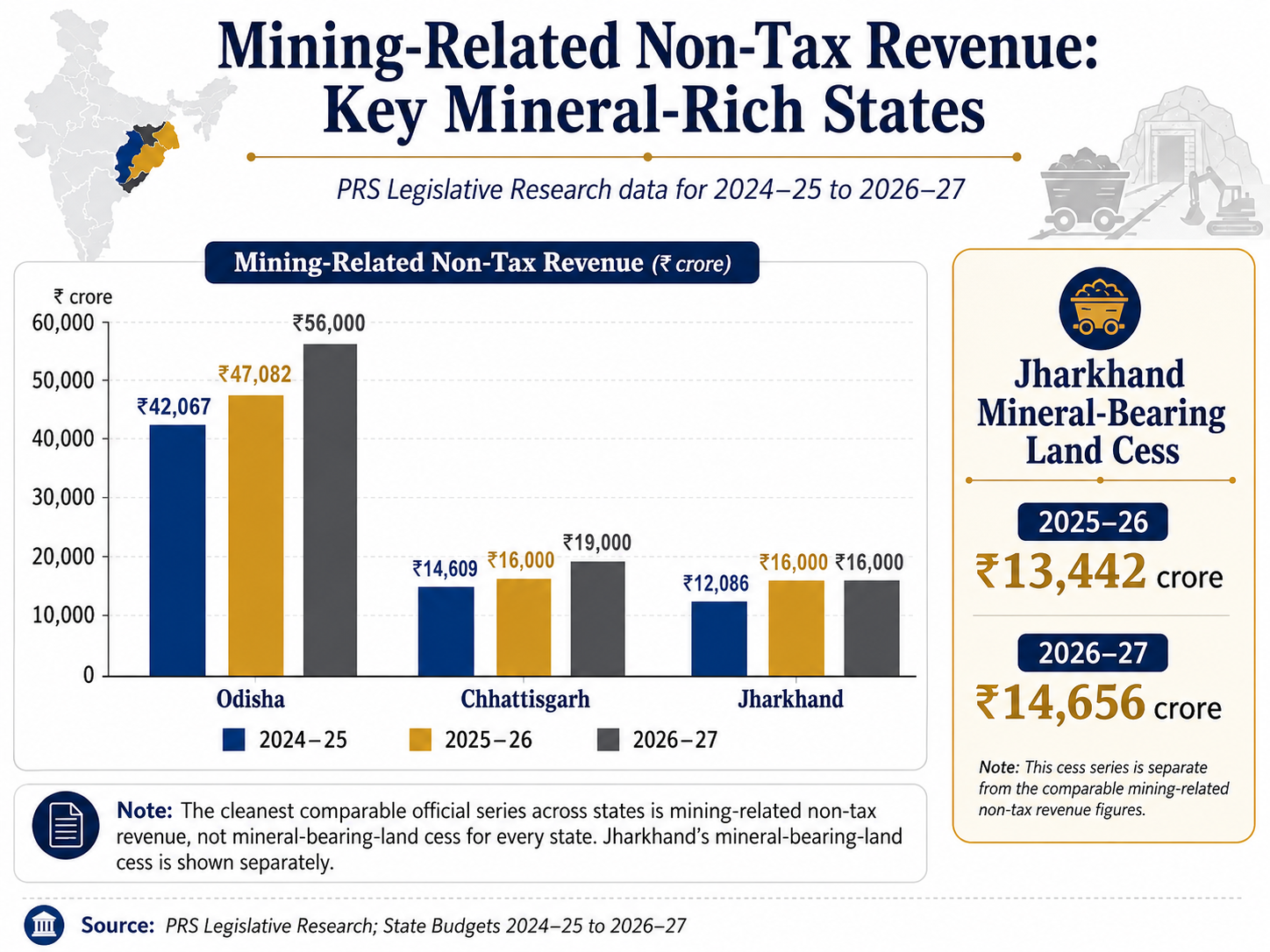
PRS state-budget data show Odisha’s mining-related non-tax revenue at approximately ₹42,067 crore in 2024-25, rising to an estimated ₹47,082 crore in 2025-26 and ₹56,000 crore in 2026-27.
For Chhattisgarh, the comparable figures are approximately ₹14,609 crore, ₹16,000 crore and ₹19,000 crore.
Jharkhand’s comparable mining-related non-tax revenues are approximately ₹12,086 crore in 2024-25 and ₹16,000 crore in both 2025-26 and 2026-27.
Jharkhand separately estimates substantial collections from its mineral-bearing-land cess, demonstrating how important the taxation issue has become for the state’s fiscal planning.
What do states gain from the new framework?
Although the debate has largely focused on the possibility of revenue losses, a more predictable mining regime could also generate benefits for mineral-producing states.
More mining investment: Companies may be more willing to develop new mines when long-term tax liabilities are easier to predict.
Higher mineral production: Projects that might otherwise be commercially marginal could become viable.
More royalty collections: Higher mineral output can generate additional royalty revenue even if states face restrictions on separate cesses.
Employment and industrial growth: Mining investment can support local jobs and downstream industries such as steel, aluminium, cement and manufacturing.
Infrastructure development: Large mining and processing projects often create demand for roads, railways, power, logistics and industrial infrastructure.
The Centre’s broader argument is that states may ultimately benefit more from a larger and more competitive mining sector than from repeatedly increasing the fiscal burden on existing mines.
What could states lose?
The most significant potential loss is fiscal flexibility.
Mineral-producing states would have less freedom to independently design new mineral-linked taxes or cesses without considering the restrictions prescribed by the Centre.
For states heavily dependent on mineral receipts, this could affect future budget planning.
Another important provision concerns state taxes or cesses imposed before the amended law comes into force.
Where such amounts have not yet been deposited or recovered, the amendment provides that they will be treated as invalid.
Amounts already collected before commencement, however, will not have to be refunded.
This distinction could affect states that were expecting significant revenue from outstanding mining-related tax demands.
What are states saying?
Jharkhand warns of a major revenue impact
Jharkhand has emerged as one of the strongest critics of the legislation.
Chief Minister Hemant Soren urged Prime Minister Narendra Modi to reconsider the measure, arguing that mining revenue plays an exceptionally important role in the state’s finances.
Soren has argued that restrictions on the state’s ability to collect mineral-related levies could affect funding available for development, welfare programmes and social-security schemes.
Jharkhand’s position is particularly significant because mining contributes a very large share of the state’s own non-tax revenue.
Kerala raises federalism concerns
Kerala has also opposed the amendment and raised broader constitutional concerns.
The state’s objection centres on whether the Centre should be able to restrict taxation powers relating to mineral-bearing land that states argue are protected under the Constitution.
Kerala has indicated that political and legal remedies could be considered.
What does the Bill mean for mining companies?
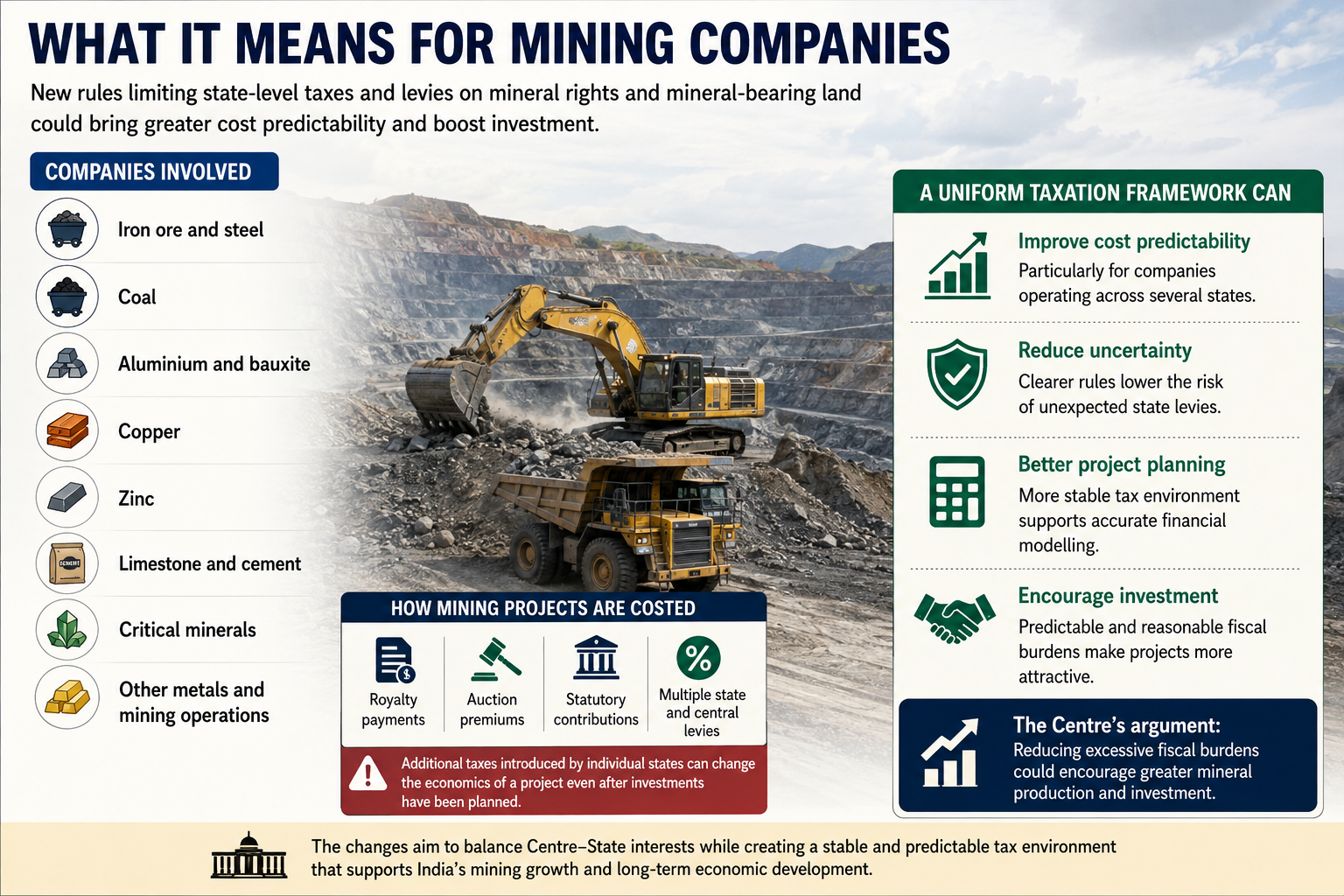
The changes could be particularly significant for companies involved in:
- iron ore and steel;
- coal;
- aluminium and bauxite;
- copper;
- zinc;
- limestone and cement;
- critical and strategic minerals; and
- other metals and mining operations.
Mining companies typically calculate project viability based on royalty payments, auction premiums, statutory contributions, environmental expenditure and multiple central and state-level levies.
Additional taxes introduced by individual states can change the economics of a project even after substantial investments have been committed.
A more uniform taxation framework could therefore improve cost predictability, particularly for companies operating mines in several states.
What could mining companies lose?
The amendment should not be interpreted as eliminating taxes or government charges on mining companies.
Mining operators will continue to face royalties, auction premiums, statutory contributions, environmental obligations, rehabilitation costs and other applicable taxes.
States may also retain the ability to impose qualifying levies as long as they comply with the conditions prescribed by the Central Government.
There is also a potential period of legal uncertainty.
If states challenge parts of the law, particularly provisions relating to mineral-bearing land, companies could temporarily face uncertainty over which past and future liabilities are legally enforceable.
States vs mining companies: who gains and who loses?
| Stakeholder | Potential gains | Potential losses / risks |
|---|---|---|
| Mineral-rich states | Potentially greater investment, higher production, employment and additional royalty collections. | Reduced flexibility to introduce new mineral-linked taxes and possible loss of unrecovered dues. |
| Mining companies | Greater tax certainty, better financial modelling and potentially lower fiscal risk. | Existing royalty and statutory costs remain, while litigation could create temporary uncertainty. |
| Central Government | Greater ability to create a nationally coordinated and predictable mineral-tax framework. | Possible constitutional disputes and political resistance from mineral-producing states. |
A bigger Centre-state question
The MMDR amendment is ultimately about more than the tax burden faced by mining companies.
It raises a fundamental question over the distribution of power within India’s federal system.
The Centre argues that minerals are strategic national resources and require a predictable, nationally coordinated investment framework.
Mineral-producing states argue that they bear the environmental, infrastructure and social costs of mining and therefore require sufficient taxation powers over resources located within their territories.
Mining can generate employment and government revenue, but it can also create displacement, environmental degradation, water stress and infrastructure pressures in affected districts.
States therefore argue that revenue from mineral resources is an important mechanism for funding development in areas where mining takes place.
The final balance between these competing interests could define India’s mineral policy for years.
What’s next?
1. Presidential assent
Following passage by Parliament, the legislation requires the President of India’s assent before completing the legislative process.
2. Government notification
The amended provisions will take effect from a date appointed by the Central Government through notification in the Official Gazette.
3. Centre must define the conditions
The next major step will be the rules prescribing the conditions or restrictions under which states may impose taxes, cesses or other levies on mineral rights and mineral-bearing land.
These rules could have a greater practical impact on states and mining companies than the headline provision itself.
4. States will calculate the financial impact
Mineral-rich states are likely to examine how much existing and future revenue could be affected.
The biggest concern may be in states where mineral-related receipts represent a large share of government non-tax revenue.
5. Legal challenges are possible
The constitutional distinction between taxation of mineral rights and taxation of mineral-bearing land could eventually be tested in court.
If states challenge the amendments, the Supreme Court may again have to define the boundary between the Centre’s power to regulate mineral development and the states’ constitutional taxation powers.
The MMDR Amendment Bill 2026 represents a major shift in India’s approach to mineral taxation.
For mining companies, the legislation could create a more predictable environment for long-term investment by reducing the risk of significantly different or unexpected state-level mineral levies.
For mineral-rich states, however, that predictability could come at the cost of fiscal flexibility and greater Central influence over revenues generated from natural resources located within their territories.
The ultimate impact will depend on the rules issued by the Centre, the amount of state revenue affected and whether the new framework survives any constitutional challenges that follow.
PRS Legislative Research analysis of the Mines and Minerals (Development and Regulation) Amendment Bill, 2026; Government of India and Ministry of Mines material relating to the amendment and India’s mineral-development framework; state budget documents covering mining-related non-tax revenue; and reporting on reactions from mineral-producing states.
Editorial note: State revenue figures and expected impacts may change depending on the rules notified under the amended legislation. Mining-related non-tax revenue and mineral-bearing-land cess collections are separate measures and should not be treated as directly interchangeable.