India is moving closer to the next phase of 5G as TRAI proposes service-quality rules for network slicing, a technology that can create dedicated virtual networks for gaming, businesses, emergency services, streaming and everyday mobile users.
New Delhi: India’s 5G ecosystem could soon enter an important new phase, with the Telecom Regulatory Authority of India (TRAI) issuing draft Quality of Service norms that take 5G network slicing into account.
The development could eventually allow telecom operators such as Reliance Jio and Bharti Airtel to provide different types of 5G connectivity for different requirements, from ordinary smartphone users to businesses, hospitals, factories, gaming platforms and emergency services.
However, the development should not be interpreted as an unrestricted final approval for all forms of network slicing. TRAI’s move concerns a draft regulatory framework, with service quality, consumer protection and net-neutrality considerations remaining important parts of the regulatory process.
What is 5G Network Slicing? A Simple Explanation
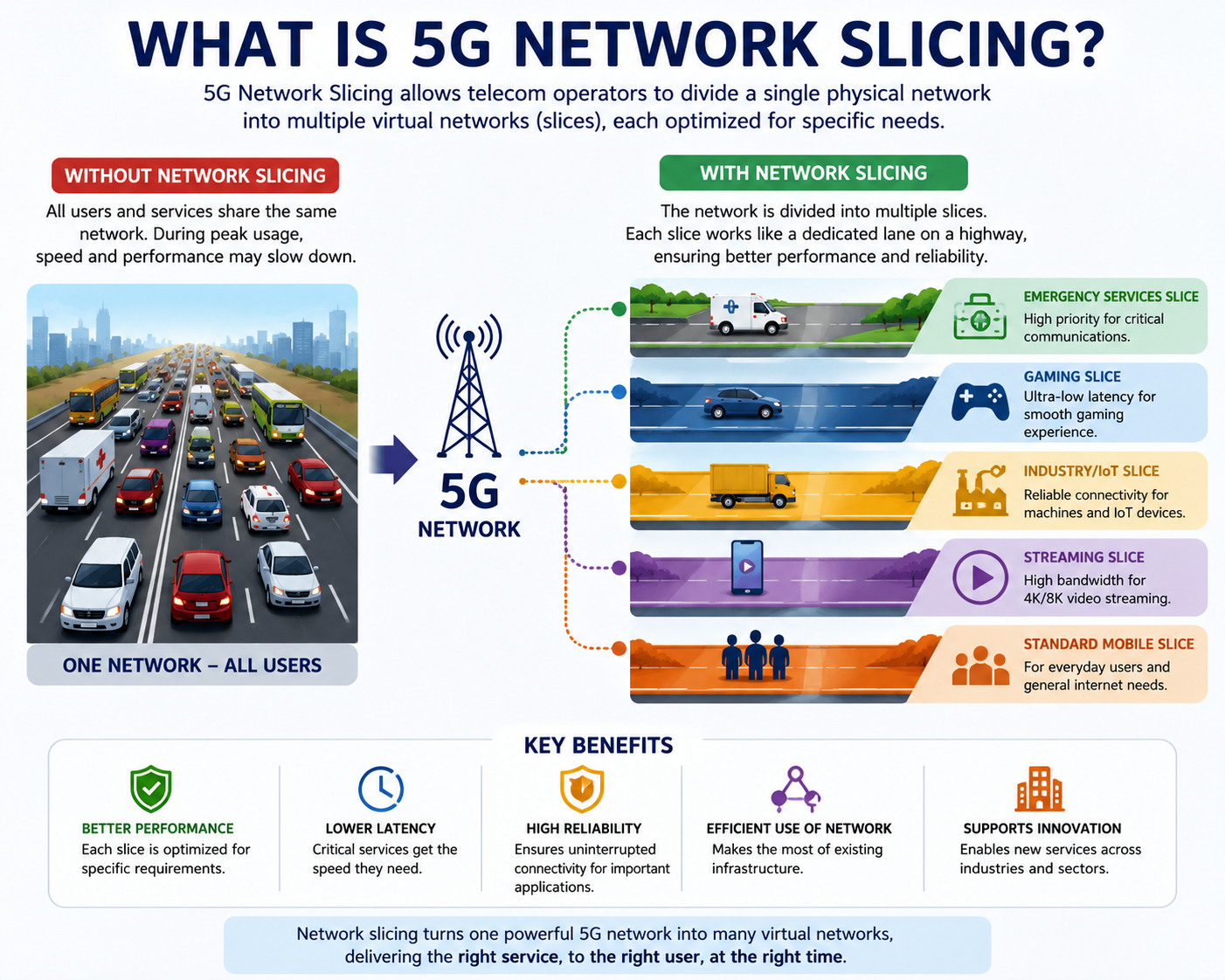
The easiest way to understand network slicing is to imagine a six-lane highway.
On a normal highway, cars, buses, trucks and ambulances all use the same road. If thousands of vehicles arrive at the same time, congestion builds up and everybody slows down.
Now imagine that some lanes are reserved for specific purposes. One lane is reserved for ambulances, another for high-speed traffic and another for heavy vehicles, while the remaining lanes continue carrying ordinary traffic.
5G network slicing works on a similar principle.
Instead of constructing completely separate mobile networks, an operator can use the same underlying 5G infrastructure to create multiple virtual networks, known as slices. Each slice can be configured according to what a particular service requires — such as higher reliability, lower latency, greater bandwidth or priority access.
Imagine 50,000 People Inside a Cricket Stadium
Consider a packed cricket stadium where tens of thousands of fans are simultaneously using their mobile phones. People may be uploading photographs, watching replays, making video calls and posting videos on social media.
At the same time, television broadcasters may be transmitting high-definition footage, stadium security cameras may be continuously sending video feeds, while police and emergency personnel need uninterrupted communication.
On a conventional shared mobile network, very heavy usage can create congestion and affect performance.
With 5G network slicing, however, emergency personnel could operate through a highly reliable priority slice, broadcasters could receive a high-bandwidth slice, stadium systems could use another dedicated slice and ordinary spectators could continue using the standard mobile network.
All of these services still use the same underlying 5G infrastructure, but network resources can be allocated differently according to their requirements.
What Has TRAI Proposed?
TRAI has moved to incorporate network slicing into India’s evolving telecom Quality of Service framework. This is significant because slicing can allow telecom companies to provide differentiated network experiences, but it also creates questions over how premium services might affect customers using ordinary mobile plans.
One of the key regulatory concerns is that providing guaranteed or higher performance to one category of subscribers should not cause an unacceptable deterioration in service quality for everyone else.
The regulator is therefore examining network performance standards alongside network slicing, while the broader policy discussion also involves India’s net-neutrality principles.
What Does This Mean for Jio and Airtel Customers?
Network slicing could eventually allow operators to move beyond mobile plans differentiated mainly by daily data allowances and maximum speeds.
Future offerings could potentially include gaming-oriented connectivity with lower latency, premium business services with more predictable performance, high-bandwidth streaming packages or dedicated enterprise connectivity for mission-critical applications.
Airtel has already explored differentiated 5G connectivity, while Jio has also discussed network slicing for enterprise use cases as telecom operators look for new ways to use and monetize their expanding 5G infrastructure.
What Could Network Slicing Be Used For?
Gaming: Lower latency for competitive and cloud gaming.
Video: Reliable high-bandwidth connectivity for high-resolution streaming.
Businesses: More predictable connectivity for cloud applications and video meetings.
Factories: Dedicated communication for robots, sensors and industrial automation.
Healthcare: Highly reliable connectivity for critical digital-health applications.
Emergency Services: Priority connectivity for public-safety communications.
Is India the First Country to Use 5G Network Slicing?
No. India is not the first market to explore the technology. Network-slicing services have already been launched or are being tested by operators in several international markets.
According to the global mobile industry body GSMA, operators in markets including China, the United States, Singapore, the United Kingdom and Malaysia have launched or piloted network-slicing services across different consumer and enterprise use cases.
China provides a recent example of how the technology is progressing. In May 2026, China Mobile, Ericsson and OPPO announced successful verification of consumer-oriented network slicing on a live commercial 5G Standalone network in Dezhou, Shandong.
Such deployments show that network slicing is gradually moving beyond laboratory demonstrations and becoming a practical feature of standalone 5G networks, although the commercial model, pricing and regulatory rules can vary between countries.
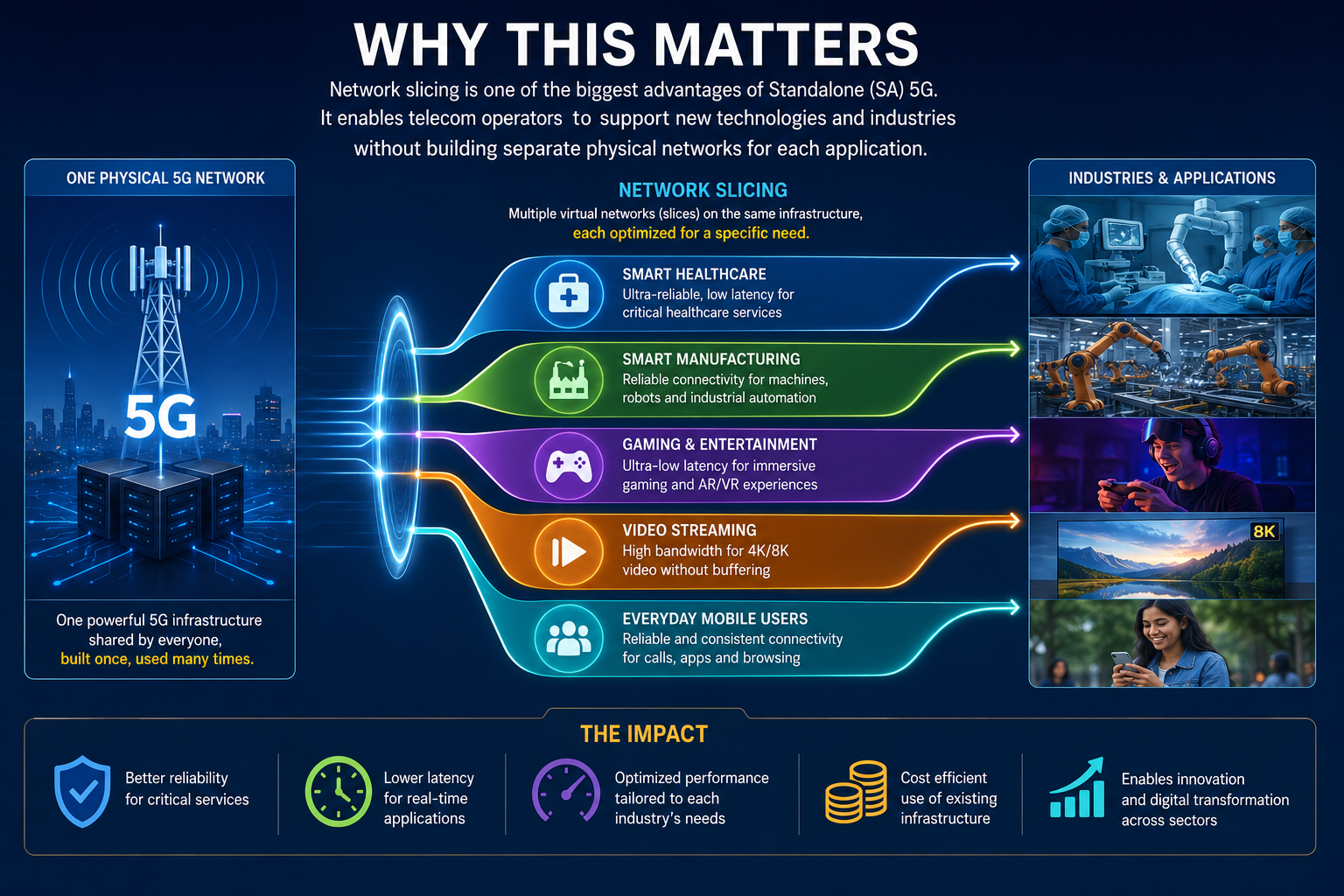
Why This Matters
Network slicing is considered one of the important technological capabilities of 5G Standalone (SA) architecture.
Instead of requiring telecom companies or businesses to build completely separate physical networks for different applications, the technology allows multiple virtual networks to operate over shared infrastructure.
This could help support advanced manufacturing, smart cities, connected vehicles, public safety, industrial IoT, immersive digital experiences and next-generation healthcare applications.
For telecom companies, it could also create new business opportunities by allowing the same underlying network to serve multiple categories of customers with different performance requirements.
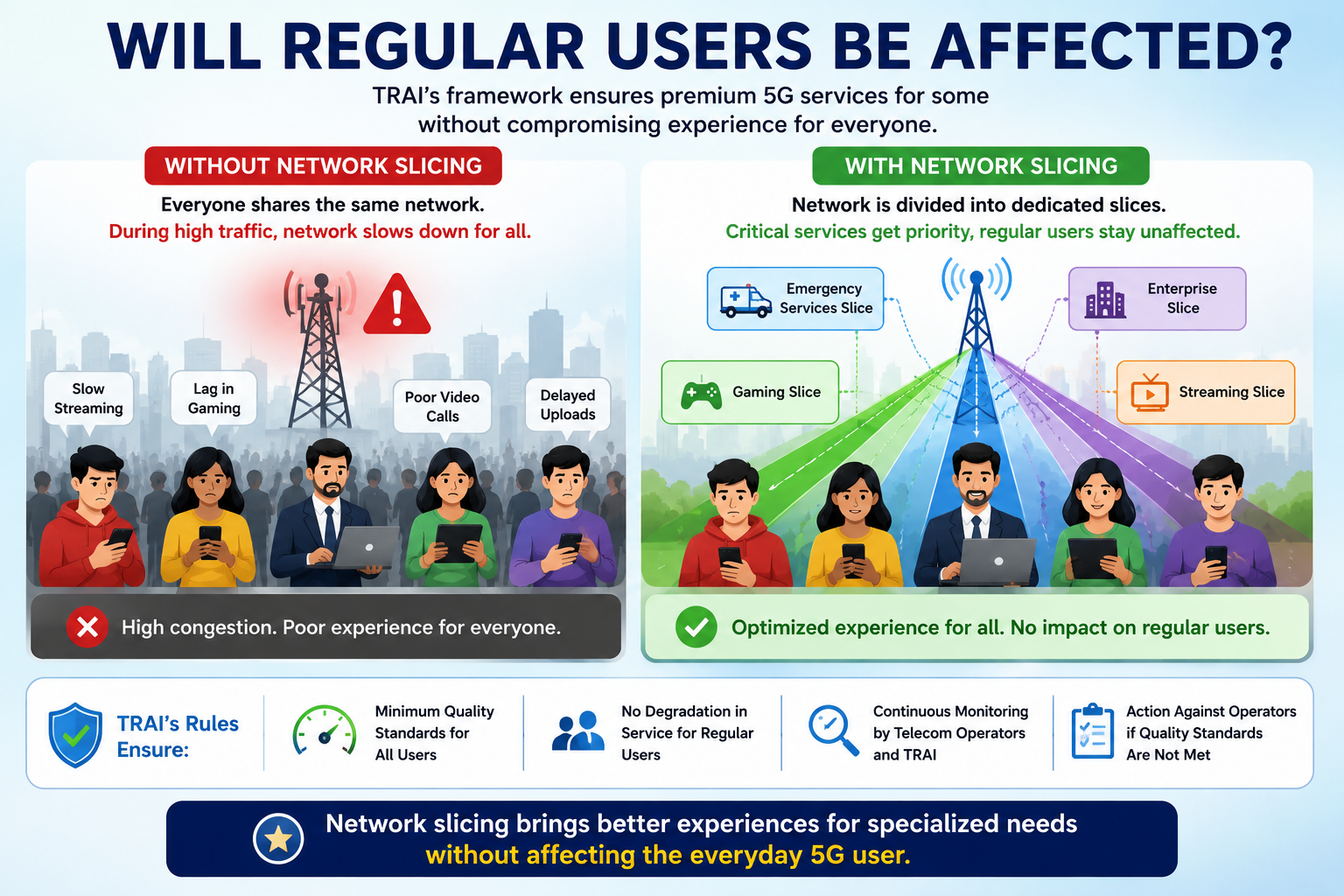
Will Regular Mobile Users Be Affected?
This is one of the biggest questions surrounding network slicing.
If a telecom operator gives guaranteed resources or higher priority to premium customers, ordinary subscribers may naturally worry that fewer network resources will remain available to them, particularly during periods of heavy traffic.
That concern is one reason regulators are looking closely at service-quality requirements and net-neutrality implications. The objective is to permit specialized 5G services while ensuring that ordinary subscribers continue receiving acceptable network performance.
Network slicing therefore does not automatically mean that a normal prepaid or postpaid customer will experience slower internet. The actual impact will depend on how operators allocate network capacity and on the final safeguards included in India’s regulatory framework.
What About Net Neutrality?
Network slicing also raises an important policy question: when does technical network optimization become unfair prioritization?
Net-neutrality principles generally seek to prevent internet service providers from unfairly blocking, slowing or prioritizing internet traffic according to particular websites, platforms or online services.
Network slicing, however, can also be used to provide technically different forms of connectivity, such as an ultra-reliable connection for emergency services or extremely low latency for an industrial machine.
India’s regulatory challenge will therefore be to distinguish legitimate specialized 5G services from practices that could unfairly disadvantage ordinary internet users.
For consumers, this could eventually mean that a mobile plan is defined not only by how much data it provides, but also by the type of network performance and experience it is designed to deliver.