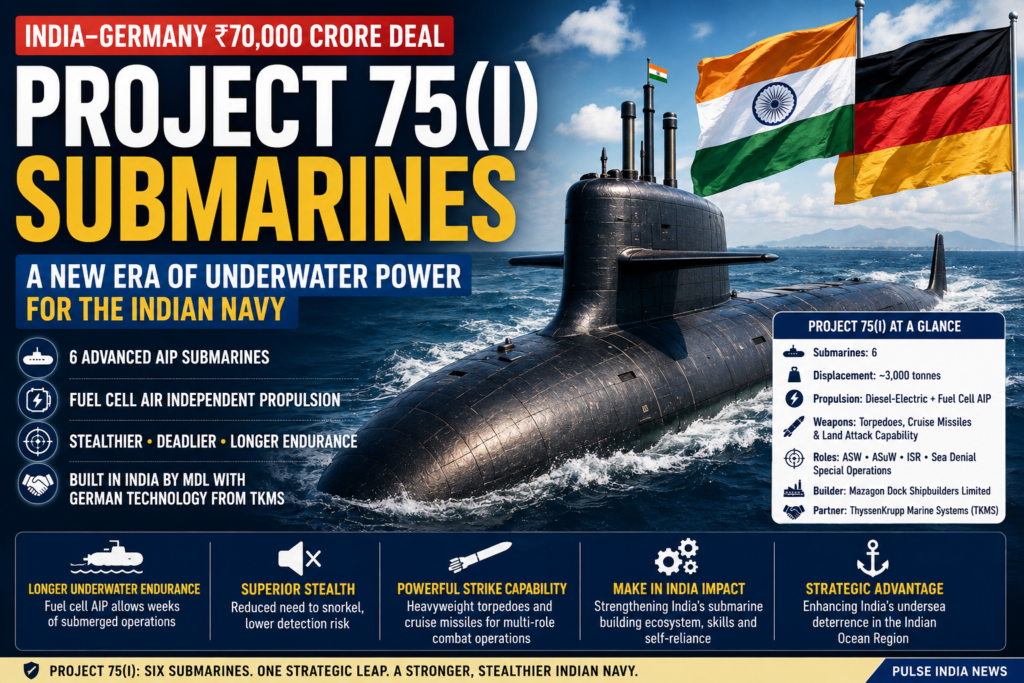
India is moving closer to one of its biggest-ever naval procurement decisions, with the approximately ₹70,000-crore Project 75(I) programme for six next-generation conventional submarines entering a crucial stage.
By Pulse India News Desk
The programme will see Mazagon Dock Shipbuilders Limited (MDL) build six advanced diesel-electric attack submarines in India with Germany’s ThyssenKrupp Marine Systems (TKMS).
At the centre of the programme is a technology that could fundamentally change how India’s conventional submarine force operates — fuel-cell-based Air Independent Propulsion, or AIP.
AIP is designed to allow a conventional submarine to remain underwater for substantially longer periods without repeatedly exposing itself by running diesel engines through a snorkel.
What is Project 75(I)?
Project 75(I), commonly written as P-75I, is India’s programme to acquire a new generation of conventional attack submarines for the Indian Navy.
The six boats are expected to combine traditional diesel-electric propulsion with an Air Independent Propulsion system, allowing them to spend considerably longer periods submerged than conventional submarines that rely only on batteries and diesel generators.
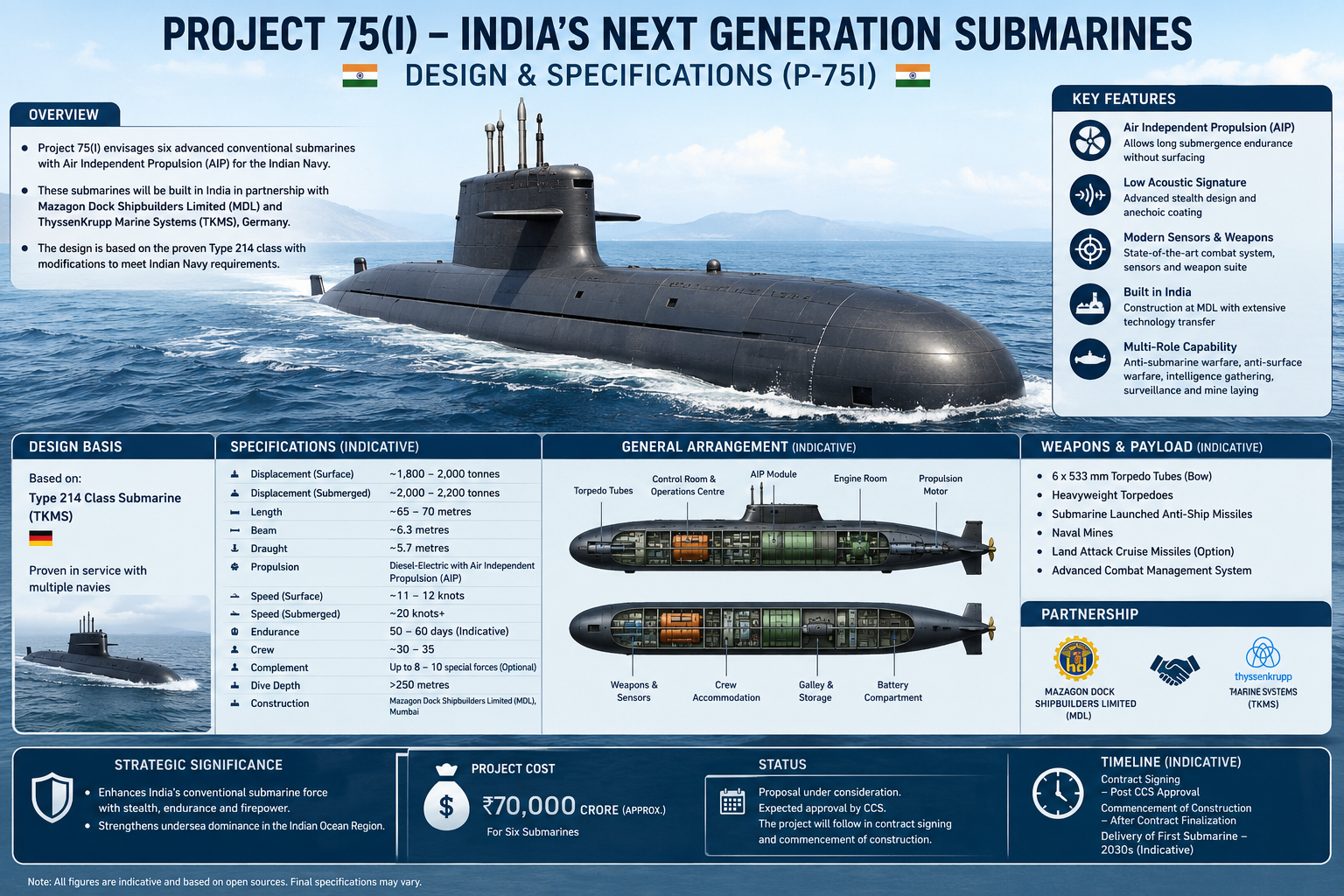
The German proposal associated with TKMS is widely reported to be based on an enlarged configuration derived from the company’s Type 214 submarine family, adapted to meet Indian Navy requirements.
Open-source programme information indicates a submarine of around 3,000 tonnes displacement, although final dimensions, weapons and combat-system specifications remain subject to the completed Indian configuration.
Project 75 vs Project 75(I): What is the difference?
Project 75 and Project 75(I) are often confused, but they represent two different stages of India’s submarine modernisation.
Project 75 produced the six Kalvari-class submarines based on the French Scorpène design. All six have now entered Indian Navy service.
Project 75(I) is the next-generation programme and places far greater emphasis on underwater endurance, AIP, weapons capability and technology transfer.
| Feature | Project 75 | Project 75(I) |
|---|---|---|
| Submarines | 6 | 6 planned |
| Design | Scorpène / Kalvari class | New German-origin design |
| Foreign partner | Naval Group, France | TKMS, Germany |
| Indian builder | MDL | MDL |
| Propulsion | Diesel-electric | Diesel-electric + AIP |
| AIP at induction | No | Yes |
| Primary focus | Modern conventional submarine fleet | Extended underwater endurance + greater stealth |
| Industrial objective | Build submarines in India | Deeper localisation, technology absorption and long-term self-reliance |
AIP: The technology that could make P-75(I) far harder to find
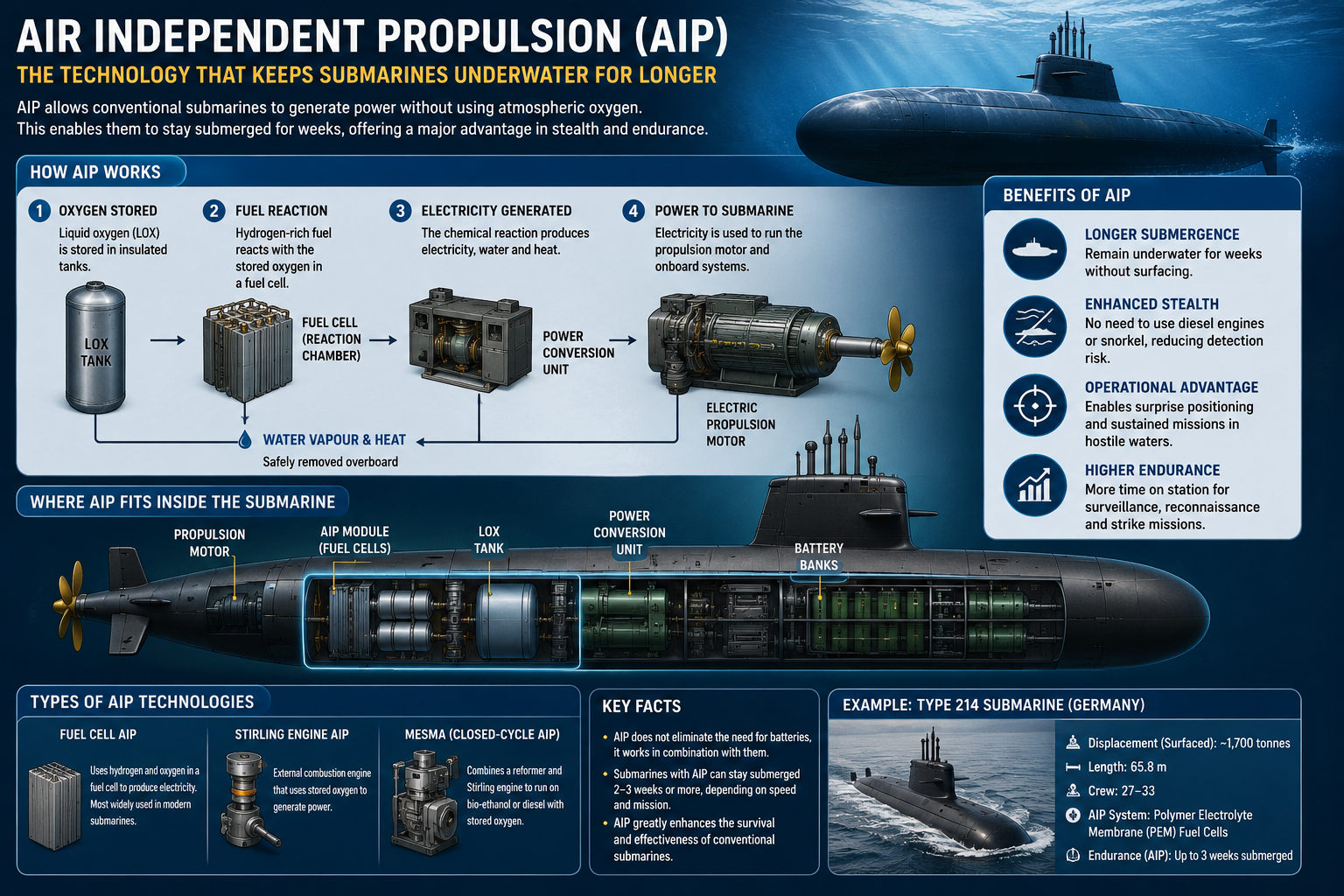
To understand why AIP matters, it is important to understand the basic weakness of a traditional diesel-electric submarine.
When submerged, the submarine normally runs on batteries. Once those batteries need recharging, diesel generators must be operated.
Diesel engines require oxygen. That means the submarine must either surface or raise a snorkel mast close to the surface.
That can increase exposure to radar, infrared sensors, electronic surveillance and maritime patrol aircraft.
1. Oxygen is stored onboard: The submarine carries oxygen for use while fully submerged.
2. Fuel enters the system: Hydrogen or a hydrogen-rich source is supplied to the fuel-cell installation.
3. Electricity is generated: Hydrogen and oxygen react electrochemically rather than through conventional combustion.
4. Batteries and propulsion receive power: The generated electricity can support onboard systems and extend the submarine’s low-speed underwater endurance.
5. The tactical result: The submarine can remain underwater for much longer before needing to snorkel.
Fuel-cell AIP vs Stirling AIP
Not all AIP systems work the same way.
Some submarine fleets use Stirling engines, while the German technology associated with P-75(I) uses fuel-cell AIP.
| Feature | Fuel-cell AIP | Stirling AIP |
|---|---|---|
| Power generation | Electrochemical | External-combustion engine |
| Mechanical activity | Relatively limited in core power generation | Uses moving engine components |
| Acoustic advantage | Well suited to very quiet patrol operation | Also quiet but uses mechanical engine cycle |
| Efficiency | High electrochemical efficiency | Thermal-cycle efficiency |
| Main purpose | Extend covert underwater endurance | Extend covert underwater endurance |
Why P-75(I) could be significantly stealthier
AIP is only one part of submarine stealth.
Modern submarine designers attempt to suppress virtually every signature that an enemy could use for detection – acoustic, magnetic, thermal, electromagnetic and visual.
Reduced snorkeling
Longer underwater endurance means fewer periods close to the surface, where a conventional submarine is more vulnerable.
Machinery isolation
Motors, pumps and other mechanical equipment can be mounted on vibration-isolation systems designed to prevent machinery noise from travelling through the hull into the surrounding water.
Hydrodynamic design
The submarine’s outer shape, control surfaces and propeller arrangement are designed to reduce turbulence and unwanted flow noise.
Anechoic treatment
Acoustic hull treatments can help absorb incoming sonar energy and reduce the transmission of internal machinery noise into the sea.
Quiet electric operation
At slow patrol speeds, a modern diesel-electric submarine running on batteries or AIP can become a particularly difficult target for passive sonar.
Why India needs new submarines
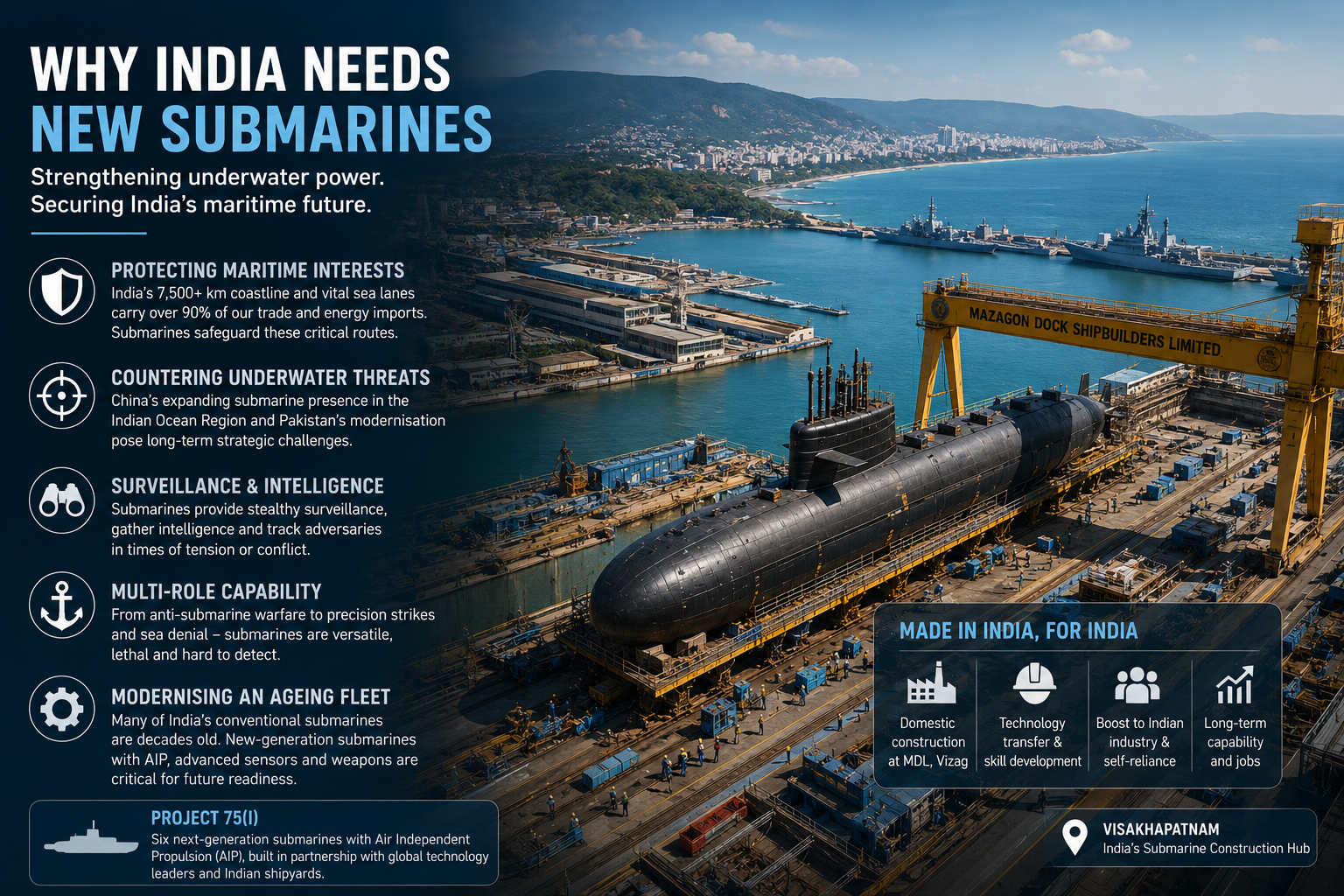
India’s requirement is driven by two pressures at the same time: ageing submarines that will eventually need replacement and a more demanding security environment in the Indian Ocean.
The Navy still operates older Sindhughosh-class and Shishumar-class conventional submarines alongside the much newer Kalvari class.
As the older boats reach the end of their service lives, new construction is necessary simply to prevent fleet numbers from falling.
But replacement is only part of the story.
The China and Pakistan factor
India’s underwater modernisation is taking place as both China and Pakistan expand or renew their submarine capabilities.
China operates one of the world’s largest submarine forces, including both conventional and nuclear-powered boats, and Chinese naval activity has progressively extended into the Indian Ocean.
Pakistan is also modernising its conventional submarine arm with new Chinese-built boats.
That makes the underwater environment around India increasingly complex.
However, submarine stealth cannot reliably be reduced to a simple claim that one country’s boat is always quieter than another.
Actual acoustic signatures are among the most closely guarded military secrets and depend on factors such as speed, depth, maintenance condition, ocean temperature, sea state and operating profile.
Project 75(I) expected specifications
The final Indian submarine configuration has not been publicly released in detail, but open-source programme information provides a broad picture.
| Specification | Reported / expected configuration |
|---|---|
| Type | Conventional attack submarine |
| Displacement | Around 3,000 tonnes |
| Propulsion | Diesel-electric + fuel-cell AIP |
| Weapons | Heavyweight torpedoes and submarine-launched missiles |
| Reported weapon capacity | Open sources cite 18 heavyweight torpedoes and at least 12 cruise missiles |
| Missions | ASW, ASuW, ISR, sea denial and special operations |
| Construction | India, through MDL with TKMS partnership |
More than a torpedo platform
A modern attack submarine is no longer limited to hunting ships with torpedoes.
The Indian Navy has sought a submarine capable of performing multiple missions across the maritime battlespace.
Heavyweight torpedoes: The primary close-range weapon against submarines and surface ships.
Anti-ship missiles: Provide the ability to engage hostile vessels from longer range.
Land-attack capability: The Navy’s requirement has included the ability to strike selected targets ashore.
Intelligence gathering: A covert submarine can monitor communications, radar emissions and naval movements.
Special operations: Submarines can support covert deployment and recovery of specialist forces.
A major Make in India opportunity
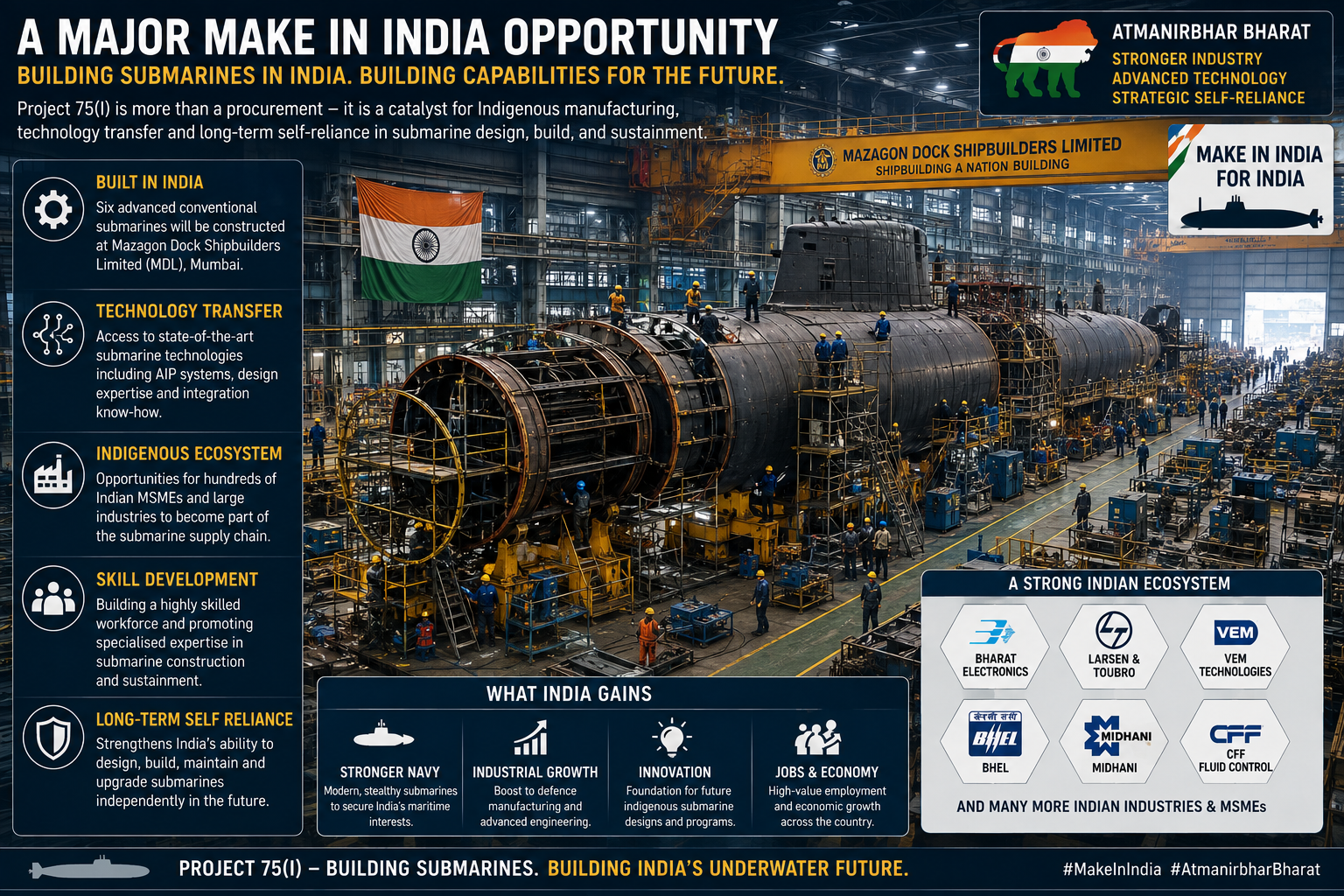
The industrial significance of Project 75(I) could eventually be as important as the submarines themselves.
MDL has already constructed both German-origin Type 209 submarines and French-designed Scorpène submarines in India.
That gives the Mumbai shipyard an existing workforce with experience in pressure-hull fabrication, submarine integration, testing and delivery.
P-75I could allow India to deepen those capabilities rather than allowing specialist skills and infrastructure to decline between major submarine orders.
The submarine supply chain could extend far beyond MDL
A programme of this scale requires far more than a shipyard.
Submarines contain thousands of highly specialised systems covering electrical power, sonar, hydraulics, communications, navigation, weapons, steel fabrication, batteries and environmental control.
Indian companies could therefore participate in increasingly sophisticated parts of the supply chain as localisation increases.
TKMS and its associated companies have already pursued partnerships with Indian firms in areas including heavyweight torpedoes and submarine-related systems.
India is building several submarine capabilities at once
P-75I is only one part of India’s wider underwater modernisation.
AIP submarine vs nuclear submarine: Different missions
India’s expansion of nuclear-powered submarines does not eliminate the requirement for conventional boats.
| Capability | AIP conventional submarine | Nuclear attack submarine |
|---|---|---|
| Endurance | Weeks underwater depending on mission profile | Months, limited primarily by crew and supplies |
| Speed | Optimised for quiet low-speed patrol | High sustained underwater speed |
| Best environment | Littoral waters and regional sea denial | Long-range deep-ocean operations |
| Key advantage | Very low acoustic signature at patrol speeds | Speed, range and endurance |
The two categories therefore complement rather than replace one another.
What about India’s indigenous DRDO AIP?
India is separately developing its own fuel-cell-based AIP technology through the Defence Research and Development Organisation.
That programme is associated with plans to integrate indigenous AIP into Kalvari-class submarines during future major refits.
It is different from the German fuel-cell AIP technology associated with Project 75(I).
Why the Indian Ocean is becoming an underwater battleground
India’s geography gives the submarine programme much wider importance.
The country sits close to sea routes linking the Persian Gulf, Africa and Europe with Southeast and East Asia.
These waters carry vital energy supplies and commercial shipping.
For the Indian Navy, protecting these routes requires the ability not only to track surface ships but also to detect and deter submarines operating below them.
The advantage of a submarine is uncertainty.
An adversary may know that a submarine has entered a region without knowing its exact location.
That uncertainty alone can force warships to slow down, change routes, deploy helicopters and dedicate large numbers of vessels and aircraft to anti-submarine warfare.
Why Germany is important to the deal
India’s submarine relationship with Germany is not new.
The Indian Navy already operates Shishumar-class submarines derived from the German Type 209 design, with some boats constructed by MDL.
Project 75(I) would bring German submarine technology back into Indian production on a much larger scale.
For TKMS, the programme would also be strategically important. Winning a six-submarine programme in India could create decades of work involving construction support, equipment, maintenance, upgrades and future collaboration.
Where the ₹70,000-crore programme stands
P-75I has had a long and complicated procurement history.
Multiple foreign submarine makers were originally considered, but the Indian Navy’s insistence on a sea-proven Air Independent Propulsion system significantly narrowed the field.
The MDL-TKMS proposal eventually emerged as the principal qualified route and moved into commercial negotiations.
The programme is now approaching another important government decision point as India and Germany work towards concluding the proposed agreement.
When could the first P-75(I) submarine enter service?
Even after a contract is signed, submarine construction will take years.
Earlier programme reporting has indicated that the first submarine could be delivered roughly seven years after contract signature.
Subsequent boats would normally follow at planned intervals once the production line reaches maturity.
The long lead time reflects the extraordinary complexity of submarine construction.
1. Final government approval
The commercial and strategic framework must receive the required clearances.
2. Contract signing
India, MDL and the German partner finalise price, configuration and responsibilities.
3. Detailed design
The German design is adapted to Indian Navy requirements.
4. Production preparation
Shipyard facilities, suppliers, tooling and specialist workforce are prepared.
5. Construction
Hull sections, machinery and combat systems are assembled and integrated.
6. Trials
Harbour trials, sea trials, diving tests, weapons integration and Navy acceptance follow before commissioning.
The bigger goal: Build submarines continuously in India
The greatest challenge for India’s submarine programme has historically been the long gaps between construction projects.
Submarine expertise is difficult to create and easy to lose.
Specialist welders, naval architects, acoustic engineers, systems integrators and suppliers need continuous work to preserve capability.
If Project 75(I) flows into future indigenous programmes without another long production gap, India could gradually move from licensed construction towards genuine design independence.
Project 75(I) could become one of the most consequential naval programmes India undertakes over the coming decade.
Its fuel-cell AIP system promises longer submerged endurance, while modern weapons, sensors and signature-reduction technologies are intended to give the Indian Navy a more capable conventional underwater combat platform.
But the programme is equally important for India’s defence industry. Building the submarines domestically could preserve specialist skills, expand the Indian supply chain and create expertise that feeds directly into future indigenous submarine projects.
Six submarines are the immediate objective. Building an enduring Indian submarine industry is the bigger prize.
Project 75(I) remains under negotiation and final specifications have not been publicly released in full. Figures relating to displacement, weapons capacity, delivery schedules and final programme value are based on publicly reported programme information and may change before contract conclusion.