India will allow electricity exports to Nepal for 18 hours every day after devastating floods damaged major hydropower infrastructure and reduced the Himalayan nation’s domestic generation capacity.
September 14, 2026 | 5 min read
- India has approved electricity exports of up to 654 MW to Nepal.
- Supply is permitted for 18 hours daily, from midnight to 6 PM.
- The approval runs from September 13 to December 31, 2026.
- 600 MW can flow through the Muzaffarpur–Dhalkebar transmission link.
- 54 MW can be supplied through the Tanakpur–Mahendranagar line.
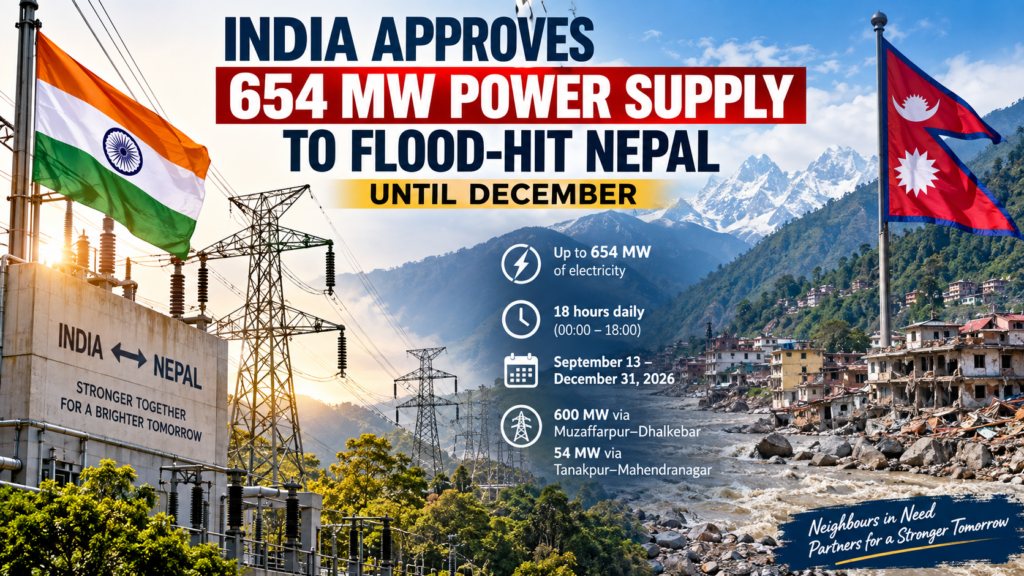
New Delhi: India has approved the export of up to 654 megawatts of electricity to Nepal as the neighbouring country struggles with a power shortage following catastrophic floods that severely damaged its hydropower infrastructure.
The Ministry of Power said the electricity can be supplied to the Nepal Electricity Authority for 18 hours a day, between 00:00 and 18:00 hours, from September 13 until December 31, 2026.
The emergency arrangement provides Nepal with an important additional source of electricity while damaged hydropower stations, transmission infrastructure and other energy facilities undergo restoration.
Two Cross-Border Power Corridors to Carry Up to 654 MW
According to the Indian government, the largest share of electricity, up to 600 MW, has been approved for export through the Muzaffarpur–Dhalkebar 400 kV double-circuit transmission line.
A further 54 MW can be supplied through the Tanakpur–Mahendranagar 132 kV single-circuit transmission line, taking the combined approved ceiling to 654 MW.
| Transmission Route | Voltage | Approved Export |
|---|---|---|
| Muzaffarpur–Dhalkebar | 400 kV | Up to 600 MW |
| Tanakpur–Mahendranagar | 132 kV | Up to 54 MW |
| Total Approved Capacity | — | Up to 654 MW |
The 654 MW figure represents the maximum approved export capacity across the two corridors and does not necessarily mean that the full amount will flow continuously throughout every approved hour.
Why Nepal Needs Emergency Electricity
Nepal relies heavily on hydropower for its electricity generation. The recent floods damaged hydropower stations and transmission infrastructure, sharply reducing generation at a time when electricity is critical for homes, hospitals, businesses, communications and continuing rescue and reconstruction work.
Nepal’s official rapid damage assessment reported extensive damage to its energy network, including multiple hydropower projects and transmission infrastructure. The disaster has reversed the normal monsoon-season situation in which Nepal can generate surplus hydroelectricity and export power to neighbouring countries.
Flood damage in the Bhote Koshi and Trishuli corridors also forced Nepal to reduce or suspend some electricity exports as generation facilities went offline.
Nepal’s electricity system is unusually dependent on hydropower. Damage to several plants at the same time therefore has a much greater impact than it would in a grid supported by large coal, gas or nuclear generation fleets. Cross-border electricity links with India can provide crucial balancing power while damaged facilities are restored.
From Power Exporter to Importer After the Floods
The disaster has produced a striking reversal in regional electricity flows. During periods of strong river flows, Nepal has increasingly sold surplus hydropower to neighbouring markets, particularly India.
But with hundreds of megawatts of generating capacity affected by the floods, Nepal has had to prioritise domestic demand and turn to additional imports from India.
The arrangement highlights the growing importance of interconnected electricity grids in South Asia, where countries can exchange surplus power and provide emergency support when domestic generation is disrupted.
India-Nepal Energy Cooperation
India and Nepal have steadily expanded cross-border electricity trade through high-capacity transmission connections linking the two national grids.
The Indian Ministry of Power said the latest approval would help Nepal meet its electricity requirements during the difficult recovery period while further strengthening the longstanding energy partnership between the two countries.
India said it remains committed to supporting Nepal and strengthening bilateral cooperation in the energy sector.
What Happens After December?
The current approval remains valid until December 31, 2026. The Ministry of Power said the amount of electricity that may be exported from January 2027 onward will be reviewed in December.
The decision is likely to depend partly on how quickly Nepal can restore damaged generating stations and transmission infrastructure and how its domestic supply-demand situation evolves during the winter months.
For now, the Indian power supply offers Nepal additional grid support at a critical stage of its recovery from one of the most damaging disasters to hit its hydropower system in recent years.