India is introducing a targeted merchant charge on certain high-value UPI payments, marking a significant change to the funding model behind the country’s dominant digital-payment network. Consumers, however, are not supposed to pay the new fee.
What you need to know
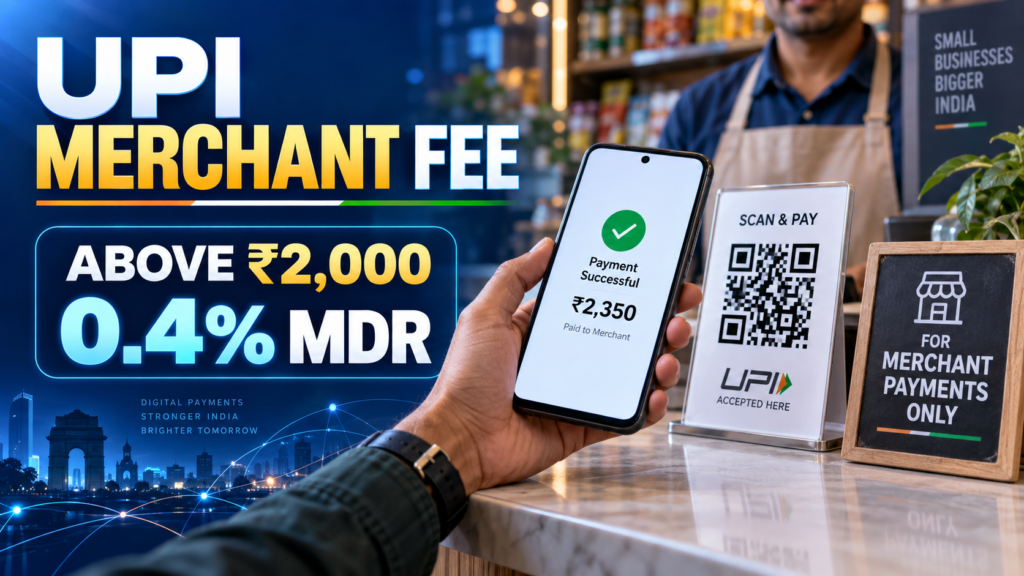
- The new fee applies to eligible UPI payments made to merchants above ₹2,000.
- The standard Merchant Discount Rate will be 0.4%.
- The measure takes effect on 15 October 2026.
- Customers must not be charged or asked to pay the MDR separately.
- Person-to-person UPI transfers will continue to remain free.
- RuPay debit-card payments remain protected from charges.
- Small merchants meeting the protected eligibility criteria are exempt.
What has India changed?
The Ministry of Finance first issued a notification protecting UPI transactions of up to ₹2,000 and payments made using RuPay-powered debit cards from direct or indirect charges by banks and payment-system providers.
This replaced the earlier blanket legal prohibition on charges across UPI payments. By specifying which transactions must remain free, the revised framework created room for an MDR to be introduced on selected payments above the protected threshold.
NPCI has now activated that pathway. Under the announced framework, eligible person-to-merchant, or P2M, UPI payments exceeding ₹2,000 will carry an MDR of 0.4% from 15 October.
This is not a blanket charge on every UPI transfer above ₹2,000. The transaction type, merchant category and applicable exemptions will determine whether an MDR is collected.
Will customers have to pay for UPI?
For ordinary users, the answer is no. NPCI has said that the MDR must not be passed on to customers. It is a payment-processing cost charged within the merchant-payment ecosystem rather than a fee imposed on the person scanning a QR code.
Transfers between individuals, such as sending money to a relative, friend or colleague, will continue to remain free, irrespective of whether the transferred amount exceeds ₹2,000.
MDR explained simply
Merchant Discount Rate is a fee connected to processing a digital payment. It is normally paid by the merchant and distributed among participants such as banks and payment-service providers.
It should not be confused with a direct UPI user fee or a tax on the transferred amount.
Which payments will attract the new MDR?
| Payment type | New treatment |
|---|---|
| UPI payment to an eligible merchant above ₹2,000 | 0.4% MDR, subject to the prescribed cap and exemptions |
| UPI merchant payment of ₹2,000 or below | No charge |
| Person-to-person UPI transfer | Remains free |
| Protected small merchant | Exempt under the announced framework |
| RuPay debit-card payment | No charge under the government notification |
| Railways, telecom, insurance and fuel payments above ₹2,000 | Special flat MDR of ₹5 per eligible transaction |
General eligible merchant transactions will be charged at 0.4%, with the MDR capped at ₹300 for high-value payments. Reports on the framework say selected sectors including railways, telecom, insurance, and fuel will instead attract a flat ₹5 MDR on eligible payments above ₹2,000.
Small merchants receiving less than ₹1 lakh per month through UPI QR payments are reported to be exempt. UPI QR transactions in rural and semi-urban areas are also protected under the new structure.
Can a shopkeeper add the fee to your bill?
The announced framework says banks and payment providers must ensure that merchants do not transfer the MDR directly to consumers. A customer should therefore not see a separate “UPI charge” simply for scanning a merchant QR code.
Enforcement will be important. Although merchants may not be permitted to add the MDR as a separate UPI surcharge, businesses could still review their broader pricing if payment-processing costs increase. That would be an indirect commercial effect rather than an authorised customer transaction fee.
Why introduce a merchant fee now?
UPI has grown from a payment alternative into critical national infrastructure. It handles billions of transactions every month and requires substantial spending on bank systems, switching capacity, settlement operations, cybersecurity, fraud detection and service reliability.
Banks and fintech companies have argued that a permanently zero-fee model makes it difficult to recover the cost of operating and upgrading the network. The government previously supported low-value merchant payments through incentive schemes funded from the Union Budget.
The targeted MDR attempts to create a more sustainable source of revenue while keeping small everyday transactions, individual transfers and protected merchants outside the charging framework.
Where will the MDR money go?
The proceeds will be distributed among the institutions that process UPI payments, including banks and payment-service providers. Part of the revenue is expected to support infrastructure expansion, cybersecurity, fraud prevention and product development.
The framework also provides for a fund supported by a portion of MDR collections to encourage UPI adoption among smaller businesses. This is intended to prevent the new revenue model from slowing digital-payment growth at the grassroots level.
What it means for consumers
Consumers can continue using UPI for routine purchases and personal money transfers without paying a direct fee. Even where an eligible merchant transaction exceeds ₹2,000, the MDR is meant to be absorbed by the merchant.
Users should be cautious if a merchant asks for an additional amount specifically described as a mandatory UPI fee. They may request another accepted payment method and retain the bill or payment screenshot if they wish to raise a complaint with the relevant bank or UPI application.
What it means for merchants and payment companies
Larger merchants will face a new payment-processing cost on eligible higher-value sales. For many organised businesses, the rate remains below the MDR commonly associated with credit-card transactions. UPI also offers advantages such as instant confirmation, lower cash-handling risk and easier reconciliation.
Banks, payment applications and fintech companies gain a new revenue stream that could help fund the rapidly expanding system. The policy may, however, renew debate about whether merchants will discourage UPI for larger purchases or seek alternative payment methods.
Why the ₹2,000 threshold matters
The threshold protects the small-value payments that account for much of UPI’s daily use groceries, transport, food, medicine and neighbourhood purchases, while targeting comparatively higher value commercial transactions.
It also represents a wider policy shift. UPI’s expansion was built around zero MDR, which encouraged millions of merchants to accept QR-code payments. India is now moving toward a selective model in which basic access remains free while some larger commercial transactions contribute toward operating the network.