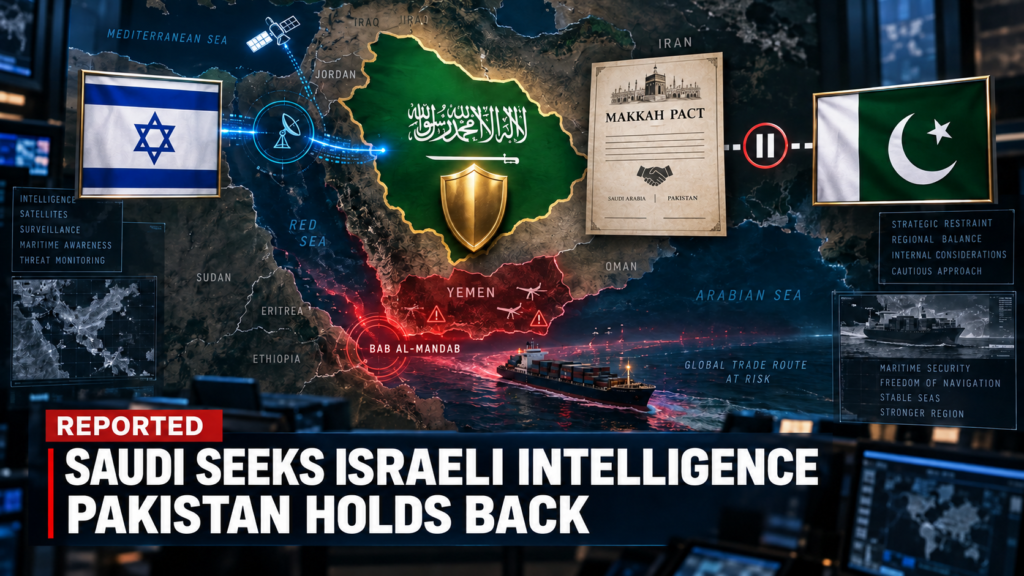
RIYADH: Saudi Arabia has reportedly approached Israel indirectly through United States Central Command for intelligence and defensive assistance against Yemen’s Iran-aligned Houthis, amid increasing threats to Saudi territory and maritime traffic around the Bab al-Mandab Strait.
The reported outreach is geopolitically significant. Saudi Arabia does not formally recognise Israel, yet Riyadh may now be considering Israeli intelligence and surveillance capabilities while the Makkah Joint Defence Agreement struggles to produce a visible military response from Pakistan.
Islamabad has condemned Houthi attacks and threats against Saudi Arabia. However, Pakistan’s Foreign Ministry has said that no military response against the Houthis has been discussed under the Makkah agreement.
Pakistan has neither formally rejected the agreement nor abandoned its relationship with Saudi Arabia. Nevertheless, its reluctance to announce combat deployments has created serious questions about the pact’s practical value during a real security emergency.
- Saudi Arabia reportedly sought Israeli intelligence assistance through US Central Command.
- The discussions reportedly concerned Houthi missile, drone and maritime threats.
- Pakistan says no military response has been discussed under the Makkah Joint Defence Agreement.
- Islamabad appears unwilling to deploy combat forces inside Yemen.
- Bab al-Mandab and the Strait of Hormuz have become central to regional energy and maritime security.
- Pakistan’s economic constraints and wider military commitments limit its freedom of action.
Makkah defence pact faces its first credibility test
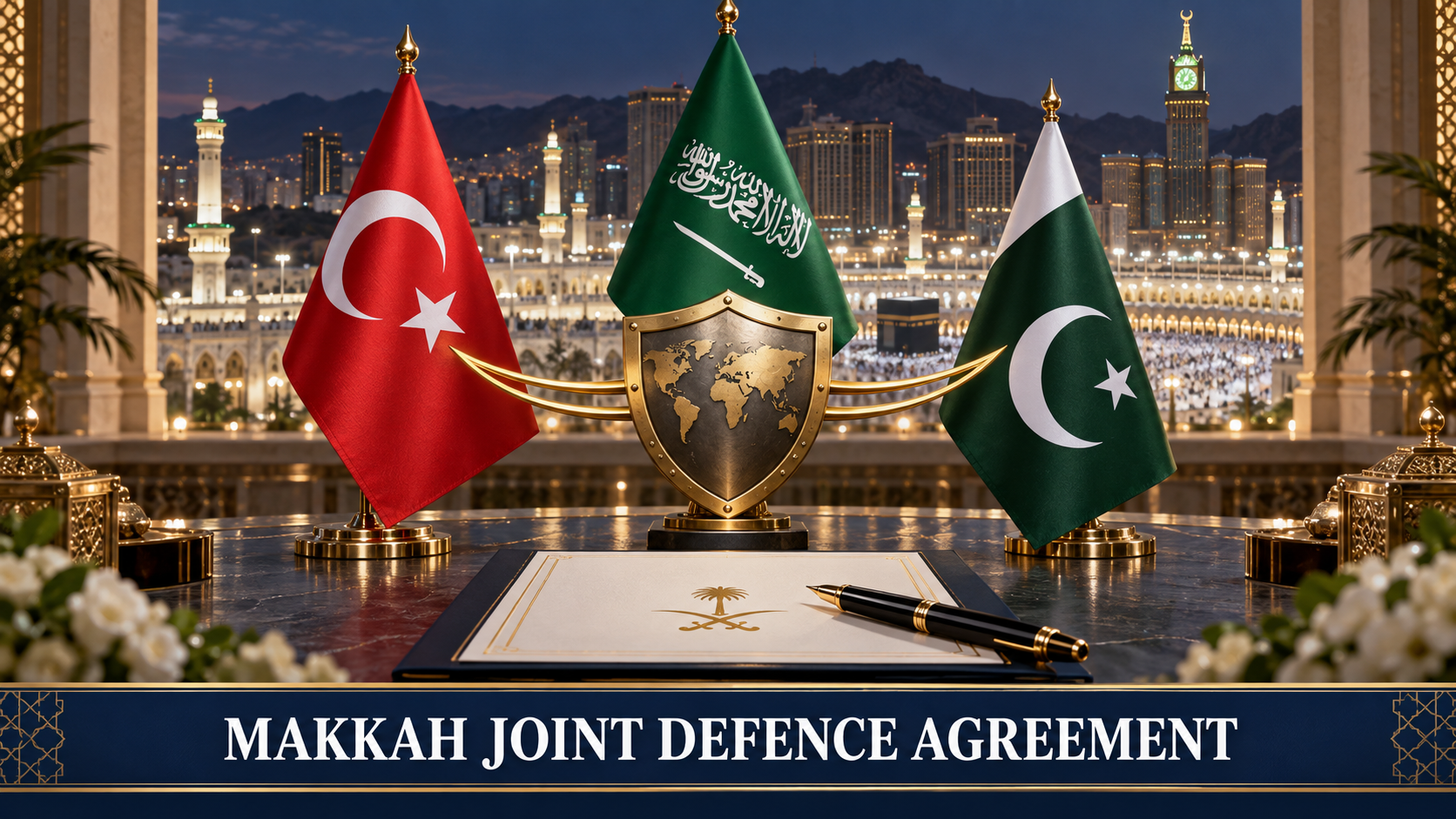
Saudi Arabia, Türkiye and Pakistan signed the Makkah Joint Defence Agreement in August 2026. According to the official joint statement , an armed attack against any one of the three countries would be considered an attack against them all.
On paper, the language resembles a collective-defence guarantee. In practice, however, the agreement does not appear to provide an automatic mechanism requiring every member to begin combat operations whenever another member comes under attack.
Pakistan’s carefully worded response illustrates that ambiguity. Islamabad says it remains committed to Saudi security and the Makkah agreement, but it has not announced air strikes, naval combat operations or a deployment of troops inside Yemen.
Saudi Arabia reportedly turns towards Israel
Reports indicate that Crown Prince Mohammed bin Salman approached Israel indirectly through US Central Command for intelligence support related to the Houthi threat.
Israel possesses advanced satellite surveillance, missile-warning, air-defence and intelligence-gathering capabilities. Such assistance could help Saudi Arabia monitor Houthi launch sites, drone movements, coastal activity and threats against commercial vessels.
The reported engagement does not necessarily mean Saudi Arabia has requested Israeli ground forces or authorised an Israeli war in Yemen. It is more accurately understood as possible intelligence and defensive cooperation through American mediation.
Two strategic waterways under pressure
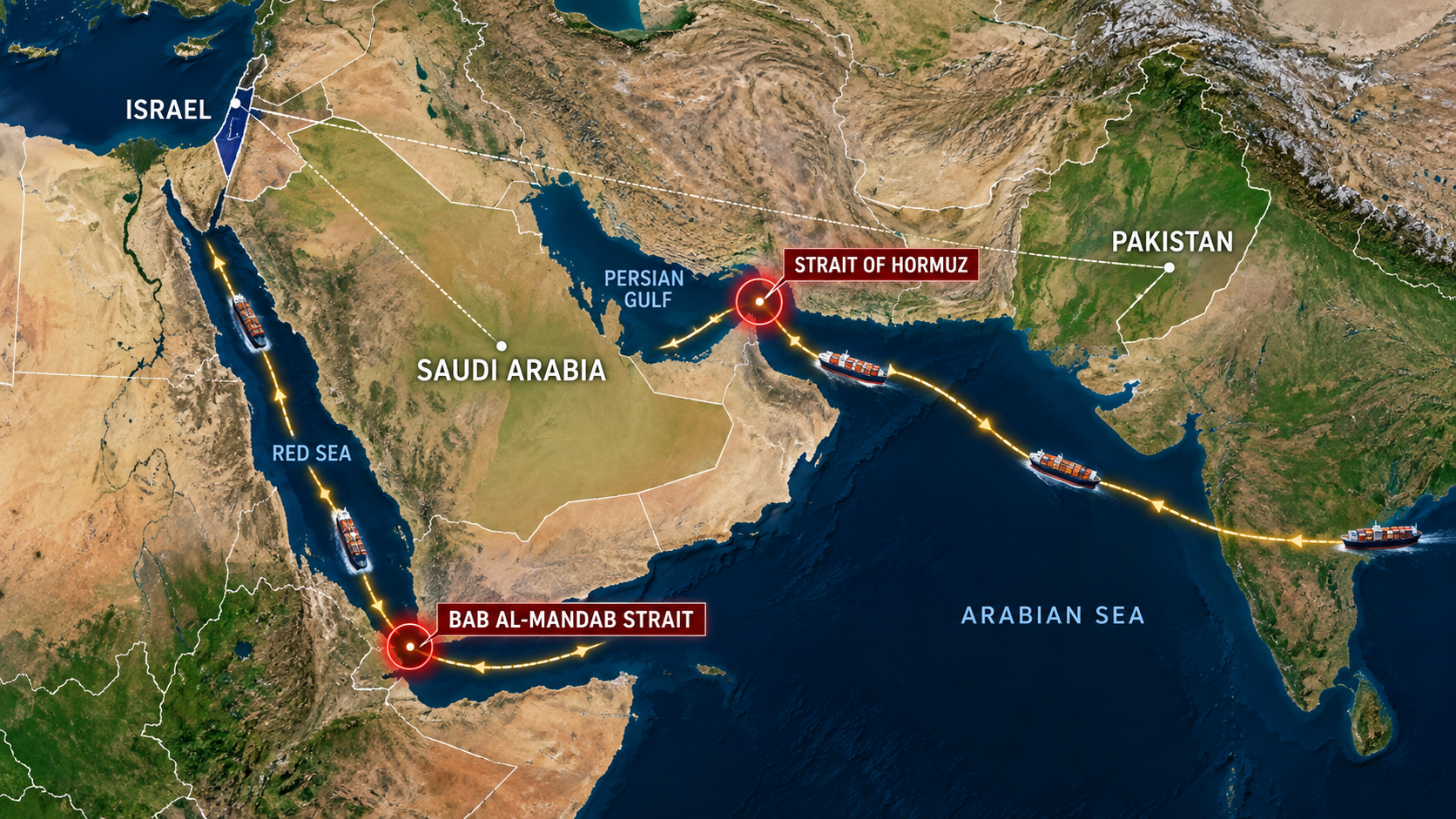
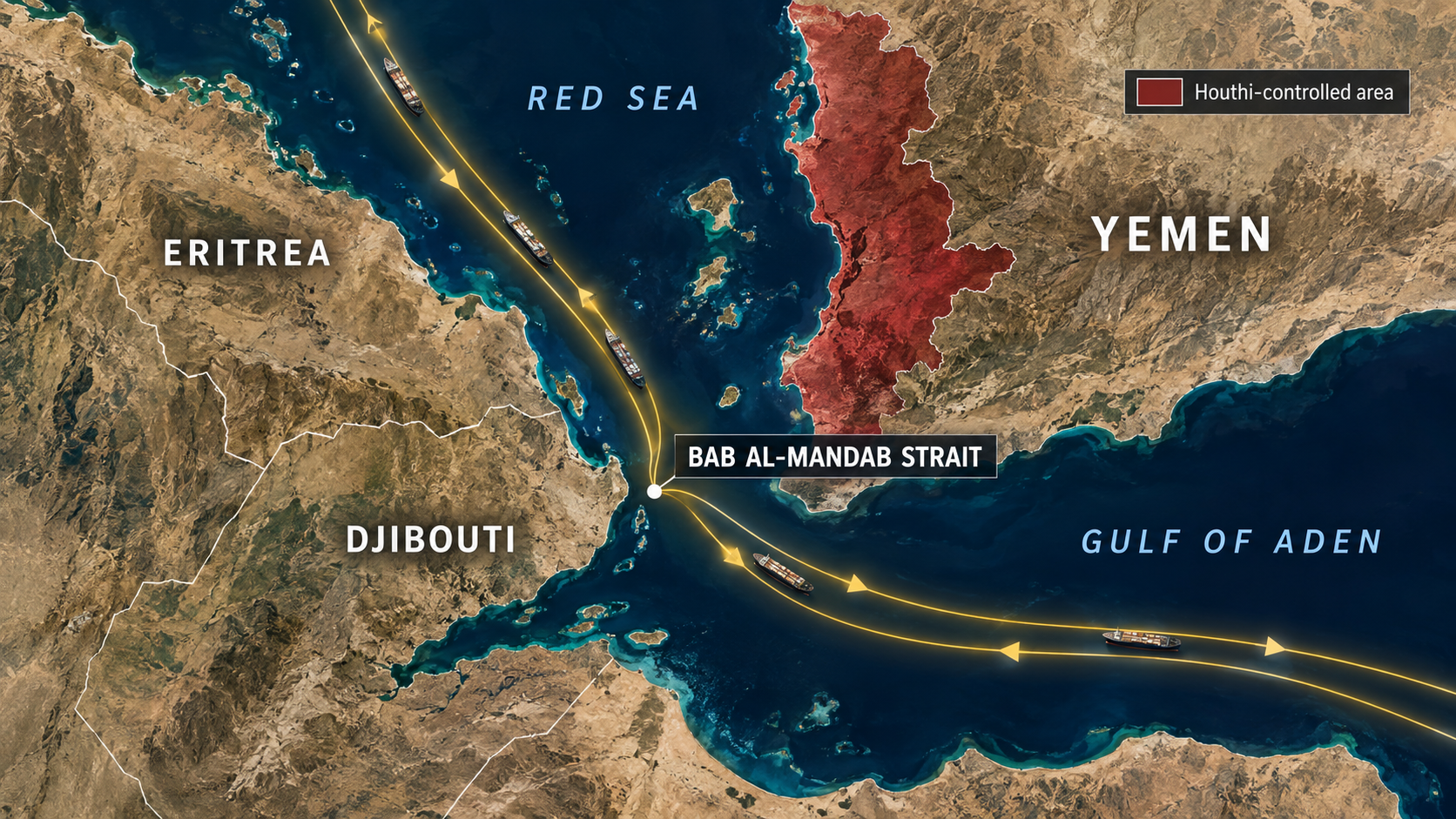
Bab al-Mandab connects the Gulf of Aden and the Indian Ocean with the Red Sea and Suez Canal. Around 10% to 12% of global maritime commerce is estimated to pass through the corridor, making it one of the world’s most important shipping chokepoints.
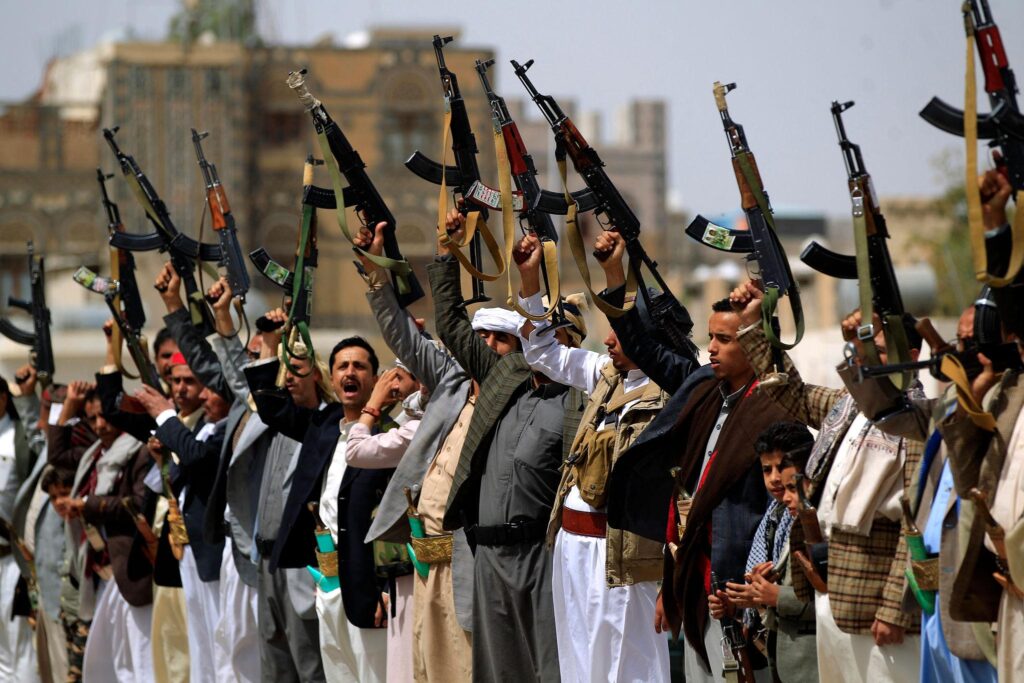
Houthi control of ports, islands and coastal territory near the strait would strengthen the group’s ability to monitor or threaten commercial vessels. Even without a complete closure, persistent missile, drone and boat attacks could force shipping companies to divert vessels around Africa’s Cape of Good Hope.
The Strait of Hormuz, meanwhile, serves as the principal maritime entrance to the Persian Gulf. Pressure on Hormuz and Bab al-Mandab at the same time would place two major energy routes under simultaneous stress.
Longer journeys would increase fuel consumption, insurance premiums, freight rates and delivery times. The economic consequences would extend beyond Saudi Arabia and affect Asian and European markets dependent on Middle Eastern energy and Suez-linked trade.
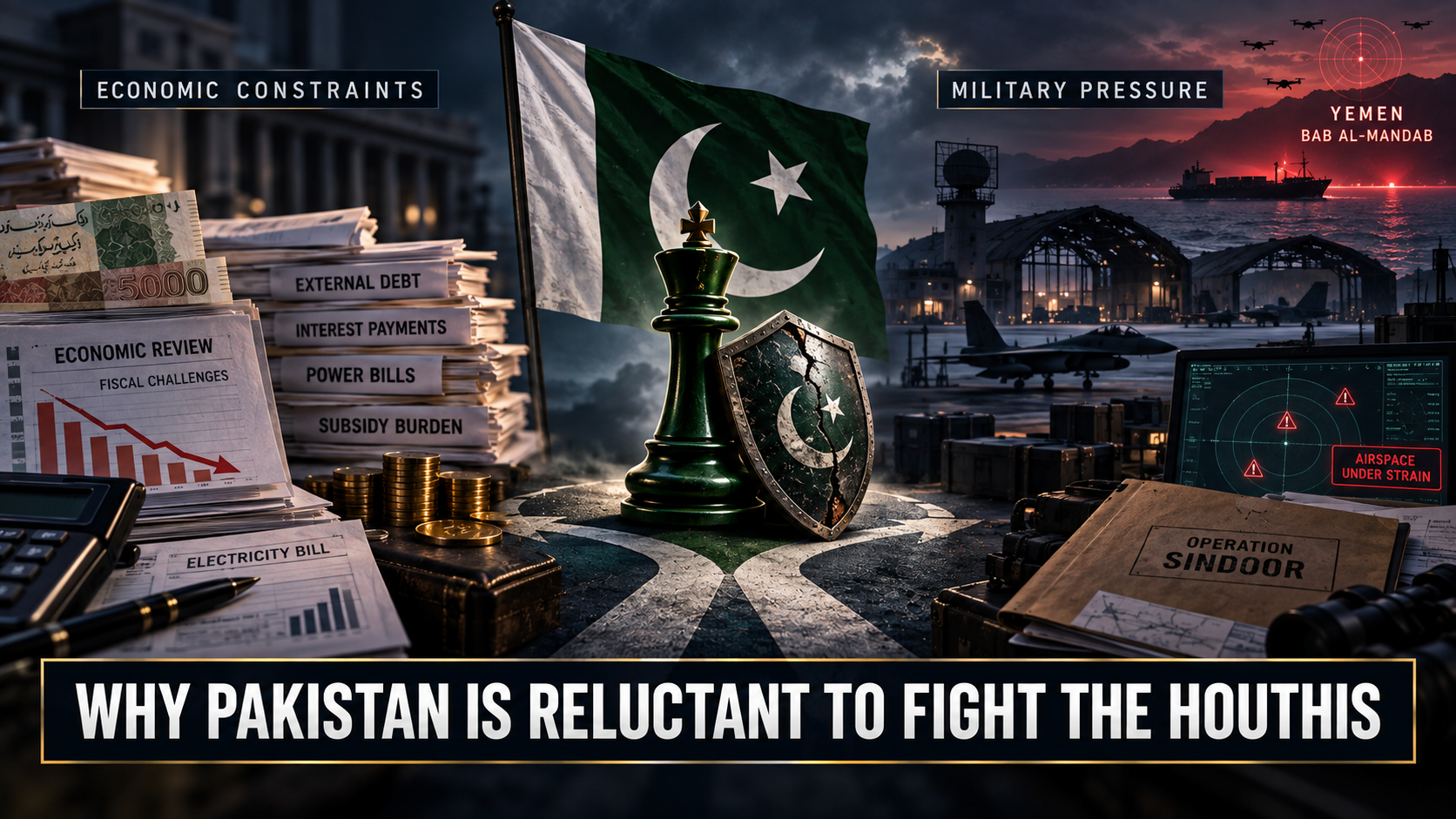
Why Pakistan is reluctant to fight the Houthis
Risk of becoming trapped in Yemen
Pakistan has strong reasons to avoid becoming directly involved in Yemen. Any intervention could become lengthy, expensive and politically divisive, without guaranteeing that air or naval operations would eliminate the Houthi threat.
An overseas deployment would also expose Pakistan to the risks of retaliation against its personnel, ships or interests elsewhere in the region.
The sensitive Iran relationship
Pakistan shares a long and sometimes unstable border with Iran. Islamabad must therefore balance its close strategic and financial relationship with Saudi Arabia against the risks of a direct confrontation with Tehran.
Because the Houthis are aligned with Iran, Pakistani military operations could damage relations with its western neighbour and create additional border-security challenges.
Domestic political and sectarian concerns
Participation in a Saudi-led conflict against the Houthis could generate political and sectarian tensions inside Pakistan. Any government in Islamabad would face resistance to sending forces into another prolonged Middle Eastern conflict.
Post–Operation Sindoor military pressure
Pakistan must also consider its continuing military requirements along its eastern border following Operation Sindoor. Pakistan lost key air base facilities and aircrafts of Pakistan Air Force, which downed the Morale of Pakistan Armed forces, and Pakistan also faced major finanical losses during Operation Sindhoor.,
Nevertheless, heightened readiness, replacement requirements, air-defence demands and continuing regional tensions can limit Pakistan’s willingness to open another operational front far from home.
Economic constraints narrow Islamabad’s options

Pakistan’s continuing economic constraints significantly reduce its ability to finance a costly foreign military campaign. The country remains under an IMF-supported reform programme, despite improvements in reserves and macroeconomic stability.
In May 2026, the IMF approved approximately $1.32 billion in additional access for Pakistan, taking disbursements under its current programmes to roughly $4.8 billion.
Islamabad must continue implementing difficult reforms involving taxation, energy pricing, state-owned enterprises, monetary policy and government expenditure. These pressures make an open-ended military operation abroad harder to justify domestically.
Pakistan also needs resources for employment, infrastructure, flood resilience and energy security. Committing substantial funds, aircraft, naval assets or troops to Yemen could deepen pressure on an already constrained national budget.
Has Pakistan abandoned Saudi Arabia?
It would be inaccurate to say that Pakistan has formally abandoned Saudi Arabia. Islamabad has condemned Houthi threats and continues to describe Saudi security as important.
However, diplomatic solidarity is different from military participation. Pakistan has not announced combat deployments, strikes against Houthi positions or operations inside Yemen.
Islamabad may instead consider limited non-combat assistance such as intelligence sharing, logistics, naval coordination, training or defensive deployments inside Saudi territory. That could allow Pakistan to claim it is honouring the Makkah agreement without entering the Yemen war.
| Issue | Makkah pact’s promise | Current position |
|---|---|---|
| Collective defence | An armed attack against one member is regarded as an attack against all. | Pakistan says no military response against the Houthis has been discussed. |
| Operational support | Members will strengthen defence cooperation and deterrence. | No Pakistani combat deployment inside Yemen has been announced. |
| Saudi security | Riyadh should be able to rely on its formal defence partners. | Saudi Arabia is reportedly seeking additional intelligence and defensive assistance. |
| Pakistan’s constraints | The pact presents the three countries as a united security bloc. | Economic pressures, Iran-border concerns and domestic sensitivities limit Islamabad’s options. |
A credibility problem for the Makkah agreement
The crisis does not prove that the Makkah agreement is meaningless. Collective-defence partnerships can provide intelligence, logistics, training and defensive assistance without requiring every member to launch an offensive war.
However, the lack of a clearly defined Pakistani contribution creates a credibility problem. Potential adversaries may conclude that the pact’s political language is stronger than its operational commitments.
Pakistan must now explain what its collective-defence promise actually provides when Saudi territory, energy infrastructure and maritime commerce face direct threats.
Türkiye’s response will also be closely watched. If neither Ankara nor Islamabad announces meaningful assistance, Saudi Arabia may become more dependent on Egypt, the United States, Britain, Israel and the wider maritime coalition.