📅July 25, 2026 | By Pulse India News Desk
From interceptor missiles and long-range radars to networked command systems, Project Kusha is being developed to strengthen the outer layers of India’s air-defence network and reduce dependence on imported strategic systems.
Project Kusha is not simply a new missile. It is a complete air-defence weapon system expected to combine interceptor missiles, long-range surveillance radars, fire-control radars, mobile launchers, secure communications and an integrated command-and-control centre.
What is Project Kusha?
Project Kusha is India’s programme to develop an indigenous long-range surface-to-air missile system for the Indian Air Force. It is intended to detect, track and neutralise aerial threats at considerably longer distances than India’s existing short- and medium-range indigenous systems.
The Ministry of Defence says the Kusha system is being developed to counter a wide variety of threats, including fighter aircraft, missiles, unmanned aerial vehicles and large enemy aircraft across a broad range and altitude envelope.
Unlike an individual missile, Kusha is expected to operate as a networked system. The missile interceptors will work alongside surveillance radars, engagement radars, launch vehicles, command posts and secure data links to create a complete long-range air-defence battery.
Kusha missile test: Why is India testing the system now?
India is testing Kusha because the programme has moved from subsystem design and ground validation into the more demanding flight-development phase. A missile system cannot be approved for military deployment solely on the basis of computer simulations or laboratory testing.
Successive trials must demonstrate the performance of the missile’s propulsion, control system, navigation, guidance, seeker, communication links and engagement sequence. Later trials must also validate the complete weapon system against different target profiles and under realistic electronic-warfare conditions.
What the maiden test demonstrated
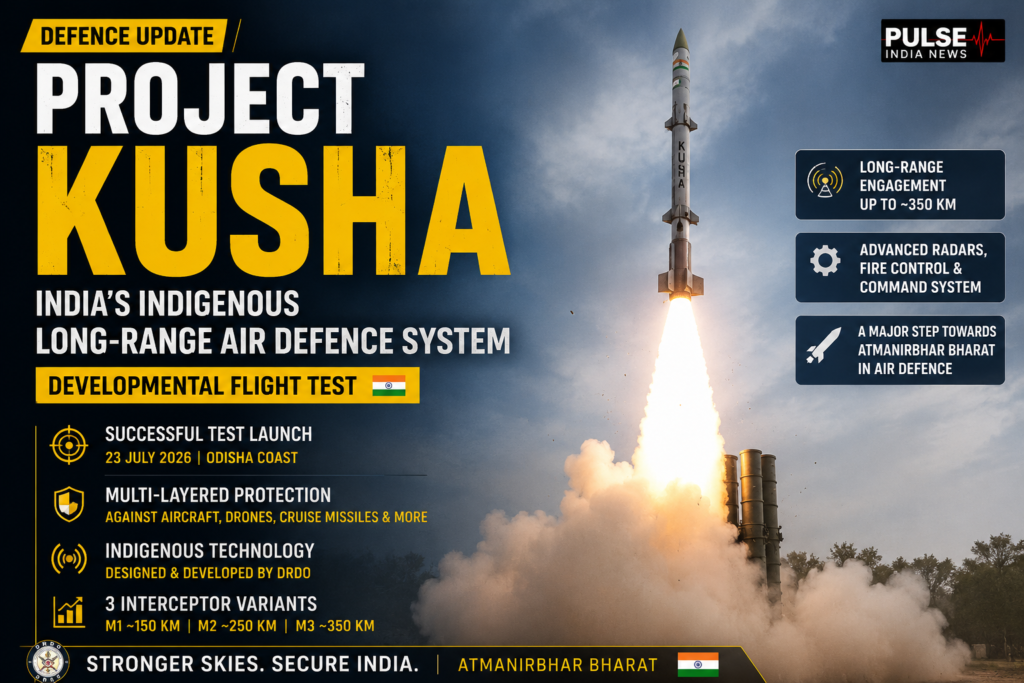
During the July 23 trial, an electronic target simulated a high-speed, high-altitude aerial threat. According to the Ministry of Defence, the Kusha missile successfully intercepted the target.
The result is an important engineering milestone, but it does not mean that the full system is ready for immediate operational deployment. Multiple developmental and user trials are still expected.
Kusha M1, M2 and M3 interceptor variants
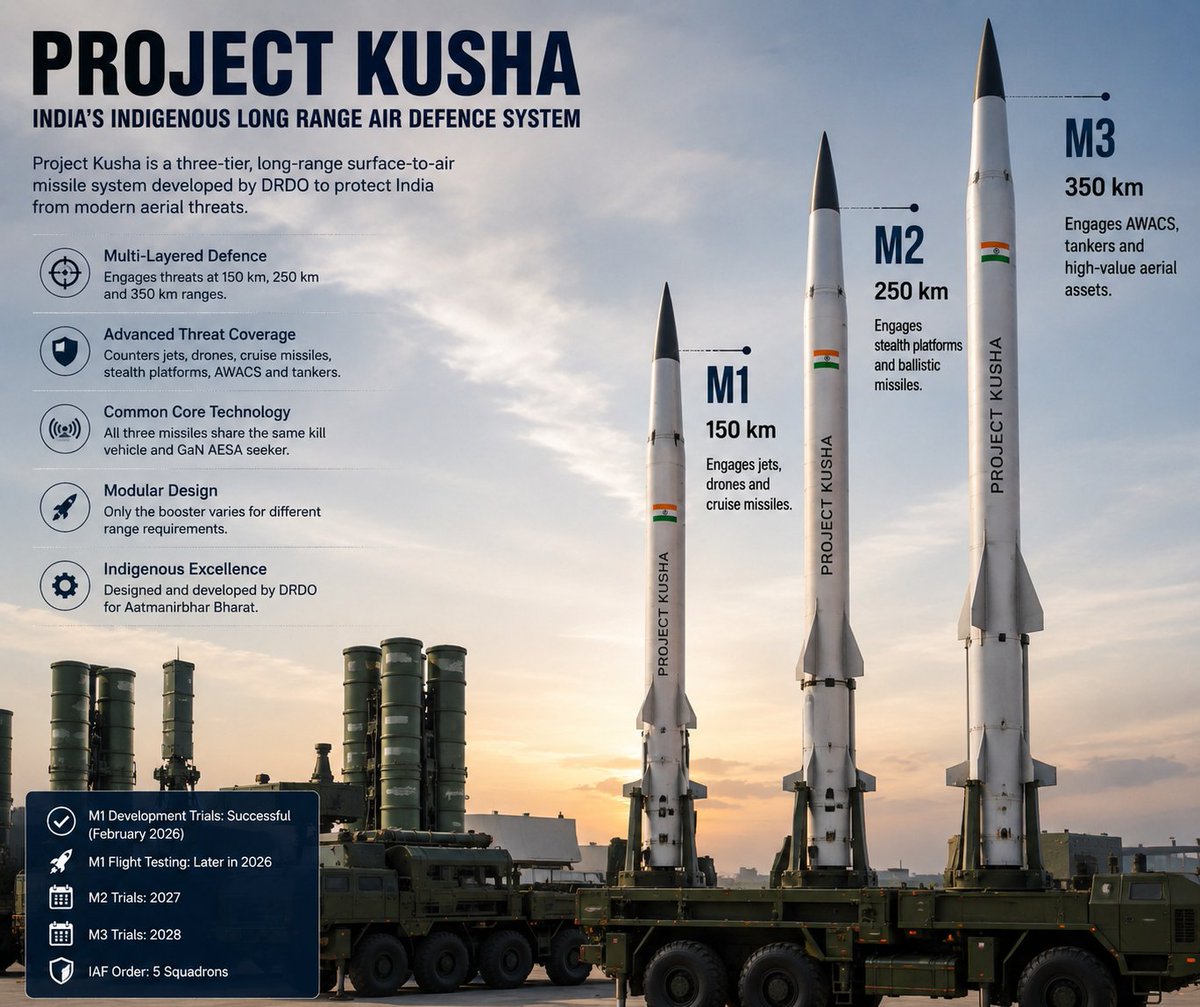
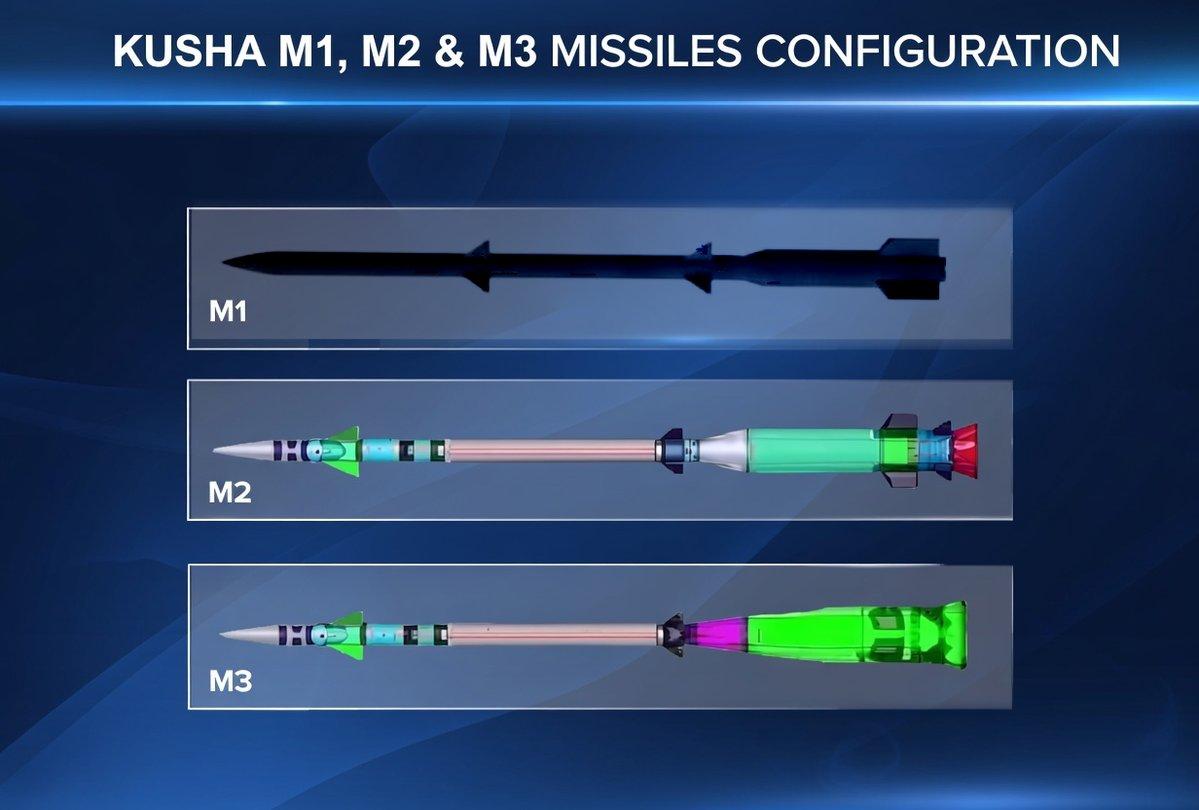
Project Kusha has been reported as a three-tier air-defence system built around interceptor classes commonly identified as M1, M2 and M3. These missiles would provide overlapping engagement zones and allow commanders to select an interceptor according to the target’s distance, altitude, value and flight profile.
Expected to form the inner Kusha engagement layer against tactical aircraft, unmanned aircraft, cruise missiles and other aerodynamic threats.
Intended to provide a wider engagement zone against combat aircraft, missiles and high-value airborne platforms operating farther from the protected area.
Planned as the outer interceptor layer, potentially threatening airborne early-warning aircraft, tankers, surveillance platforms and long-range strike aircraft.
Project Kusha technical specifications
| Specification | Confirmed or reported information | Assessment |
|---|---|---|
| System category | Mobile, land-based long-range surface-to-air missile system | Confirmed role |
| Developer | DRDO laboratories with Indian industry partners | Officially confirmed |
| Primary user | Indian Air Force | Programme requirement |
| Interceptor classes | M1, M2 and M3 | Reported programme structure |
| Engagement ranges | Approximately 150 km, 250 km and 350 km | Reported or planned figures |
| Target set | Fighter aircraft, missiles, UAVs and large enemy aircraft | Officially confirmed |
| Radar network | Surveillance and fire-control radars | Officially confirmed generally |
| Command system | Integrated command-and-control centre | Officially confirmed |
| Launch arrangement | Road-mobile, canister-based launch system expected | Reported configuration |
| Propulsion | Solid-propellant missile architecture expected | Not fully disclosed |
| Guidance | Inertial or mid-course guidance with radar updates and terminal seeker-based homing expected | Detailed architecture not disclosed |
| Current status | Developmental flight-testing phase | Confirmed |
| Operational status | Not yet inducted | Confirmed by programme stage |
Range, guidance and technology used by Project Kusha
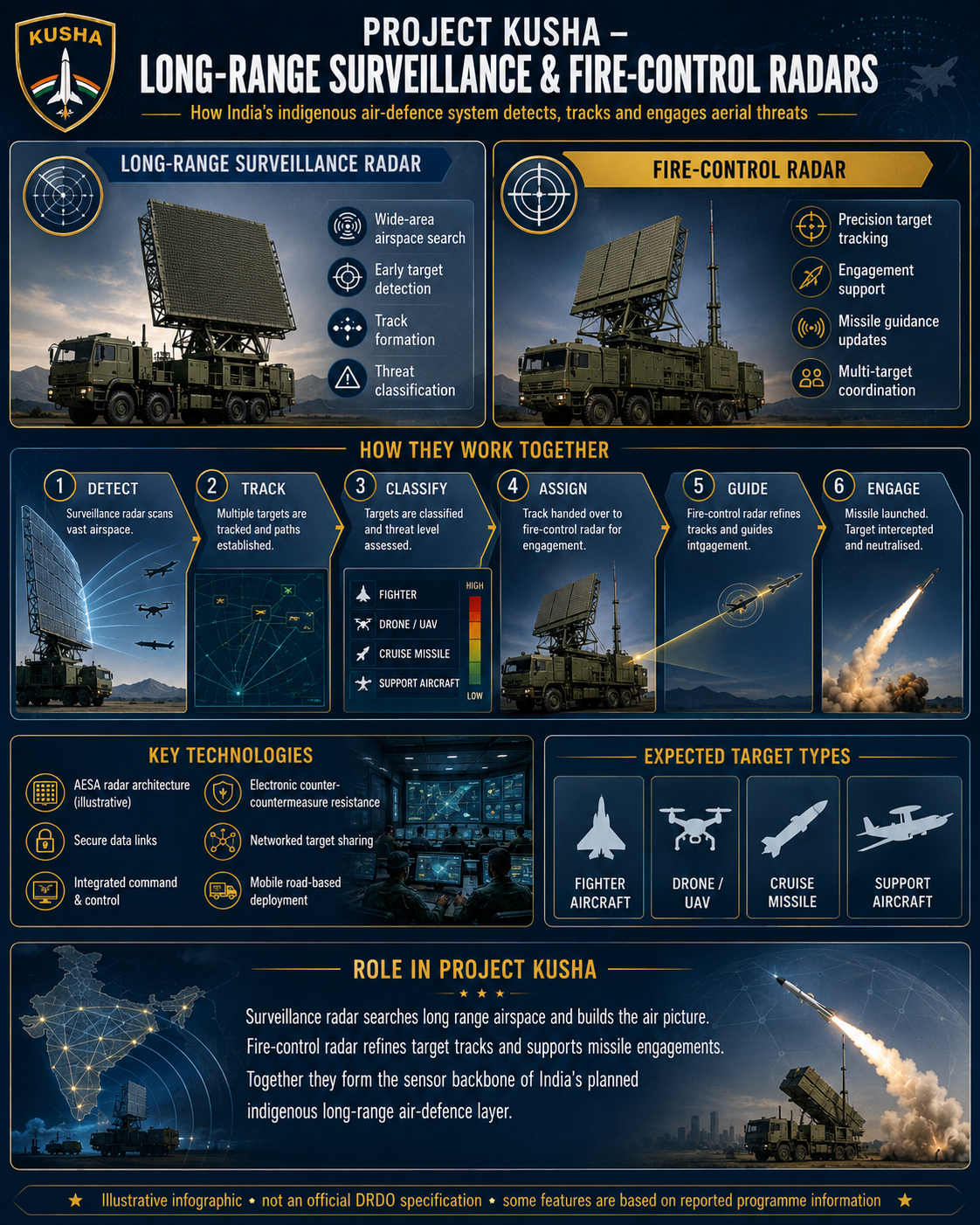
Searches a wide volume of airspace, detects approaching targets, establishes tracks and supplies an early-warning picture to the command centre.
Generates precise target information, supports engagement planning and provides guidance updates to interceptor missiles during flight.
Combines information from sensors, prioritises threats and assigns the most suitable missile and firing unit to each target.
Transmit target updates and engagement commands between radars, command posts, launchers and missiles while resisting interference.
An onboard seeker is expected to refine the target’s position during the final phase and improve accuracy against manoeuvring threats.
The system is expected to incorporate frequency agility, secure communications and electronic counter-countermeasure features.
Expected engagement sequence
A typical Kusha engagement could begin when the surveillance radar detects an approaching aircraft, drone or missile. The command centre would then classify the track, assess its threat level and select an appropriate interceptor.
After launch, the missile would navigate towards the predicted interception point while receiving updated target information. During the terminal phase, its onboard seeker would attempt to acquire and home on the target.
Where Kusha fits in India’s layered air defence
No single missile can efficiently stop every type of aerial threat. India therefore employs a layered approach in which different systems defend different ranges, altitudes and target categories.
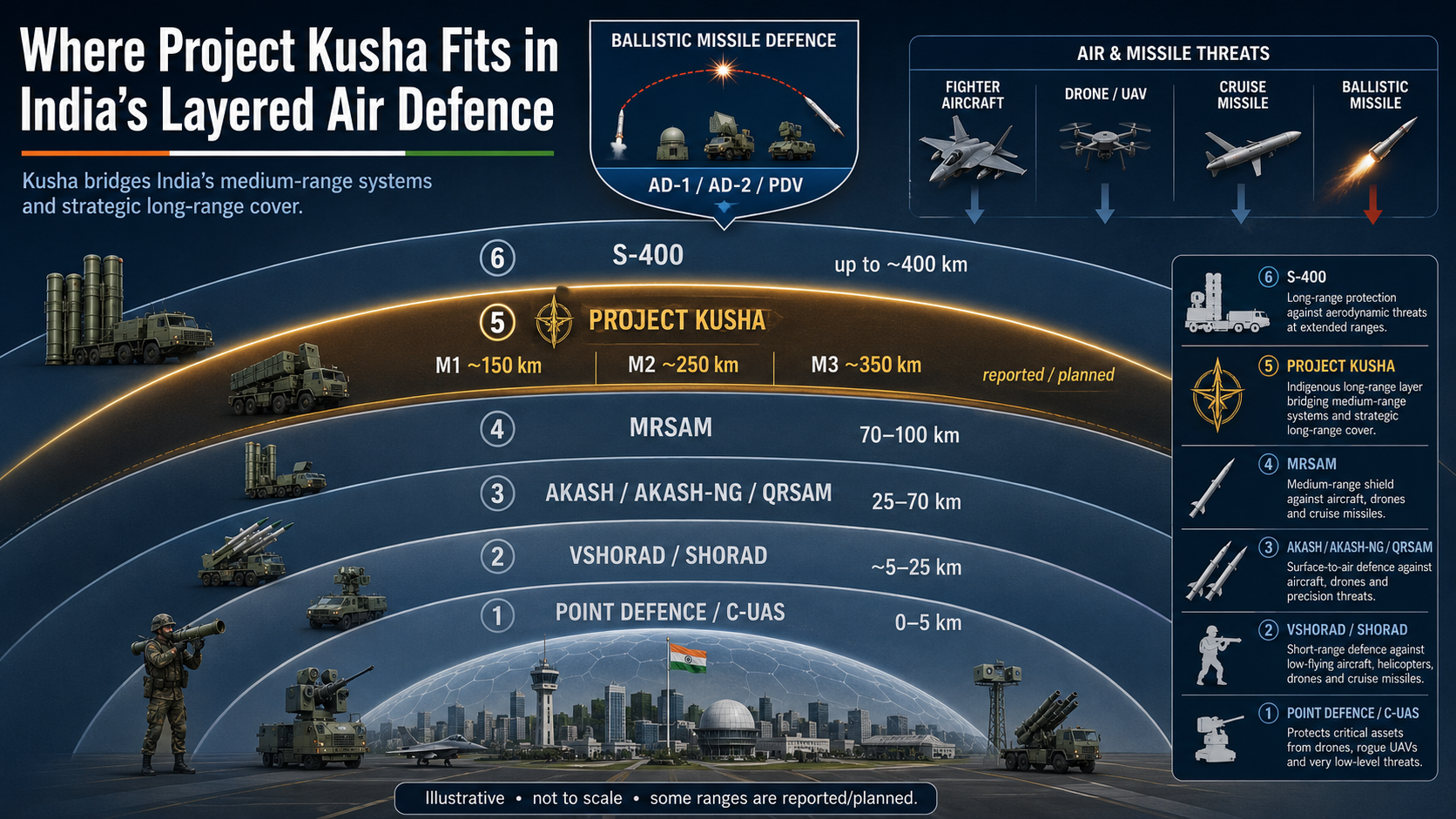
Kusha is expected to complement the S-400 rather than immediately replace it. The Russian system is already operational, while Kusha remains under development and must complete extensive testing.
India’s dedicated ballistic missile defence interceptors also form a separate specialised layer. Although some reports associate Kusha with selected missile-defence roles, the maiden test was officially described as an interception of a simulated high-speed, high-altitude aerial threat, not as a demonstrated operational ballistic-missile interception.
Project Kusha and Atmanirbhar Bharat
The programme brings together indigenous missile propulsion, guidance, radar, electronics, secure communications, command software, mobile launchers and domestic manufacturing. Successful development would give India greater control over production, maintenance, upgrades, ammunition replenishment and long-term system availability.
The Ministry of Defence has stated that all major Kusha weapon-system elements, including the missiles, radars and command-and-control centre, are being developed by DRDO laboratories and Indian industry partners.
This is strategically important because long-range air-defence systems are among the most complex military technologies to design and manufacture. Domestic production can reduce exposure to foreign supply restrictions and enable future improvements to be made according to India’s operational needs.
Project Kusha development status
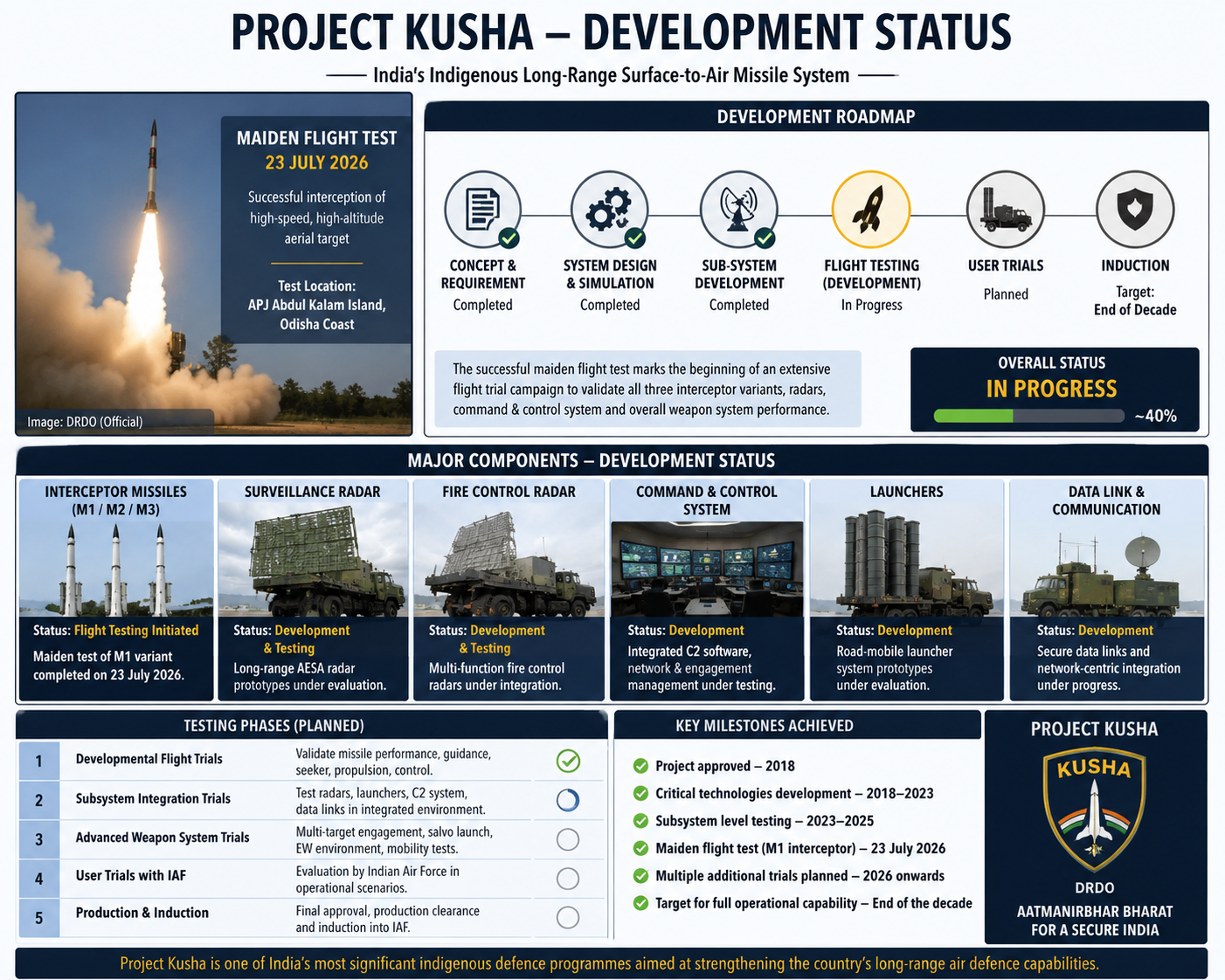
Project Kusha is currently in the developmental flight-testing phase. The maiden flight test on July 23, 2026, established an important baseline, but the complete interceptor family and integrated weapon system have not yet completed operational user trials.
| Programme element | Current public status |
|---|---|
| System concept and design | Advanced development |
| Maiden Kusha missile flight | Successfully completed on July 23, 2026 |
| Three-interceptor family | Reportedly under development |
| Surveillance and fire-control radars | Development and integration underway |
| Command-and-control network | Under development |
| Integrated weapon-system trials | Further trials required |
| Indian Air Force user trials | Not publicly confirmed as completed |
| Production clearance | Not yet announced |
| Operational induction | Pending successful development and user evaluation |
What trials are likely to follow?
Future trials are expected to examine full-range performance, low- and high-altitude targets, manoeuvring threats, radar integration, electronic interference, simultaneous tracking and engagement, salvo launches and complete battery-level operation.
The Indian Air Force would then need to evaluate the system in operational scenarios before large-scale production and induction could begin.
Why Project Kusha is important for India
Kusha could engage certain threats farther from protected cities, air bases, military formations and strategic infrastructure.
Modern attacks can combine fighters, drones, cruise missiles, precision weapons and electronic warfare in a single operation.
Indigenous production would improve access to spare parts, interceptor stocks, upgrades and lifecycle support.
Long-range interceptors could force hostile surveillance, tanker and command aircraft to operate farther from Indian airspace.
Kusha can contribute to a larger sensor-and-shooter network rather than operating as an isolated missile battery.
The programme can expand domestic capability in radars, seekers, propulsion, electronics, launchers and command software.
The successful maiden test is therefore an important milestone rather than the final destination. Kusha must still prove that its different missiles, sensors and command systems can operate together reliably under demanding conditions.
If the remaining development programme succeeds, Project Kusha could become one of the most consequential indigenous defence systems produced by India and a central element of the country’s future multi-layered air-defence network.
Sources and specification note
- Press Information Bureau: DRDO conducts successful maiden flight test of Kusha
- DRDO: Medium-Range Surface-to-Air Missile
- DRDO: Akash Weapon System