📅July 24, 2026 | By Pulse India News Desk
The new 10% and 12.5% import duties replace an expiring temporary tariff, with India moving into the lower-rate category after consultations with Washington.
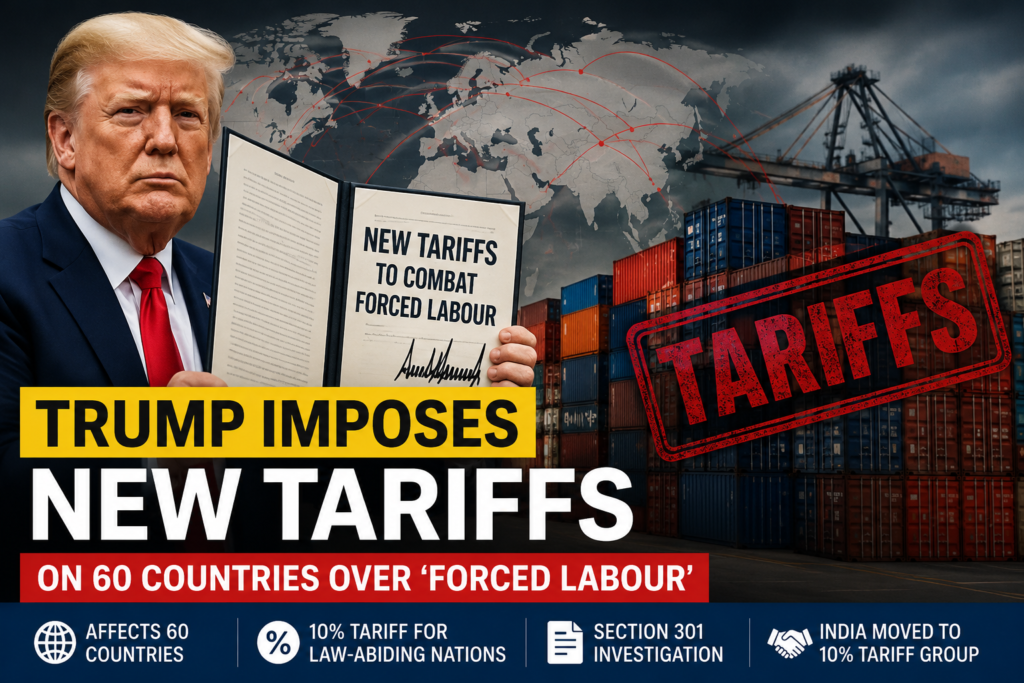
US President Donald Trump has imposed a fresh round of tariffs on imports from 60 economies, presenting the action as an effort to combat forced labour while increasing pressure on countries that sell lower-cost goods to the American market.
The new tariffs range from 10% to 12.5% and will take effect as a temporary 10% import levy expires. The action covers several major US trading partners, including India, China, the United Kingdom, Japan, South Korea, Canada and members of the European Union.
Quick Summary
- The Trump administration has announced new import tariffs covering 60 economies.
- Countries will generally face duties of either 10% or 12.5%.
- India has been placed in the lower 10% tariff category.
- The US says the action targets weak enforcement against forced-labour goods.
- Some energy products, raw materials and economically sensitive goods will be exempt.
- Additional US tariffs targeting industrial subsidies may follow.
What Are the New Tariff Rates?
The Trump administration has divided affected trading partners into different tariff groups based on whether they maintain and enforce restrictions against goods linked to forced labour.
| Country category | New tariff rate | US administration’s reasoning |
|---|---|---|
| Countries with forced-labour import laws or enforcement commitments | 10% | Considered to have introduced restrictions or made progress toward enforcement. |
| Countries without an adequate import prohibition | 12.5% | Considered to lack sufficient legal safeguards or enforcement measures. |
| Selected exempt products | Exempt | Includes some energy products, raw materials and goods considered economically sensitive. |
Countries that have introduced forced-labour import bans, committed to adopting such measures or developed partial enforcement systems will generally face the lower 10% rate.
Economies that the United States says have failed to establish adequate prohibitions will face the higher 12.5% tariff.
The administration says goods produced through coercive labour practices gain an unfair cost advantage over products made under stronger labour and wage protections.
India Placed in Lower 10% Tariff Group
What the Decision Means for India
India was initially expected to face the higher 12.5% rate but was later moved into the 10% category following consultations with US officials.
The lower tariff provides India with a relatively more favourable position than countries facing the full 12.5% levy, although Indian exporters may still experience higher costs in sectors not protected by exemptions.
The final impact on Indian businesses will depend on the detailed product schedule, existing customs duties and whether particular goods qualify for exclusions.
Exporters operating on narrow margins may need to renegotiate prices, absorb part of the additional duty or shift more costs to American buyers.
Why Is the US Targeting Forced Labour?
The White House says forced labour is both a human-rights problem and an unfair trade practice that harms American workers and manufacturers.
US officials argue that businesses using workers under coercive or exploitative conditions can produce goods at artificially low costs. These goods may then undercut products manufactured in countries with stronger employment protections, higher wages and stricter workplace standards.
The Office of the United States Trade Representative investigated whether major US trading partners had introduced and effectively enforced restrictions against imports produced using forced labour.
The process included consultations with foreign governments, public hearings and submissions from companies, trade organisations and other interested groups.
Tariffs Introduced Under Section 301
The administration imposed the duties under Section 301 of the Trade Act of 1974.
Section 301 permits the US government to investigate foreign policies or practices that it considers unreasonable, discriminatory or harmful to American commerce. The law also allows Washington to respond with tariffs or other trade restrictions.
The Trump administration has increasingly relied on established trade laws after earlier emergency-based tariffs faced legal challenges.
Which Products Could Be Exempt?
The new duties will not apply equally to every shipment entering the United States.
The administration has indicated that exemptions may apply to products that are unavailable in sufficient quantities from American manufacturers or alternative overseas suppliers.
- Certain oil, gas and energy products
- Selected raw materials
- Goods whose tariffs could cause serious economic disruption
- Products already subject to some national-security duties
- Informational materials and charitable donations
- Personal baggage carried by travellers
- Certain qualifying goods under regional trade agreements
The precise financial effect will therefore vary by industry, product classification, country of origin and eligibility for exclusions.
How Could Consumers and Businesses Be Affected?
Impact on Businesses
American importers may absorb the additional cost, negotiate lower prices with suppliers or move production to countries with more favourable tariff treatment.
Impact on Consumers
Retail prices could rise if companies pass tariff expenses to buyers, particularly where domestic alternatives are limited or more expensive.
Tariffs are collected from US importers at the border rather than directly from foreign governments.
Businesses may respond by reducing profit margins, changing suppliers, delaying imports or increasing the prices of finished goods.
Supporters say the policy will discourage companies from relying on supply chains connected to labour abuses and encourage more manufacturing inside the United States.
Critics warn that broad country-level tariffs may raise prices without directly identifying the factories, companies or industries responsible for forced-labour violations.
Critics See a Broader Trade Strategy
Although the White House describes the measure as a human-rights and fair-trade action, several trade analysts view it as part of Trump’s broader attempt to rebuild the US tariff system.
Trump has repeatedly argued that tariffs can reduce dependence on imports, protect American industry and encourage companies to shift production to the United States.
The new forced-labour duties broadly preserve elevated import taxes after the expiration of the temporary 10% tariff.
This has led critics to argue that the forced-labour justification is also being used to maintain wider protectionist trade barriers.
More US Tariffs May Follow
The forced-labour tariffs may represent only one part of a much larger expansion of US trade restrictions.
The administration is also expected to consider tariffs targeting countries accused of subsidising excess industrial production.
Washington says such subsidies allow foreign manufacturers to produce goods at artificially low prices and flood international markets, making it difficult for American companies to compete.
Trump has separately threatened additional tariffs on Canadian products and proposed future duties on imported generic medicines.
What Happens Next?
The USTR is expected to monitor whether affected countries strengthen their laws, enforcement mechanisms and customs controls against products connected to forced labour.
Trading partners may seek lower tariffs or product exclusions by negotiating with Washington and demonstrating stronger enforcement.
At the same time, businesses and governments could challenge the duties through US courts, diplomatic channels or international trade institutions.
Exporters will now examine the detailed tariff schedules to determine which products are covered, how the duties interact with existing trade barriers and whether further US measures are likely.
Frequently Asked Questions
What tariff rate will India face?
When do the new US tariffs take effect?
Why is Trump imposing the tariffs?
Will all imported products face the new tariff?
Could the tariffs increase prices in the US?
The Bottom Line
Trump’s new forced-labour tariffs preserve a broad barrier against imports from 60 economies while giving India and selected partners the lower 10% rate. The policy could strengthen pressure against abusive labour practices, but it may also raise costs, disrupt supply chains and trigger fresh legal and diplomatic disputes.
This article is based on publicly reported information available at the time of publication. Tariff classifications, exemptions and implementation rules may change through official US government notices or subsequent negotiations.