📅July 24, 2026 | By Pulse India News Desk
The Prime Minister said further measures would be discussed by the Union Cabinet as demonstrations over examination integrity continued at Delhi’s Jantar Mantar.
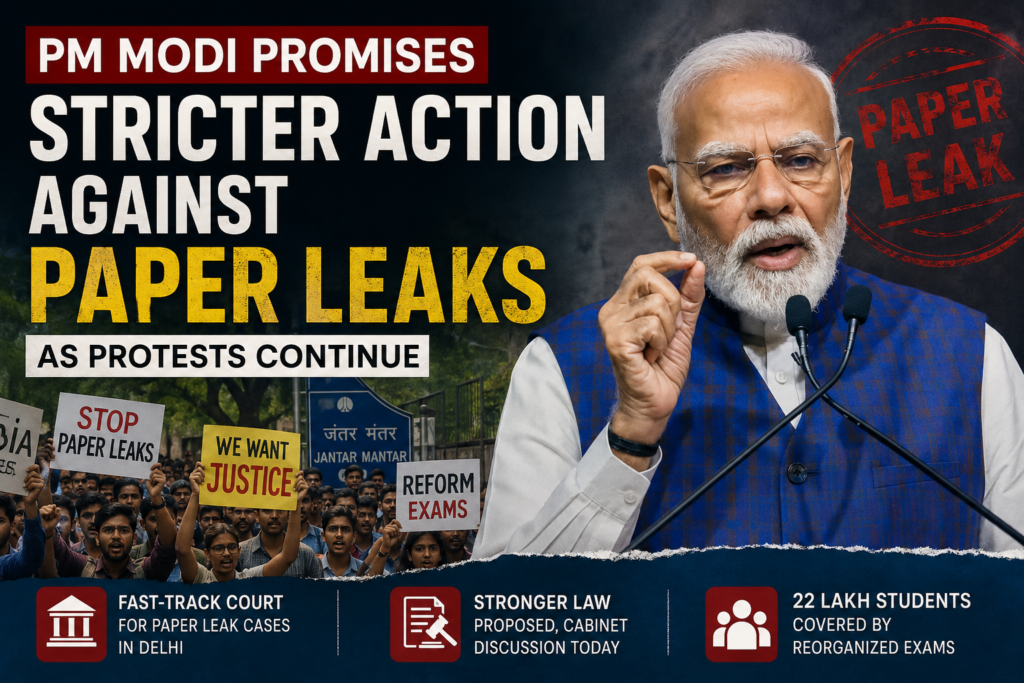
Prime Minister Narendra Modi has promised stronger action against examination paper leaks, saying the issue has caused deep distress to students and their families. The government is preparing further legal steps while a dedicated fast-track court has been established to hear related cases.
Prime Minister Narendra Modi has announced that the Union government will pursue stricter measures against examination paper leaks as student-led protests continue in the national capital.
In a video statement released late on Thursday, the Prime Minister said the government recognised the seriousness of the crisis and the damage it had caused to students preparing for competitive and public examinations.
The statement came amid sustained demonstrations at Jantar Mantar and shortly after steps were taken to establish a fast-track court for cases connected with examination malpractice.
Students were covered by reorganised examinations, according to the Prime Minister’s statement.
A dedicated court will hear offences involving examination leaks and unfair practices.
The anti-cheating law provides imprisonment and financial penalties for those convicted.
Modi calls paper leaks a painful national issue
Modi said examination leaks were not a routine administrative failure but a serious problem affecting lakhs of students and their families. He said several actions had already been initiated during the previous two-and-a-half months.
“Paper leak is not an ordinary issue. It is very painful for lakhs of students and their families.”
— Prime Minister Narendra ModiThe Prime Minister said suspects had been arrested and were in custody. He added that the government’s immediate priority was to prevent students from losing an academic year because of cancelled or compromised examinations.
Watch PM Modi’s official video statement
Cabinet discussion and proposed legislation
Modi said government departments had worked on proposals for fast-track handling of paper-leak cases. The plan was expected to be discussed by the Union Cabinet before being given its final shape.
The government would then seek to move the proposed measure through Parliament during the second week of the ongoing session, he said.
The proposed response is expected to combine faster judicial proceedings, stricter punishment, improved examination security and measures intended to ensure that students do not lose an academic year.
Fast-track court created in Delhi
A specialised fast-track court has been established at the Rouse Avenue Courts Complex in Delhi to deal with offences under the Public Examinations (Prevention of Unfair Means) Act, 2024 and connected cases.
Pending matters registered under the legislation are expected to be transferred to the designated court for faster hearings.
Judicial officer Anu Grover Baliga has been posted as the special CBI judge for the newly created court.
What punishment does the anti-cheating law provide?
The Public Examinations Act was introduced to address organised cheating, question-paper leaks, impersonation and other unfair practices affecting major public examinations.
Those found guilty can face imprisonment of up to five years and a financial penalty of up to ₹10 lakh, depending on the nature and severity of the offence.
Senior Education Ministry appointments changed
The developments were accompanied by changes in senior administrative positions connected with the Education Ministry.
Protests continue at Jantar Mantar
Demonstrations continued at Jantar Mantar despite the government’s announcements. A large number of participants were students and young people demanding greater transparency and accountability in the conduct of public examinations.
Their concerns included the NEET controversy, unemployment, examination irregularities and alleged problems associated with the CBSE’s on-screen marking process.
Protesters associated with the Cockroach Janta Party have also demanded the resignation of Education Minister Dharmendra Pradhan. Opposition leader Rahul Gandhi reiterated the same demand following the Prime Minister’s video statement.
Sonam Wangchuk’s hunger strike intensified pressure
The protest campaign began on June 6 and gained wider national attention after Ladakh activist Sonam Wangchuk joined the movement with an indefinite hunger strike on June 28.
Wangchuk subsequently ended his 26-day fast following negotiations and assurances relating to peaceful protesters, education reforms and examination paper leaks.
What happens next?
Attention will now turn to the Cabinet’s deliberations and the exact form of any new legislation or amendments introduced in Parliament.
The effectiveness of the government’s response will depend on whether investigations are completed quickly, offenders are prosecuted and examination bodies introduce stronger safeguards against future leaks.
Protest groups are also expected to continue pressing for wider reforms and political accountability until the announced measures are formally implemented.