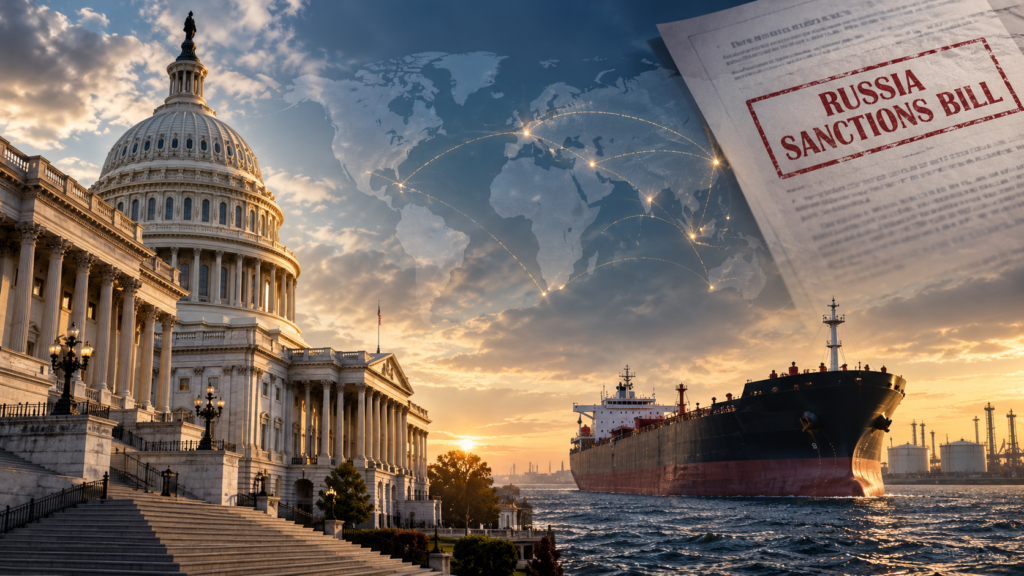
The bill gives President Donald Trump a possible new tariff tool against major buyers of Russian energy. India has warned that its use could affect bilateral ties and global oil markets.
By Pulse India News Desk · September 17, 2026 · 5 min read · World
WASHINGTON / NEW DELHI: The U.S. House of Representatives passed the Lindsey O. Graham Sanctioning Russia and Iran Act of 2026 by 262 votes to 159 on September 16, sending the measure to President Donald Trump after an earlier 86–11 Senate vote. The bill aims to intensify pressure on Moscow over its war in Ukraine and authorizes tariffs of up to 100% on countries buying Russian energy, potentially including India and China.
As of September 17, the bill awaits the president’s signature. No 100% tariff on India has been imposed under it. Even if it becomes law, the president would have to decide whether to use the authority, against whom and at what rate.
- Congress has approved the sanctions bill; Trump’s signature is the next step.
- The proposed ceiling is up to 100%, not an automatic tariff rate.
- India says it will protect its energy security and trade interests.
What does the sanctions bill cover?
The legislation targets Russia’s energy and defence industries and the so-called shadow fleet of tankers used to move oil while evading restrictions. It also contains provisions extending sanctions on Iran. Its trade provision would let the U.S. president place steep tariffs on goods from countries that continue to buy Russian oil and gas, with the stated aim of reducing revenue available to Moscow.
Supporters argue that pressure on Russia’s customers could help push Moscow towards negotiations. Opponents in the House questioned the breadth of the president’s tariff powers and the potential costs for U.S. consumers and partners.
What is a tariff, and who pays it?
A tariff is a tax charged when goods enter a country. In this case, a U.S. tariff on Indian goods would generally be collected from the U.S. importer when those goods arrive, not directly from an Indian shopper buying petrol. Importers could absorb some of the cost, negotiate lower prices with Indian suppliers or pass costs to U.S. customers. Which of these happens depends on the product and market.
For example, a hypothetical 100% tariff on a qualifying shipment valued at $100 would mean a $100 import duty before other costs. That is an illustration of the rate, not a claim that such a duty currently applies to Indian exports.
How likely is a tariff on India?
India is exposed to the risk, but no credible percentage probability can yet be assigned. It is a major purchaser of Russian crude, so a measure designed to pressure Russian-energy buyers could include it. At the same time, the bill gives Trump a choice: he could refrain from imposing tariffs, select a rate below the 100% ceiling or seek a negotiated approach. The legislation’s passage does not settle any of those decisions.
The administration would also have to weigh the effects on its relationship with India, on trade negotiations and on global oil supplies. Indian refiners have arranged September and October deliveries that include Russian oil, according to sources cited by Reuters. Abrupt changes to sourcing could be difficult while other supply disruptions are already affecting energy markets.
What has India said?
India’s Ministry of External Affairs said New Delhi had raised the issue with U.S. officials in recent months and clearly conveyed the possible implications for the bilateral relationship and international energy market. It said India remained committed to securing energy for its people, would continue buying from diverse sources according to market conditions and would take necessary steps to protect its trade and economic interests.
That response leaves room for diplomacy while signalling that India does not intend to abandon its energy-security priorities solely because Congress has passed the bill. Analysts cited by Reuters say the tariff threat could also complicate ongoing India–U.S. trade talks.
Will petrol and diesel prices rise in India?
There is no direct, automatic price increase from the House vote. The proposed tariff concerns U.S. imports from targeted countries. Indian fuel prices could face indirect pressure if future U.S. action disrupts crude sourcing or contributes to higher global oil prices. Any effect would depend on the final policy, crude prices, exchange rates and decisions by refiners and the Indian government.
What happens next?
The immediate step is a decision by President Trump on signing the bill. If it becomes law, attention will shift to any formal tariff announcement: the countries covered, the rate, the products affected, the start date and any exemptions. Until those details are announced, claims that India already faces a new 100% tariff would be premature.
Reporting basis: Reuters on the congressional vote and bill; Reuters on India’s response. Status reflects reporting available September 17, 2026.