Representative Thomas Massie has introduced articles of impeachment accusing the Pentagon chief of conducting military operations against Iran without congressional authorisation. The proposal faces an uncertain path in the House.
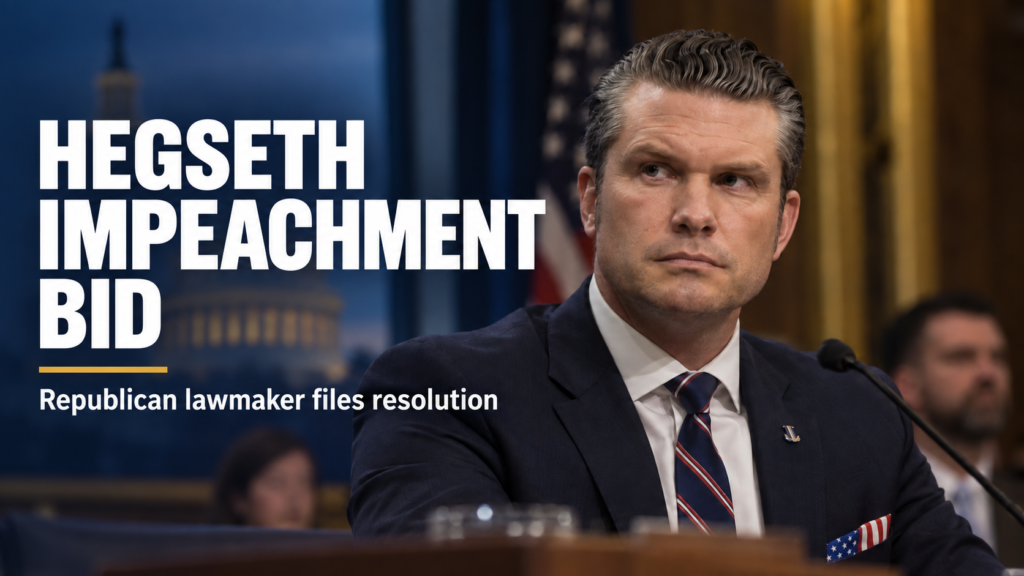
WASHINGTON: Republican Representative Thomas Massie has introduced a resolution seeking to impeach US Defence Secretary Pete Hegseth, bringing a dispute over the Iran war and Congress’s authority into a direct challenge against a senior member of President Donald Trump’s administration.
Massie presented the articles in the House of Representatives on Tuesday, 15 September. He alleges that Hegseth continued hostilities against Iran without the approval required from Congress. The resolution also raises allegations concerning other uses of military power and Hegseth’s conduct in office.
Articles of impeachment have been introduced. The House has not impeached Hegseth, and he remains in office. The claims in Massie’s resolution are allegations, not established findings.
What does the resolution allege?
At the centre of Massie’s case is the argument that US military operations against Iran have continued without congressional authorisation. His resolution alleges violations of the War Powers Resolution, the law intended to limit how long a president can engage US forces in hostilities without Congress’s approval.
The wider set of articles also challenges Hegseth’s actions in relation to military strikes on vessels suspected of drug trafficking, operations in Yemen, the US operation involving Venezuelan President Nicolás Maduro and the Pentagon’s treatment of Senator Mark Kelly. These are Massie’s accusations; their inclusion in an impeachment resolution does not establish wrongdoing.
The Pentagon has rejected the thrust of the challenge. Its press secretary, Kingsley Wilson, defended Hegseth’s leadership and said the department remained united behind his vision.
Will there be an impeachment vote?
Massie introduced the measure as a privileged resolution, a procedural route that can require the House to address it quickly. House leaders could seek to table the proposal rather than hold a vote on the impeachment allegations themselves.
Its immediate timetable is now in doubt. House Speaker Mike Johnson has announced that Thursday’s votes will be cancelled as lawmakers leave for their pre-election recess earlier than planned.
Why does it matter?
The move is unusual because the impeachment effort comes from a Republican against a defence secretary serving under a Republican president. It also places the constitutional dispute over the Iran war before lawmakers ahead of the November midterm elections.
A separate vote on war powers underscores the division. On Tuesday, the House passed a measure seeking to halt US military operations against Iran without congressional authorisation by 220 votes to 204, with seven Republicans joining Democrats. That measure is distinct from Massie’s impeachment resolution.
A House vote in favour would bring formal impeachment charges. Removal from office would require a subsequent trial and conviction in the Senate. Introducing articles alone does neither.
For now, Hegseth remains Defence Secretary, and Massie’s resolution has not succeeded. The next development to watch is whether House leaders bring the measure up when lawmakers return or move to dismiss it.