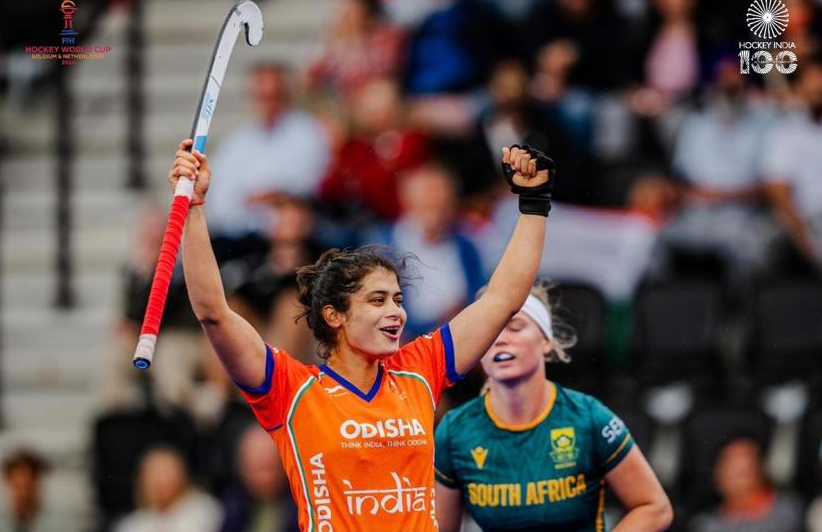
India produced their most commanding performance of the FIH Women’s Hockey World Cup 2026 so far, dismantling South Africa 6-1 in Pool D with six different scorers and a relentless attacking display in Amstelveen.
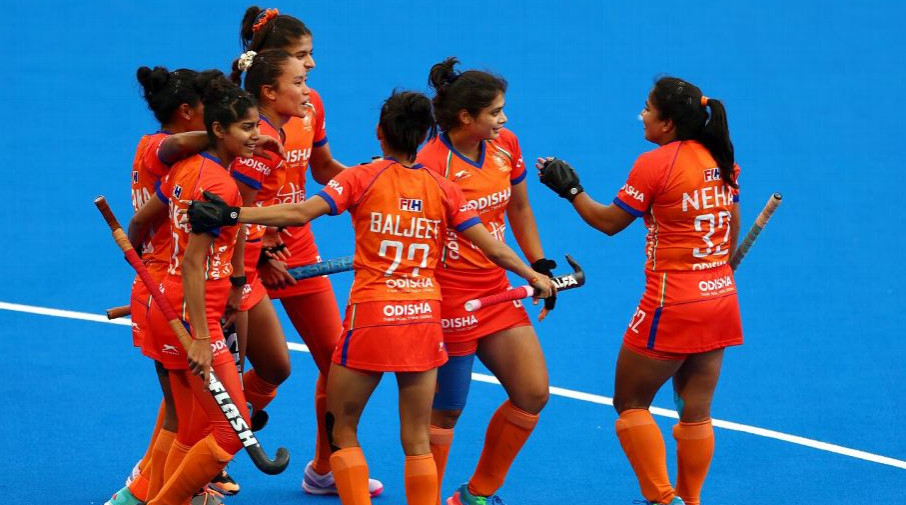
India delivered a statement performance in their second Pool D fixture of the FIH Women’s Hockey World Cup 2026, sweeping aside South Africa 6-1 in Amstelveen.
Six different Indian players found the net as the team combined aggressive pressing, rapid ball circulation and repeated circle penetration to overwhelm a South African defence that struggled to contain India’s width and movement.
Sunelita Toppo, Navneet Kaur, Sushila Chanu, Deepika Sehrawat, Lalremsiami and Sakshi Rana all scored before Kayla de Waal grabbed a late consolation for South Africa.
More importantly, the result moved India to four points from two matches and placed them in a strong position ahead of their decisive final Pool D contest against England.
India Take Control From the Opening Quarter
India entered the contest knowing goal difference could become important in a tightly contested Pool D and immediately attempted to impose themselves higher up the pitch.
Rather than allowing South Africa time to build from the back, India’s forwards pushed aggressively onto the first receiver while the midfield stepped up behind them to compress the playing area.
The pressure produced the breakthrough in the 11th minute.
Sunelita Toppo reacted quickest after sustained pressure near the baseline and converted to put India 1-0 ahead.
It was the type of opening India needed – early control, an early goal and no opportunity for South Africa to settle into their defensive structure.
Navneet Kaur and Sushila Chanu Stretch India’s Lead
India’s attacking momentum continued into the second quarter.
In the 17th minute, Navneet Kaur doubled the lead following a penalty-corner sequence, giving India the breathing room their dominance deserved.
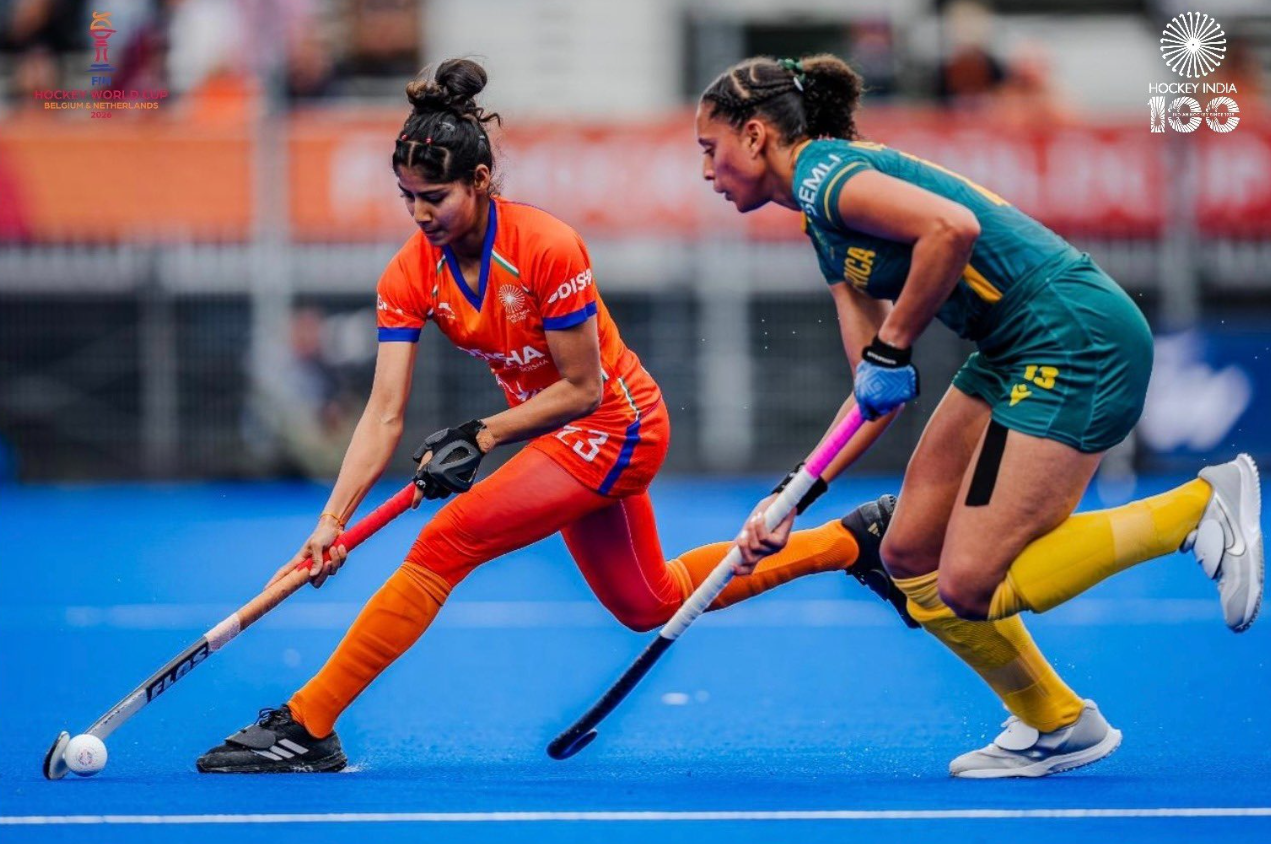
South Africa attempted to defend deeper and close the centre of the circle, but that created additional room for India to attack through the flanks and work the ball towards the baseline.
The third goal followed in the 25th minute, when Sushila Chanu reacted to a deflection generated from a Deepika penalty-corner attempt and steered the ball home.
India went into half-time 3-0 ahead, firmly in control of the contest.
India vs South Africa Match Timeline
Sunelita Toppo converts after sustained Indian pressure around the South African baseline and circle.
Navneet Kaur capitalises on a penalty-corner routine as India double their advantage.
Sushila Chanu reacts to a deflected penalty-corner attempt and puts India three goals clear.
Deepika attacks from the right channel and finishes with a powerful strike to extend India’s dominance.
Lalremsiami finds space inside the attacking circle and drives a powerful finish past the goalkeeper.
India strike again almost immediately as Sakshi Rana completes a rapid attacking combination.
Kayla de Waal converts from a penalty-corner deflection to score South Africa’s consolation goal.
India complete a dominant five-goal victory and strengthen their qualification position in Pool D.
India’s most effective weapon was their ability to turn possession into immediate attacking pressure. Their structure frequently resembled a high-pressing 3-4-3 shape in possession, with players maintaining width while midfield runners attacked the spaces created between South Africa’s defensive lines.
The key difference from India’s opening match against China was the speed of their circulation in the attacking half. Rather than holding possession harmlessly, India repeatedly switched the point of attack and used quick passes towards the baseline to force South Africa’s defensive unit to rotate.
South Africa attempted to remain compact in a deeper defensive shape and counter when possession changed. However, India’s counter-press prevented many of those transitions from developing and repeatedly returned the ball to the Indian attack.
Third Quarter Turns Into an Indian Goal Rush
If South Africa hoped half-time would interrupt India’s rhythm, the third quarter produced the opposite effect.
India increased the speed of their attacks and started finding larger gaps around the edge of the circle as South Africa struggled to maintain their defensive spacing.
Deepika Sehrawat made it 4-0 in the 38th minute, producing a powerful finish that effectively removed any realistic prospect of a South African comeback.
India were not finished.
Lalremsiami struck in the 44th minute before Sakshi Rana added another only a minute later.
Three goals in the third quarter transformed a comfortable victory into a rout and demonstrated the attacking depth within India’s squad.

Salima Tete Drives India’s Press From Midfield
While the six goals were shared across the team, India’s midfield control was equally important to the performance.
Captain Salima Tete helped India maintain their attacking tempo by carrying possession forward quickly and ensuring South Africa could not easily escape pressure after turnovers.
India’s midfield repeatedly recovered second balls around the attacking 25, allowing the forwards to remain high rather than retreating to rebuild attacks from deeper areas.
That territorial pressure was one of the clearest explanations for India’s repeated circle entries and the volume of shooting opportunities they created.
India vs South Africa Match Statistics
| Metric | India | South Africa |
|---|---|---|
| Final Score | 6 | 1 |
| Field Goals | 4 | 0 |
| Penalty Corner Goals | 2 | 1 |
| Circle Entries | 29 | 11 |
| Shots on Target | 14 | 4 |
- Relentless pressing: India repeatedly regained possession before South Africa could establish counter-attacks.
- Width in attack: India’s movement on both flanks stretched South Africa’s defensive structure.
- Six different scorers: The goals were distributed across midfielders and forwards rather than relying on one player.
- Circle-entry dominance: India’s 29 circle entries reflected their sustained territorial control.
- Third-quarter acceleration: Three goals between the 38th and 45th minutes effectively finished the contest.
Six Different Scorers Highlight India’s Attacking Depth
One of the most encouraging aspects of the performance was the distribution of India’s goals.
Rather than relying solely on a penalty-corner specialist or one prolific forward, six different players scored India’s six goals.
Sunelita Toppo opened the scoring, Navneet Kaur and Sushila Chanu extended the lead, Deepika Sehrawat added the fourth before Lalremsiami and Sakshi Rana completed the attacking surge.
That diversity makes India considerably more difficult to defend because opponents cannot concentrate their defensive plan on stopping one primary scoring route.
South Africa Grab Late Consolation
With the contest effectively decided, South Africa continued searching for a goal rather than simply attempting to limit the damage.
They were rewarded in the 55th minute when Kayla de Waal converted following a penalty-corner situation.
The goal prevented India from securing a clean sheet but did little to alter the overall picture of a match dominated by the Indian attack.
Women’s Pool D Points Table
| Pos | Team | P | W | D | L | Pts | GD |
|---|---|---|---|---|---|---|---|
| 1 | India | 2 | 1 | 1 | 0 | 4 | +5 |
| 2 | China | 2 | 1 | 1 | 0 | 4 | +2 |
| 3 | England | 2 | 1 | 0 | 1 | 3 | +2 |
| 4 | South Africa | 2 | 0 | 0 | 2 | 0 | -9 |
What the Result Means for India
India’s five-goal victory significantly strengthened their position in Pool D.
After drawing their opening match against China, India now have four points from two matches and a substantially improved goal difference.
China are also on four points, while England remain close behind on three, meaning the final round will determine the teams progressing from the group.
India’s emphatic margin against South Africa could therefore prove extremely valuable if qualification eventually comes down to goal difference.
India vs England Becomes the Qualification Decider
India’s final Pool D match against England will now determine whether they progress safely into the next stage.
A draw would guarantee India a top-two finish, while victory would strengthen their position further and could carry additional significance under the tournament’s second-stage format.
The challenge will be substantially greater than the one posed by South Africa. England possess the ability to press more aggressively, defend the midfield more compactly and punish turnovers in transition.
India will therefore need to reproduce the speed, width and attacking confidence shown in this 6-1 victory while remaining disciplined when possession changes hands.
India’s success against South Africa came from playing forward quickly rather than allowing possession to become passive. Their midfield moved the ball into wide channels early, forwards attacked the baseline and the counter-press prevented South Africa from relieving pressure.
Against England, maintaining that attacking ambition will be important, but India will also need greater balance behind the ball because England are likely to offer a much stronger transition threat.
India’s 6-1 demolition of South Africa was more than just a victory — it was the attacking performance their World Cup campaign needed.
Six different scorers, repeated circle penetration and three goals in a devastating third-quarter burst demonstrated the depth and tempo India can produce when their press and attacking structure work together.
Salima Tete’s side controlled territory, recovered possession aggressively and stretched South Africa across the width of the pitch. The only blemish was the late goal conceded from a penalty corner.
The bigger test now arrives against England. India have placed themselves in a strong qualification position, but Thursday’s final Pool D encounter will determine whether this emphatic victory becomes the launchpad for a deeper World Cup run.