📅 August 16, 2026 | By Pulse India Sports Desk
Harmanpreet Singh’s Brace Powers India Past Wales in Hockey World Cup Opener
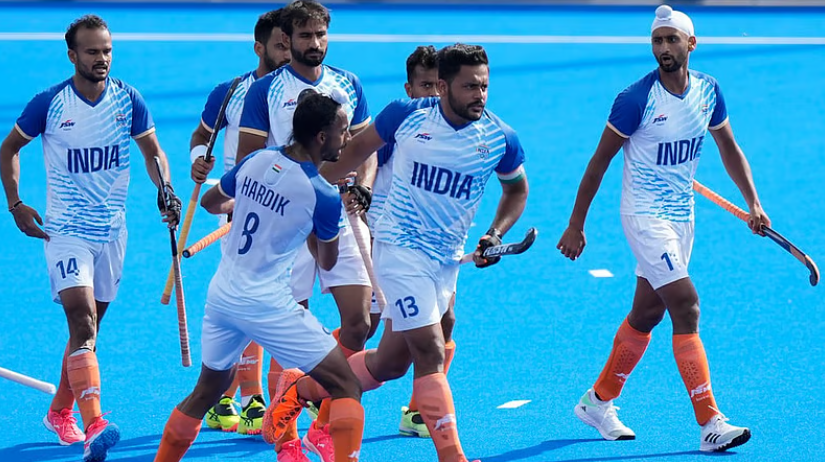
India opened their FIH Men’s Hockey World Cup 2026 campaign with a convincing 3-1 victory over Wales at the Wagener Hockey Stadium in Amstelveen, delivering an encouraging performance built around penalty-corner efficiency, territorial control and a disciplined defensive structure.
Sanjay opened the scoring in the eighth minute before captain Harmanpreet Singh struck twice from penalty corners in the 11th and 43rd minutes. Sam Welsh pulled one back for Wales late in the fourth quarter, but India remained composed to secure all three points.
| Match | India vs Wales |
| Competition | FIH Men’s Hockey World Cup 2026 – Pool D |
| Venue | Wagener Hockey Stadium, Amstelveen, Netherlands |
| Final Score | India 3-1 Wales |
| India Goals | Sanjay 8′, Harmanpreet Singh 11′, 43′ |
| Wales Goal | Sam Welsh 56′ |
| Player of Match | Harmanpreet Singh |
| India Next Match | India vs England – 17 August 2026 |
India scored all three goals from penalty corners, underlining the continued importance of their drag-flick battery. Harmanpreet Singh converted twice, while Sanjay scored India’s opener from a retaken penalty corner.
The result was comfortable, but the performance also highlighted an area India will want to improve: despite creating several promising attacks from open play, they were unable to score a field goal.
India 3-1 Wales: Match Review
Wales actually began the contest with confidence and made a couple of early circle entries, forcing India’s defence to remain alert.
Goalkeeper Suraj Karkera dealt with the early threat before India gradually began to establish greater control through patient possession and quick movement down the flanks.
The pattern of the contest changed sharply once India earned their first penalty corner. From that point onward, India’s set-piece threat became the defining tactical factor of the match.
🏑 Sanjay Gives India the Perfect Start
India earned their first penalty corner in the seventh minute after Dilpreet Singh helped create an opening inside the Welsh circle.
Sanjay’s initial drag-flick was blocked by the first rusher, but the ball struck a defender’s foot and India were awarded a retake.
On the second attempt, Sanjay found a way through the Welsh defence to give India a 1-0 lead in the eighth minute.
🏑 Harmanpreet Makes it 2-0 Three Minutes Later
India did not allow Wales any time to recover.
Another penalty corner arrived in the 11th minute after a challenge on Sanjay, and this time Harmanpreet Singh stepped up.
The Indian captain produced a precise drag-flick to beat the Welsh defence and double India’s advantage.
At 2-0 after only 11 minutes, India had established the kind of early cushion that allowed them to control the pace of the game rather than constantly chase attacking opportunities.
First Quarter: India’s Penalty Corners Change the Match
The first quarter revealed both India’s biggest strength and the central tactical problem facing Wales.
Whenever India entered the circle at speed, Wales struggled to defend cleanly. Those defensive interventions repeatedly created penalty-corner opportunities, bringing India’s most dangerous weapon into play.
Harmanpreet and Sanjay gave India multiple drag-flick options, making it harder for Wales to commit their runners towards one specific shooter.
Wales Improve in the Second Quarter
The second quarter was much tighter.
Wales became more compact defensively and reduced the space available around the top of the circle. India continued to enjoy possession and territory but were unable to add a third goal before half-time.
Wales also produced one of their clearest opportunities in the 19th minute when Jack Pritchard found space inside India’s circle following a long pass.
Mohith HS, who had replaced Karkera as part of India’s goalkeeper rotation, rushed from his line and narrowed the angle effectively, forcing the attempt away from goal.
India Create Chances but Field Goal Remains Missing
India continued to generate promising attacking situations through Abhishek, Sukhjeet Singh, Mandeep Singh and Rajinder Singh.
The ball movement was often sharp, particularly when India switched play quickly from one flank to the other.
However, the finishing touch from open play was missing.
That is perhaps the main area coach Craig Fulton will examine before the more difficult Pool D fixtures. Penalty corners can decide major matches, but India will also need greater output from their forwards if opponents manage to limit set-piece opportunities.
India Stretch Wales Through the Flanks
India began the second half by using the width of the pitch effectively.
Rather than forcing passes directly through Wales’ central defensive block, India moved the ball rapidly towards the sidelines and attempted to attack around the outside.
This gradually stretched Wales’ midfield and created more space around the circle.
The pressure eventually resulted in another penalty corner late in the third quarter.
🚀 Harmanpreet’s Second Drag-Flick Makes it 3-0
India’s third goal arrived in the 43rd minute.
Harmanpreet again took responsibility from the penalty corner and fired a powerful grounded drag-flick beyond the goalkeeper to the left.
It was his second goal of the match and effectively put the result beyond Wales heading into the final quarter.
India Push for a Fourth Goal
India continued to play positively after moving three goals ahead rather than dropping into a purely defensive structure.
Shilanand Lakra nearly scored in the 53rd minute after attempting to lift the ball over the goalkeeper from close range, but Toby Reynolds-Cotterill reacted well to keep it out.
That was part of a wider spell in which India repeatedly entered the Welsh circle without finding the fourth goal.
🧤 Mohith Produces Crucial Penalty-Corner Save
Wales earned a penalty corner in the 54th minute and finally had an opportunity to test India’s defensive set-piece unit.
Mohith responded with an excellent save, deflecting away a powerful drag-flick that appeared to be heading towards goal.
Although India eventually conceded two minutes later, Mohith’s intervention was another encouraging moment for India’s goalkeeping unit.
🏑 Sam Welsh Pulls One Back After Video Review
Wales finally found a breakthrough in the 56th minute during a crowded goalmouth sequence.
The incident went to video review amid questions over a possible infringement near the goal line.
The review determined that the ball had crossed the line before the relevant offence, and Sam Welsh was awarded the goal.
The score was reduced to 3-1, but India remained calm through the remaining minutes and prevented Wales from creating a dramatic finish.
India vs Wales Match Timeline
8′ – India 1-0: Sanjay scores from a retaken penalty corner.
11′ – India 2-0: Harmanpreet Singh converts India’s next penalty corner.
Half-time: India lead 2-0 after controlling most of the opening 30 minutes.
43′ – India 3-0: Harmanpreet scores his second penalty-corner goal.
54′: Mohith makes an important penalty-corner save for India.
56′ – India 3-1: Sam Welsh scores after a video review.
60′: India close out the contest and collect three points.
🔎 Tactical Analysis: Why India Controlled the Match
The clearest difference between the teams was India’s efficiency from penalty corners. Every Indian goal came from a set piece, with Harmanpreet converting twice and Sanjay adding another.
India repeatedly moved the ball towards the flanks before attacking the Welsh circle. This forced Wales to defend across the full width of the pitch and gradually opened gaps around the defensive line.
India were able to spend long periods inside Wales’ half because their defenders stepped forward aggressively and helped recover loose possession before Wales could develop counterattacks.
Both Indian goalkeepers were involved. Karkera handled Wales’ early pressure, while Mohith produced key interventions later in the game, including an important penalty-corner save.
Despite controlling territory and creating several open-play opportunities, India’s three goals all came from penalty corners. Against stronger opposition, converting field chances will become increasingly important.
What India Did Well
Penalty-corner conversion: India’s biggest match-winning weapon worked immediately.
Fast start: Two goals inside the opening 11 minutes prevented Wales from settling.
Control of territory: India spent long periods attacking inside the Welsh half.
Defensive composure: Wales created occasional chances but were rarely able to build sustained pressure.
Game management: India never allowed the late Welsh goal to create panic.
What India Need to Improve
Field goals: Harmanpreet himself acknowledged after the match that India need to create and convert more chances from open play.
Final-third efficiency: Several promising attacks ended without a decisive final touch.
Late defensive concentration: The 56th-minute goal prevented India from keeping a clean sheet and showed why concentration must remain high even with a comfortable lead.
Transition defence: Wales produced a few dangerous moments through long passes and quick breaks, an area England could exploit more effectively.
⭐ India’s Top Performers
Harmanpreet Singh: Two penalty-corner goals and another captain’s performance under pressure.
Sanjay: Scored India’s first goal and helped establish control in the opening quarter.
Mohith HS: Produced a key one-on-one intervention and a strong penalty-corner save.
India’s midfield: Helped dominate possession, recycle the ball and consistently shift the point of attack.
📊 Pool D After Opening Matches
| Pos | Team | P | W | D | L | GF | GA | GD | Pts |
|---|---|---|---|---|---|---|---|---|---|
| 1 | England | 1 | 1 | 0 | 0 | 4 | 1 | +3 | 3 |
| 2 | India | 1 | 1 | 0 | 0 | 3 | 1 | +2 | 3 |
| 3 | Wales | 1 | 0 | 0 | 1 | 1 | 3 | -2 | 0 |
| 4 | Pakistan | 1 | 0 | 0 | 1 | 1 | 4 | -3 | 0 |
England sit top of Pool D on goal difference after beating Pakistan 4-1, while India are second following their 3-1 victory over Wales.
India vs England Is Now the Key Pool D Clash
India’s next match against England on August 17 could play a major role in deciding who takes control of Pool D.
Both teams began their campaigns with victories, but England currently hold the advantage on goal difference after their 4-1 win over Pakistan.
The challenge will be significantly greater for India. England are likely to press with greater intensity than Wales and punish turnovers more aggressively.
India’s penalty-corner strength gives them a major weapon, but their forwards may need to contribute field goals if they are to secure another three points.
What the Wales Win Means for India
Opening matches at a World Cup can often be awkward, particularly against an opponent with little pressure and a willingness to defend aggressively.
India avoided that trap.
The early goals allowed Harmanpreet’s side to dictate the match, conserve control and enter the second round of Pool D fixtures with three points already secured.
More importantly, the victory provides confidence ahead of matches against England and Pakistan, where the tactical margins are likely to become considerably smaller.
India’s 3-1 win over Wales was exactly the kind of start they needed at the FIH Men’s Hockey World Cup 2026.
Harmanpreet Singh’s penalty-corner quality provided the decisive edge, while Sanjay’s early goal ensured India were never forced to chase the match.
There were also encouraging signs in India’s possession structure, goalkeeper performance and ability to attack through the flanks.
The biggest question remains open-play finishing. India created enough opportunities to score more than three goals but relied entirely on penalty corners.
A professional opening win — but England on August 17 will provide a much stronger test of India’s World Cup ambitions.
India Goals: Sanjay 8′, Harmanpreet Singh 11′, 43′
Wales Goal: Sam Welsh 56′
Player of the Match: Harmanpreet Singh ⭐
India Status: 3 points from opening match
Next Match: India vs England – August 17, 2026
FIH Hockey World Cup 2026 India vs Wales IND vs WAL Hockey India Hockey Harmanpreet Singh Sanjay Hockey Men’s Hockey World Cup Hockey World Cup 2026 Team India Hockey Pool D India vs England Hockey Amstelveen Wagener Stadium
🏆 Related Sports Stories
- Devdutt Padikkal’s Maiden Century Puts India in Command Against Sri Lanka
- Women’s T20 Asia Cup 2026: Full Schedule, India Squad and Live Streaming Details
Follow Pulse India News for the latest Indian sports news, Hockey World Cup 2026 updates, cricket reports, match reviews and analysis.