Commissioning of the second indigenous Nistar-class Diving Support Vessel gives India dedicated deep-sea diving and submarine-rescue support on both the eastern and western seaboards.
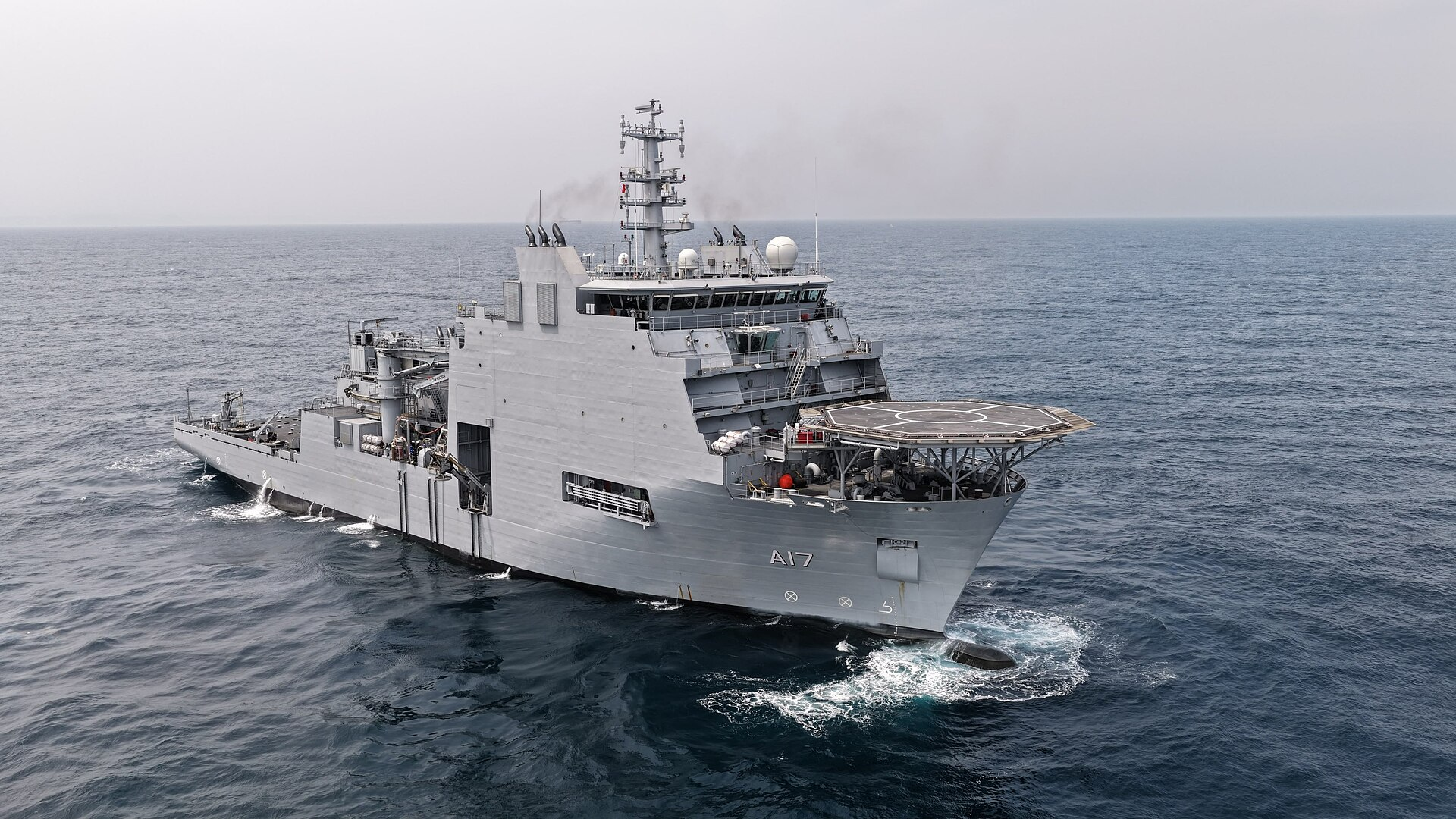
The Indian Navy commissioned INS Nipun at the Naval Dockyard in Mumbai on Monday, 31 August 2026, adding a powerful specialist platform for deep-sea diving, underwater intervention, salvage and submarine rescue. The ship is the second vessel of the indigenous Nistar class and will operate under the Western Naval Command, complementing INS Nistar on India’s eastern seaboard.
Chief of the Naval Staff Admiral Krishna Swaminathan presided over the ceremony in the presence of Vice Admiral Sanjay Vatsayan, Flag Officer Commanding-in-Chief, Western Naval Command, senior naval officers, representatives of Hindustan Shipyard Limited, veterans and families of the commissioning crew.
INS Nipun was designed and constructed by Hindustan Shipyard Limited at Visakhapatnam and delivered to the Navy on 30 July 2026. Its induction completes a two-ship class intended to give the Navy sustained access to highly specialised underwater capabilities on both coasts.
- Second indigenous Nistar-class Diving Support Vessel and the sister ship of INS Nistar.
- Built by Hindustan Shipyard Limited and classified under Indian Register of Shipping rules.
- Supports saturation, air and heliox diving, underwater inspection, intervention and salvage.
- Designed to act as a mother ship for a Deep Submergence Rescue Vehicle during submarine emergencies.
- Nearly 75% indigenous content was reported by the Ministry of Defence at the time of delivery.
Why INS Nipun is more than an ordinary support ship
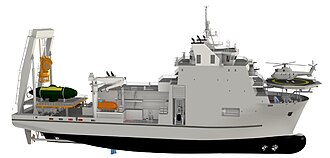
A Diving Support Vessel is essentially a floating deep-sea operations base. Unlike a destroyer or frigate, INS Nipun is not centred on offensive missile firepower. Its operational value comes from combining diving chambers, life-support systems, underwater vehicles, medical support and precise station-keeping equipment on one self-sustaining platform.
The vessel can hold position above a work or rescue site while divers, a diving bell, remotely operated vehicles or a submarine-rescue vehicle operate below. Precise station-keeping is critical because uncontrolled ship movement caused by waves, wind or current could place divers and connected underwater systems at serious risk.
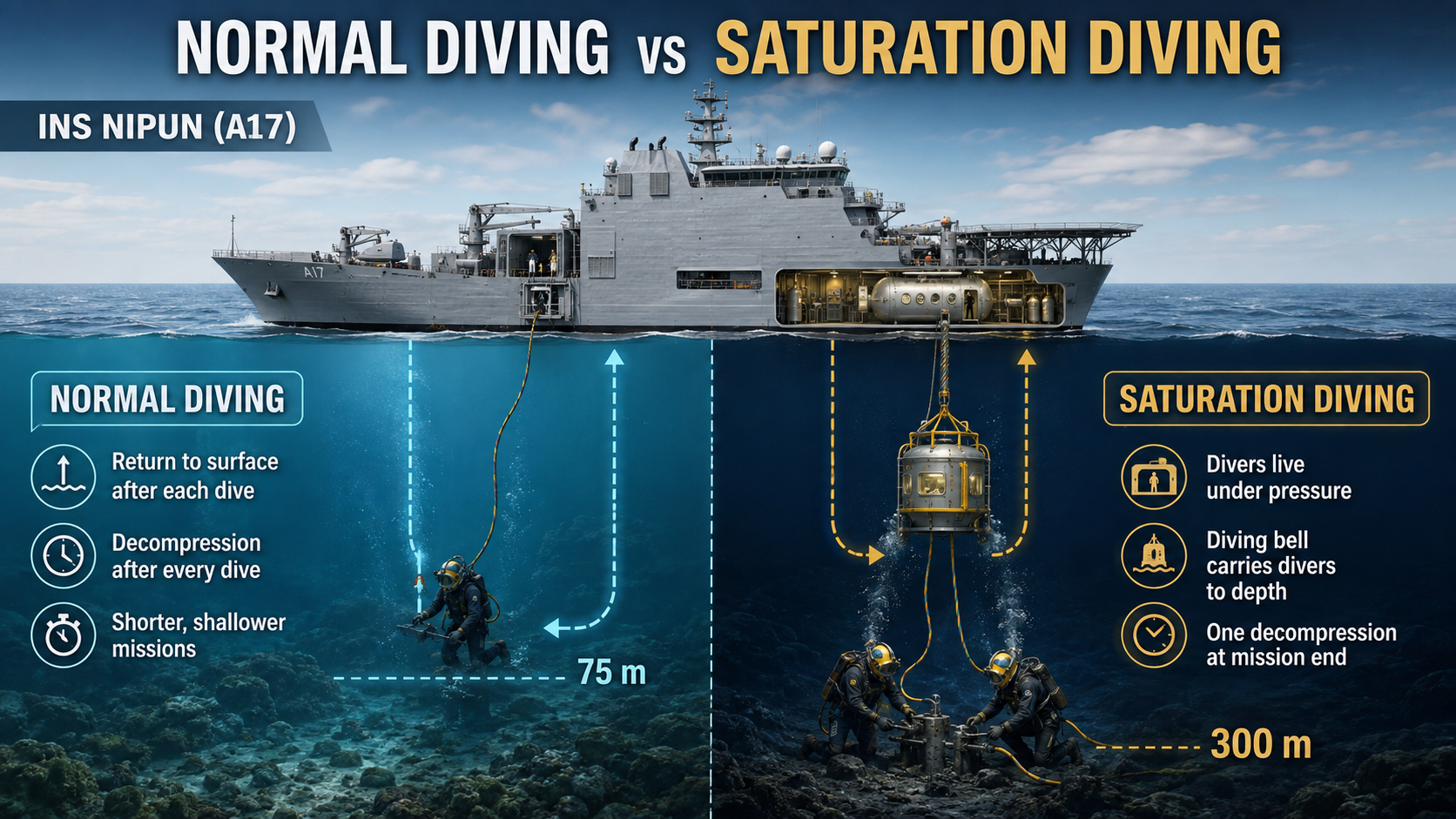
How saturation diving works
At great depth, pressure causes inert gases in a diver’s breathing mixture to dissolve into body tissues. Repeatedly ascending and decompressing after every work period would sharply limit the time available underwater. Saturation diving solves this problem by allowing divers to live in a pressurised chamber complex aboard the ship for an extended mission.
Divers travel between the chamber and the work site inside a sealed diving bell. Their bodies remain at the working pressure, and they undergo one controlled decompression sequence at the end of the mission. INS Nipun can support saturation diving as well as air and helium-oxygen, or heliox, diving for different depths and operational requirements.
INS Nipun technical specifications and capabilities
| Specification | Verified detail | Operational purpose |
|---|---|---|
| Type | Nistar-class Diving Support Vessel | Deep-sea diving, underwater intervention, salvage and submarine rescue |
| Builder | Hindustan Shipyard Limited, Visakhapatnam | Indigenously designed and constructed specialist naval platform |
| Classification | Indian Register of Shipping rules | Construction and certification to applicable marine-class standards |
| Length | 118.4 metres | Space for diving, medical, rescue and underwater-support systems |
| Maximum breadth | 22.8 metres | Provides stability and working area for deep-sea operations |
| Displacement | 9,350 tonnes in the original design description; official commissioning material describes the loaded ship as approximately or above 10,000 tonnes | Reflects the size of the integrated support and rescue platform |
| Diving capability | Saturation diving to 300 metres; side-stage diving to 75 metres | Supports prolonged deep-water work and conventional diving missions |
| Underwater vehicles | Remotely Operated Vehicles for diver monitoring and salvage to 1,000 metres | Inspection and intervention where human diving is unsafe or impractical |
| Submarine rescue | Can embark and support a Deep Submergence Rescue Vehicle | Evacuates personnel from a disabled submarine on the seabed |
| Diving modes | Saturation, air and heliox diving | Supports different mission depths and breathing-gas requirements |
| Station-keeping | Dynamic-positioning and precision navigation systems | Maintains a safe position above divers, bells and rescue vehicles |
| Medical systems | Life-support, compression and decompression facilities | Supports rescued submariners and diving casualties |
| Aviation support | Capable of helicopter operations at sea | Medical evacuation, logistics, search and mission support |
How INS Nipun would respond to a submarine emergency
If a submarine becomes disabled on the seabed, time becomes the most critical factor. The support ship must reach the area, locate and inspect the submarine, clear debris around its rescue hatch and establish a stable operating position. A Deep Submergence Rescue Vehicle can then descend, mate with the submarine’s hatch and evacuate sailors in groups.
INS Nipun provides the launch, recovery, command, medical and logistical infrastructure required to sustain that mission. Its ROVs can first inspect the disabled submarine and monitor conditions. Rescued personnel can then receive medical assessment and controlled hyperbaric treatment if they have been exposed to abnormal pressure.
This is why the support ship matters as much as the rescue vehicle itself: without a stable mothership, specialised crews, decompression facilities and an integrated command system, a DSRV cannot deliver a complete rescue response.
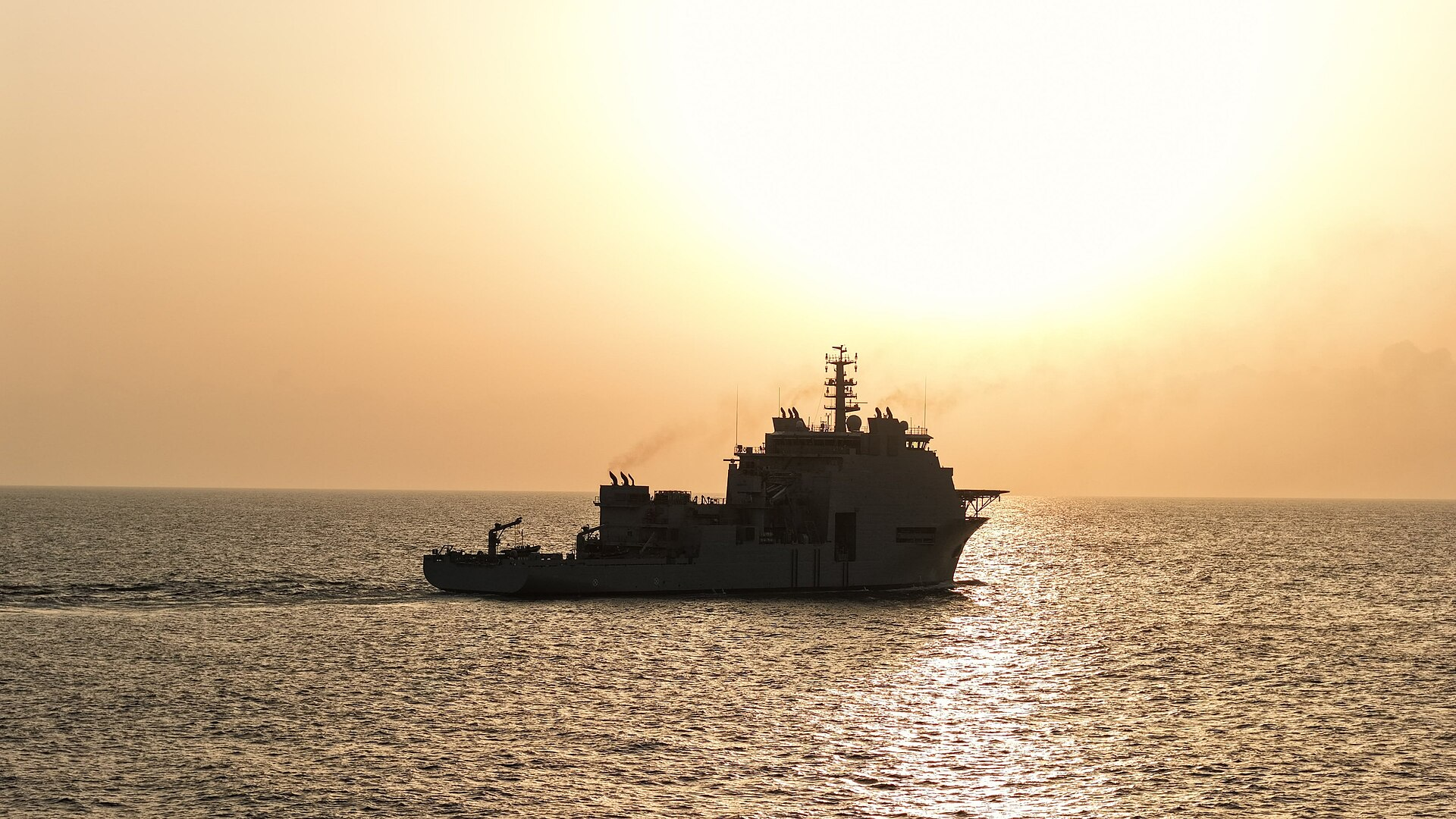
Ships of the Nistar class
| Name | Pennant | Yard No. | Keel laid | Launched | Delivered | Commissioned | Home port | Status |
|---|---|---|---|---|---|---|---|---|
| INS Nistar | A16 | 11190 | 28 Dec 2019 | 22 Sep 2022 | 8 Jul 2025 | 18 Jul 2025 | Visakhapatnam | Active |
| INS Nipun | A17 | 11191 | 23 Mar 2020 | 22 Sep 2022 | 30 Jul 2026 | 31 Aug 2026 | Mumbai | Active |
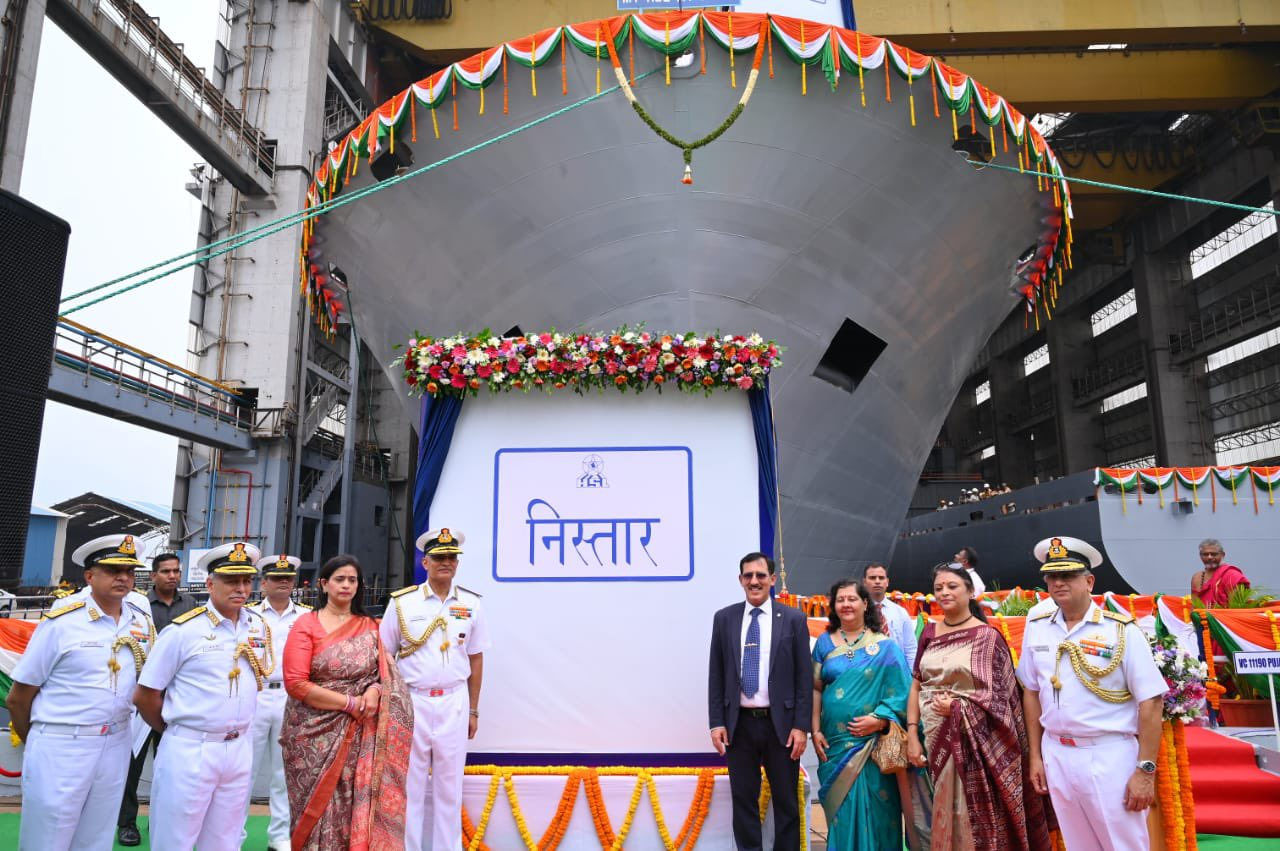
Which countries possess comparable submarine-rescue technology?
The Indian Navy has said that only a limited group of navies operates this combination of deep-sea diving, underwater intervention and submarine-rescue capability. The systems are not identical: some countries use dedicated rescue ships, while others maintain air-transportable rescue modules that can be installed on a suitable vessel of opportunity.
| Country or group | Representative capability | How it compares |
|---|---|---|
| India | INS Nistar and INS Nipun with Indian Navy DSRV units | Dedicated indigenous Diving Support Vessels serving the eastern and western seaboards |
| United States | Submarine Rescue Diving and Recompression System | Rapidly deployable system installed on a vessel of opportunity; designed for rescue down to about 610 metres |
| France, Norway and United Kingdom | NATO Submarine Rescue System | Jointly owned, transportable rescue system capable of operating at around 600 metres |
| Japan | JS Chiyoda with DSRV, ROV and hyperbaric facilities | Dedicated submarine-rescue ship combining underwater search, rescue and medical support |
| Singapore | MV Swift Rescue and DSAR 6 | Dedicated rescue mothership; DSAR 6 is rated to 500 metres and can carry 17 rescued personnel per trip |
| South Korea | Cheonghaejin-class and newer submarine-rescue assets | Dedicated ships and DSRVs supporting the Republic of Korea Navy’s submarine force |
| Russia | Igor Belousov and Bester-series rescue submersibles | Dedicated search-and-rescue ship with deep-submergence rescue capability |
| China | Type 925/926 submarine-support and rescue ships with DSRVs | Dedicated platforms for submarine support, deep-sea rescue and salvage |
This is a representative rather than exhaustive list. Italy, Sweden and other submarine-operating nations also contribute specialist rescue vehicles, diving systems or multinational rescue arrangements. International interoperability is essential because the nearest capable rescue system may belong to a partner navy rather than the country operating the distressed submarine.
India has already demonstrated the capability overseas
INS Nistar demonstrated the class’s wider strategic value during Exercise Pacific Reach 2025 in Singapore. The Indian Navy’s Submarine Rescue Unit operated alongside Singapore’s MV Swift Rescue and Japan’s JS Chiyoda, while the Indian DSRV conducted mating drills with foreign submarines.
According to the Ministry of Defence, the Indian system achieved a historic first mating with South Korea’s submarine Shin Dol-Seok and later mated with Singapore’s RSS Invincible. During the exercise’s concluding rescue drill, INS Nistar helped localise and survey the simulated accident site before the rescue assets were deployed.
That deployment showed that the Nistar class is not limited to supporting Indian submarines. It can also contribute to multinational rescue missions, strengthening India’s stated role as a preferred submarine-rescue partner across the Indian Ocean and wider Indo-Pacific.
A boost for the Western Naval Command
INS Nistar is based on the eastern seaboard, while INS Nipun will strengthen the Western Naval Command. This two-coast distribution can reduce mobilisation time during an emergency in the Arabian Sea, Bay of Bengal or the wider Indian Ocean, where long distances can directly affect the chances of a successful rescue.
The platform also has peacetime and non-combat applications. Its divers, ROVs, medical facilities and underwater equipment can support salvage, inspection of submerged infrastructure, recovery after maritime accidents and Humanitarian Assistance and Disaster Relief operations.
Another milestone for indigenous shipbuilding
The Ministry of Defence said Nipun was delivered with nearly 75% indigenous content. At the joint launch in 2022, the wider DSV project had achieved approximately 80% indigenous content and involved more than 120 Indian MSME vendors supplying equipment, materials and services.
Building a Diving Support Vessel is technically demanding because the ship must integrate marine engineering, precision navigation, hyperbaric medicine, life-support systems and underwater robotics. The completion of both Nistar-class ships shows that Indian shipyards can deliver complex specialist platforms in addition to conventional combat vessels.
Why INS Nipun matters
Submarine strength is not measured only by the number of boats a navy operates. A credible undersea force also needs rescue, repair, medical and recovery systems ready to respond when something goes wrong. INS Nipun fills that less visible but essential part of maritime preparedness.
With INS Nistar in the east and INS Nipun in the west, the Indian Navy now has a stronger two-coast framework for deep-sea diving, underwater intervention and submarine rescue. The commissioning is therefore more than the addition of another auxiliary ship—it is a major improvement in India’s ability to operate beneath the surface and save lives in one of the world’s most unforgiving environments.
- PIB: INS Nipun commissioned into the Indian Navy
- PIB: Delivery of the second indigenous Diving Support Vessel Nipun
- PIB: Nistar-class dimensions and original design displacement
- PIB: Joint launch of Nistar and Nipun
- PIB: Diving depths, side stage and ROV capabilities
- PIB: Commissioning and equipment of INS Nistar
- PIB: Indian submarine-rescue capability at Pacific Reach 2025
- United States Navy: Submarine Rescue Diving and Recompression System
- NATO: NATO Submarine Rescue System
- Singapore MINDEF: MV Swift Rescue and DSAR 6 fact sheet
- Japan MOD: Submarine Rescue Ship Chiyoda
- US Army ODIN: Russia’s Igor Belousov-class rescue ship
- US Army ODIN: South Korea’s Cheonghaejin-class submarine-rescue ship