By Pulse India News Desk
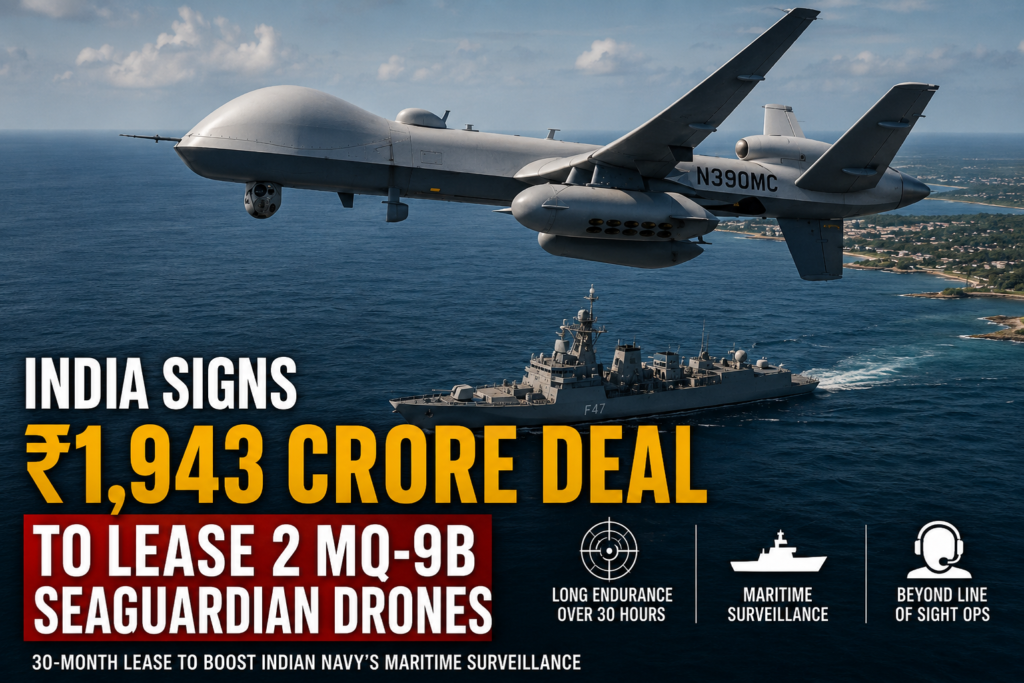
India has signed a ₹1,943-crore ($203 million) agreement to lease two MQ-9B SeaGuardian high-altitude, long-endurance unmanned aircraft for the Indian Navy, giving the service additional maritime surveillance capacity for the next 30 months.
By Pulse India News Desk
The contract with General Atomics Aeronautical Systems covers two MQ-9B SeaGuardian remotely piloted aircraft for a period of 30 months and is intended to strengthen the Indian Navy’s surveillance and reconnaissance capabilities.
The new agreement comes while India is already moving ahead with a much larger programme to buy 31 MQ-9B SkyGuardian and SeaGuardian aircraft for the three armed services.
That makes the latest deal strategically interesting. India is not choosing between leasing and buying the MQ-9B. It is using the two approaches for different purposes — leasing aircraft for near-term operational availability while simultaneously building a permanent MQ-9B fleet for the future.
What exactly has India signed?
India has entered into a 30-month lease for two MQ-9B SeaGuardian aircraft for the Indian Navy.
The agreement immediately stands apart from India’s 2024 MQ-9B deal because the Navy is not purchasing these two aircraft outright.
Instead, they are being made available for a defined operational period under a lease arrangement.
For the Navy, the important result is access to additional long-endurance unmanned surveillance capacity without having to wait for the full fleet being acquired under India’s separate 31-aircraft procurement programme.
What is the MQ-9B SeaGuardian?
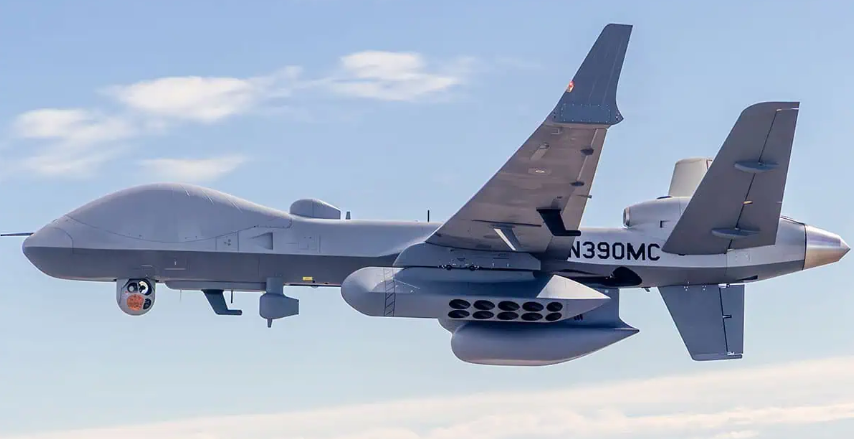
The MQ-9B SeaGuardian is the maritime-focused member of General Atomics’ MQ-9B remotely piloted aircraft family.
Unlike a relatively short-endurance tactical drone, SeaGuardian is designed to remain on station for very long periods, communicate beyond the horizon through satellite links and conduct surveillance during both day and night.
General Atomics says SeaGuardian can remain airborne for more than 30 hours depending on configuration, making persistence one of its most important operational advantages.
Its modular architecture allows different sensor packages to be fitted depending on the mission. These can include wide-area maritime radar, electro-optical and infrared sensors, Automatic Identification System receivers, electronic-support equipment and specialised anti-submarine warfare systems.
MQ-9B SeaGuardian specifications
| Specification | MQ-9B SeaGuardian |
|---|---|
| Type | Maritime High-Altitude / Long-Endurance RPAS |
| Wingspan | About 24 metres |
| Length | About 11.7 metres |
| Endurance | Over 30 hours depending on configuration; specialised configurations can reach higher endurance figures |
| Operating altitude | Above 40,000 ft in published configurations |
| Powerplant | Honeywell TPE331-10 turboprop |
| Control | Line-of-sight and satellite beyond-line-of-sight communications |
| Maritime sensors | Configurable maritime radar, EO/IR, AIS and Electronic Support Measures |
| ASW option | Sonobuoy dispensing, monitoring and acoustic-processing capability can be integrated |
Why long endurance changes maritime surveillance
Aircraft endurance is particularly important at sea because the area that must be monitored is enormous.
A conventional aircraft may spend a significant portion of its mission flying to and from the patrol area. A long-endurance unmanned system can arrive over a surveillance zone and remain there for many hours.
Persistent watch: Remain over an area far longer than most conventional crewed patrol sorties.
Large-area coverage: Maritime radar can search large stretches of ocean for vessels and unusual activity.
Target identification: EO/IR sensors can provide detailed imagery of selected contacts.
AIS correlation: Radar contacts can be compared with Automatic Identification System information transmitted by cooperating vessels.
Electronic surveillance: Configured ESM equipment can contribute to detecting and locating radio-frequency emitters.
Networked operations: Information can be relayed to naval commanders and other platforms through data links.
Why the Indian Navy needs persistent surveillance
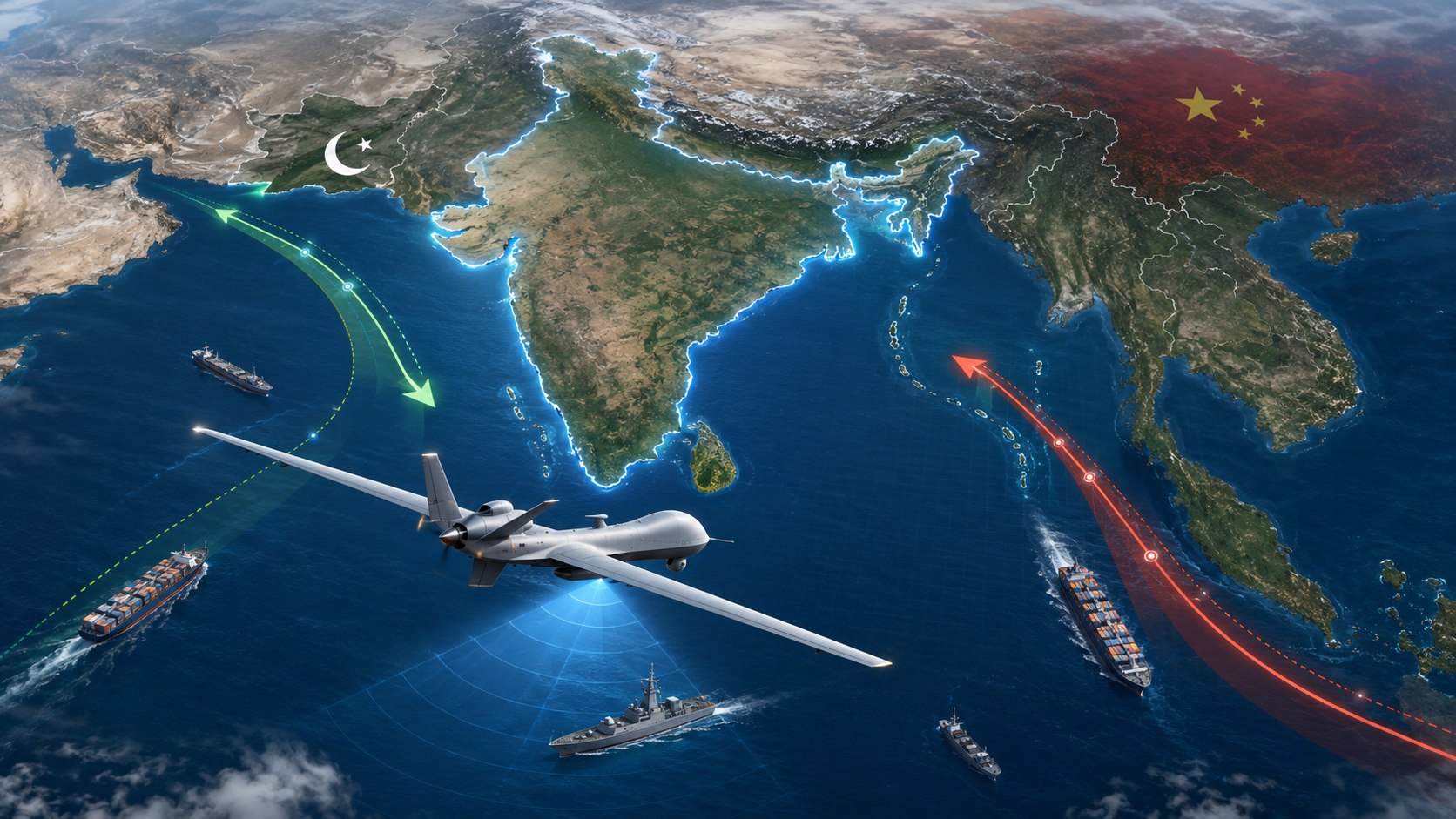
India’s coastline stretches across the Arabian Sea and Bay of Bengal, while the country’s island territories extend its strategic reach deep into the Indian Ocean.
The wider Indian Ocean also contains some of the world’s most important commercial and energy routes connecting the Persian Gulf, Africa and Europe with Southeast and East Asia.
For the Indian Navy, monitoring this environment means watching far more than ships immediately outside Indian territorial waters.
It requires persistent awareness of surface vessels, naval deployments, shipping movements, unusual maritime activity and strategically important approaches across a vast operating area.
How the MQ-9B can find and identify ships
A maritime surveillance drone does not rely on a single sensor.
Instead, different systems can be combined to build a more complete picture of what is happening at sea.
Wide-area maritime radar
The radar provides the broad search function. It can scan large sections of ocean and detect surface contacts beyond the visual range of the aircraft.
Electro-optical and infrared sensors
Once a vessel has been located, EO/IR sensors can be used to examine it more closely and provide imagery during day or night operations.
Automatic Identification System
Commercial vessels commonly broadcast identity, position and navigation information using AIS. Comparing those signals with radar contacts can help operators understand which vessels are cooperating normally and which contacts require closer examination.
Electronic Support Measures
When fitted, ESM equipment can detect and help characterise radio-frequency emissions from maritime and other sources, adding another layer to the intelligence picture.
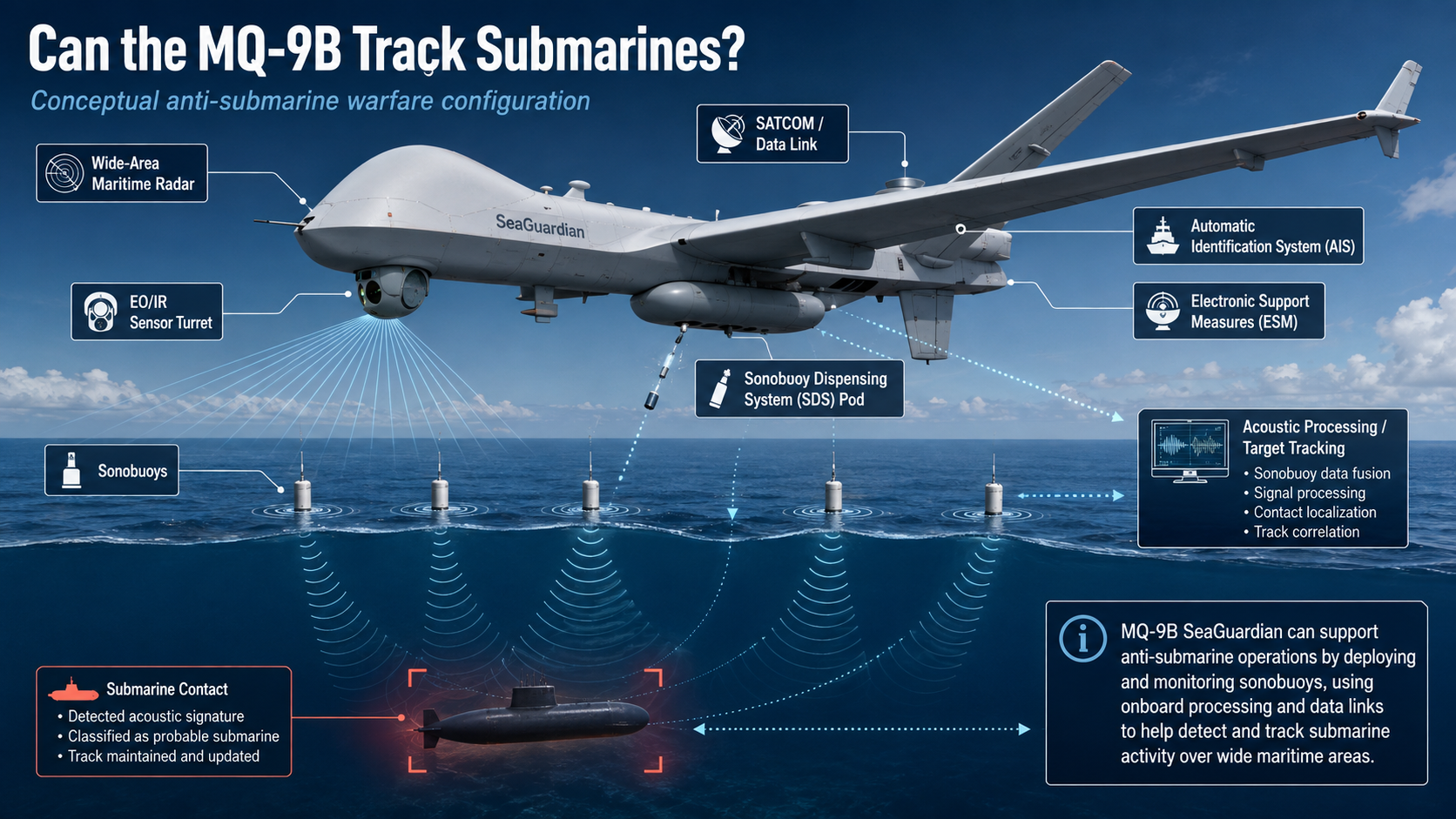
Can the MQ-9B track submarines?
Potentially, yes — but the distinction between the capability of the SeaGuardian platform and the specific equipment supplied to India is important.
General Atomics has developed an optional anti-submarine warfare package for SeaGuardian combining a Sonobuoy Dispensing System and Sonobuoy Monitoring and Control System.
Sonobuoys are expendable sensors placed into the ocean. Depending on the buoy type, they can listen passively for underwater acoustic signatures or use active acoustic techniques.
The SeaGuardian ASW system can receive acoustic information from deployed sonobuoys and use processing software to help create tracks containing information such as a contact’s estimated course, speed and depth.
General Atomics says an individual Sonobuoy Dispensing System pod can carry up to 10 A-size or 20 G-size sonobuoys.
MQ-9B, P-8I and MH-60R: A layered maritime surveillance network
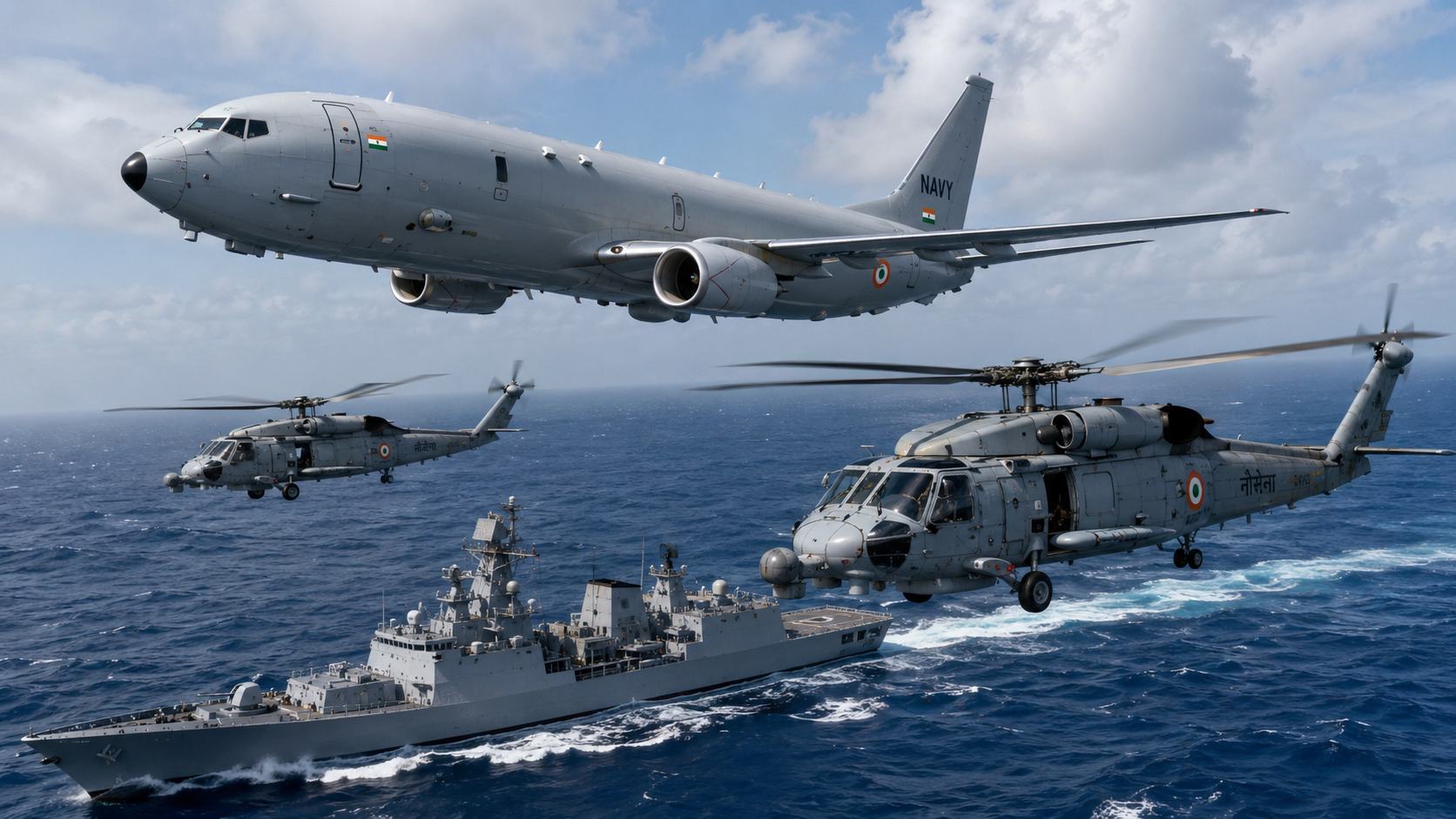
The MQ-9B becomes considerably more valuable when viewed as one part of a wider Indian Navy surveillance and anti-submarine warfare network.
India already operates P-8I long-range maritime patrol aircraft and MH-60R Seahawk helicopters, while naval ships carry their own radar, electronic surveillance and sonar systems.
Each platform brings different strengths.
| Platform | Key advantage | Typical contribution |
|---|---|---|
| MQ-9B SeaGuardian | Very long endurance | Persistent ISR and wide-area maritime monitoring |
| P-8I | High speed and powerful mission systems | Long-range maritime patrol and anti-submarine warfare |
| MH-60R | Shipborne ASW flexibility | Localised submarine search, prosecution and surface warfare |
| Naval warships | Continuous presence | Surface surveillance, sonar, air defence and combat response |
In a networked operation, a long-endurance UAV could maintain surveillance over a broad area and relay information about contacts. Faster or more heavily equipped crewed aircraft, helicopters and ships could then be directed towards targets requiring closer investigation.
Lease vs purchase: What is the difference?
The most important distinction in India’s MQ-9B strategy is that the latest two-aircraft lease and the existing 31-aircraft procurement are separate arrangements serving different requirements.
| Feature | New MQ-9B lease | 31-aircraft procurement |
|---|---|---|
| Number | 2 SeaGuardians | 31 SkyGuardian / SeaGuardian RPAS |
| Arrangement | Lease | Purchase |
| Duration | 30 months | Permanent fleet acquisition |
| Latest reported value | ₹1,943 crore | Much larger multi-billion-dollar procurement programme |
| Primary immediate benefit | Near-term operational availability | Long-term tri-service capability |
| Strategic role | Bridge and reinforce current surveillance requirements | Build a permanent national HALE unmanned fleet |
Why lease aircraft when India is already buying 31?
At first glance, spending ₹1,943 crore to lease two aircraft while 31 are already being purchased might appear unusual.
Operationally, however, the two arrangements can be complementary.
Immediate capability
Large defence procurements take time. Aircraft must be produced, tested, delivered, supported and integrated into operational units.
A lease can help maintain or expand capability during the period before the full purchased fleet becomes available.
Operational familiarity
Operating leased aircraft allows naval personnel to continue accumulating experience with long-endurance remotely piloted maritime operations, mission planning and integration with other naval assets.
No capability gap
The Navy’s surveillance requirement exists today. It cannot simply wait for every aircraft in the permanent procurement programme to arrive.
High utilisation
A small number of extremely long-endurance aircraft can still generate substantial surveillance coverage when used intensively, particularly for persistent patrol missions.
What India actually gets from the lease
Based on the publicly announced agreement, India receives access to two MQ-9B SeaGuardian remotely piloted aircraft for 30 months for Indian Navy surveillance and reconnaissance requirements.
The China factor in the Indian Ocean
The strategic importance of long-endurance maritime surveillance has increased as the Indian Ocean becomes a more contested operating environment.
China’s expanding naval reach means the Indian Navy must be able to build a detailed picture of maritime movements across a region stretching far beyond India’s immediate coastline.
Surface ships can usually be detected and classified more easily than submarines, but even surface activity becomes difficult to monitor continuously across an ocean-sized operating area.
Persistent remotely piloted aircraft allow the Navy to maintain a watch over selected corridors for far longer periods without consuming the limited flight hours of every crewed maritime patrol aircraft.
The MQ-9B therefore strengthens India’s ability to maintain maritime domain awareness rather than simply adding another aircraft type to the inventory.
Pakistan and India’s western maritime approaches
India must simultaneously maintain surveillance across the Arabian Sea and its western maritime approaches.
Persistent UAV coverage can complement ships and crewed aircraft by watching selected areas for extended periods and identifying activity that requires further investigation.
This is particularly useful in an operating environment where commanders may need to monitor commercial shipping, fishing vessels, naval units and other maritime contacts at the same time.
Andaman and Nicobar: Why geography matters
India’s island territories give the country a strategic position close to important sea lanes linking the Indian and Pacific Oceans.
For long-endurance surveillance aircraft, these maritime approaches are particularly well suited to persistent monitoring because aircraft can watch large sections of ocean and help identify patterns of vessel movement.
Combined with naval ships, shore-based sensors and crewed maritime aircraft, HALE drones can contribute to a much broader picture of activity around strategically important routes.
The real advantage: Finding something before it becomes a threat
The greatest value of surveillance is often not what happens after a threat has been confirmed.
It is the ability to detect something unusual early enough for commanders to decide what to do next.
Step 1 — Detect: Wide-area sensors identify a vessel or unusual activity.
Step 2 — Classify: Radar, AIS, imagery and electronic information help determine what the contact may be.
Step 3 — Track: Persistent surveillance allows operators to follow movement over time.
Step 4 — Share: Information is distributed to naval command centres and other platforms.
Step 5 — Respond: A P-8I, helicopter, ship or another appropriate asset can investigate or respond if required.
What MQ-9B does not replace
Long endurance should not be confused with the ability to perform every naval aviation mission.
SeaGuardian cannot simply replace India’s P-8I fleet, naval helicopters, satellites or surface warships.
A P-8I can travel rapidly to a distant contact and carries a highly specialised maritime mission suite. An MH-60R can operate directly from a warship and perform close anti-submarine operations. A surface combatant provides persistent presence and can carry weapons, sonar, radar and air-defence systems.
The MQ-9B’s role is different: stay airborne, watch continuously, collect information and extend the reach of the wider force.
From two leased drones to a 31-aircraft permanent fleet
The most important long-term development is India’s decision to acquire 31 MQ-9B SkyGuardian and SeaGuardian aircraft.
The Ministry of Defence signed the tri-service procurement contract with the US Government in October 2024, together with a separate arrangement covering performance-based logistics and depot-level maintenance, repair and overhaul in India.
That programme moves India beyond temporary access to a permanent high-altitude, long-endurance unmanned capability across the armed forces.
The new two-aircraft lease should therefore be understood as part of a transition: India is maintaining immediate unmanned maritime surveillance capacity while preparing for a much larger permanent MQ-9B force.
Strategic advantages for India
More hours over strategically important maritime areas.
Routine persistent monitoring can be shared with unmanned systems while crewed aircraft are available for missions requiring their specialised capabilities.
Long-duration ISR improves the chance of identifying unusual activity before it approaches critical areas.
MQ-9B sensor information can contribute to the wider operational picture used by naval commanders.
The aircraft can remain over distant surveillance areas without placing an onboard aircrew at risk.
Operational experience can support India’s transition towards a much larger MQ-9B force.
What to watch next
Several questions will determine how important the new lease becomes operationally.
Deployment location: Where the two aircraft will primarily operate from.
Sensor configuration: The exact maritime radar, electronic-support and other mission equipment included in the lease.
ASW package: Whether India’s leased aircraft receive sonobuoy-related anti-submarine warfare capability.
Operational integration: How closely SeaGuardian operations are connected with P-8I aircraft, MH-60R helicopters and naval ships.
31-aircraft deliveries: Progress towards induction of India’s permanent MQ-9B fleet.
Indian support ecosystem: Development of domestic maintenance and lifecycle-support capability under the larger procurement programme.
India’s ₹1,943-crore lease of two MQ-9B SeaGuardians is much more than a temporary addition of two drones.
It provides the Indian Navy with additional long-endurance surveillance capacity during a period when maritime competition across the Indian Ocean is increasing and India’s permanent MQ-9B fleet is still being built.
The SeaGuardian’s greatest strength is persistence. Its ability to remain airborne for more than 30 hours in appropriate configurations allows the Navy to watch strategically important maritime areas for periods that would be demanding for conventional crewed aircraft.
But its real strategic value comes when it operates alongside India’s P-8I aircraft, MH-60R helicopters, warships, satellites and other surveillance systems.
Two leased SeaGuardians provide the immediate capability. India’s 31-aircraft MQ-9B purchase is intended to turn that capability into a permanent part of India’s future surveillance architecture.
Contract information is based on Reuters reporting dated August 17, 2026. Information on India’s 31-aircraft procurement is based on Ministry of Defence / Press Information Bureau material. MQ-9B capabilities and published specifications are based on General Atomics Aeronautical Systems information.
Exact sensors, payloads, support equipment and anti-submarine warfare systems included with India’s latest two-aircraft lease have not been publicly disclosed in full. Platform capabilities described in this article should therefore not automatically be interpreted as the confirmed configuration of India’s leased aircraft.