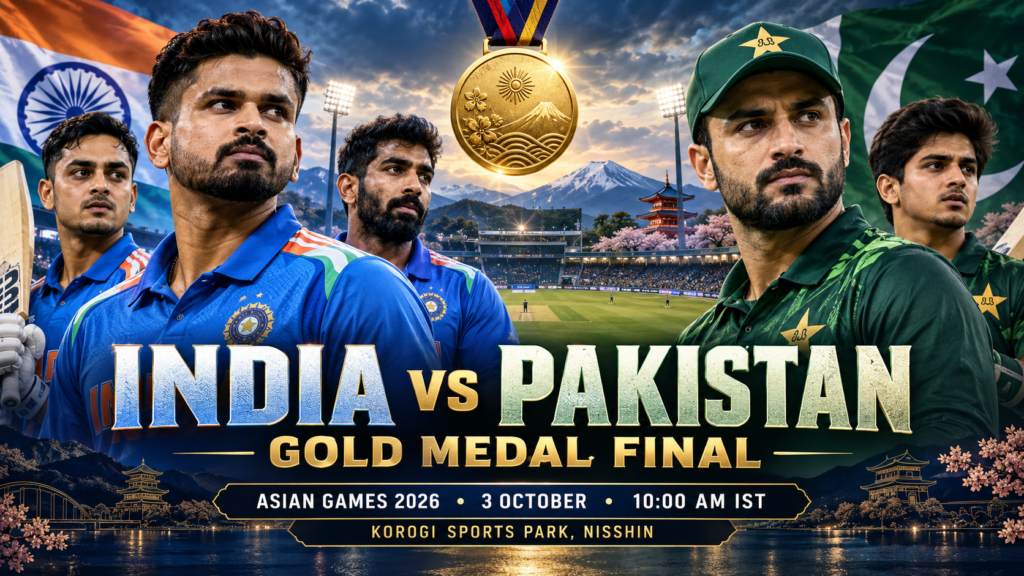
Ishan Kishan’s recovery innings and Jasprit Bumrah’s new-ball burst have taken India to the gold medal match. Pakistan arrive with a dangerous spin attack and a middle order that has already survived a tense chase.
Match: India vs Pakistan, men’s T20 gold medal match
Date: Saturday, 3 October 2026
Scheduled start: 10:00 AM IST · 1:30 PM Japan time
Venue: Korogi Sports Park, Nisshin, Japan
Stakes: India seek consecutive men’s titles; Pakistan seek their first men’s cricket gold.
A final decided by adaptation
India’s 124-run semi-final victory looks overwhelming, but their batting innings was a reminder that conditions in Nisshin can punish even a powerful lineup. Early wickets forced a recovery before Kishan’s unbeaten 80 carried India to 169/7. Sri Lanka then managed only 45 as India’s bowlers and fielders took control.
Pakistan faced a different test. Bangladesh reached 111/7 in a match reduced to 13 overs per side, and Pakistan slipped to 53/4 during the chase. Hasan Nawaz and Abdul Samad finished the job with an unbeaten 59-run partnership, securing a six-wicket win with nine balls remaining.
Those contrasting routes make the final more interesting than a simple comparison of winning margins. India have demonstrated greater bowling dominance; Pakistan have shown that their lower middle order can recover under pressure. Both teams will need to handle spin and protect wickets before attempting a late acceleration.
Recent form and route to the final
| Team | Quarter-final | Semi-final | Main takeaway |
|---|---|---|---|
| India | Afghanistan match abandoned; advanced on higher seeding. | Beat Sri Lanka by 124 runs: 169/7 versus 45 all out. | Batting recovered from early trouble; bowling made the result emphatic. |
| Pakistan | Hong Kong match abandoned; advanced on higher ranking. | Beat Bangladesh by six wickets: 112/4 chasing 111/7 in a 13-over game. | Spin created openings; Nawaz and Samad rescued the chase. |
India also swept Afghanistan 3-0 in their recent bilateral T20I series. However, the Asian Games sample is small: each finalist has played only one completed match in this tournament. A washed-out quarter-final should not be counted as an on-field victory.
India probable playing XI and review
India · projected XI
1. Vaibhav Sooryavanshi
2. Abhishek Sharma
3. Sanju Samson (wicketkeeper)
4. Shreyas Iyer (captain)
5. Ishan Kishan
6. Tilak Varma
7. Shivam Dube
8. Axar Patel
9. Washington Sundar
10. Ravi Bishnoi
11. Jasprit Bumrah
Playing XI analysis: Retaining the semi-final combination gives India attacking openers and substantial batting depth. Kishan’s position at No. 5 offers a recovery option if the top order loses early wickets, while Tilak and Dube can change the innings’ tempo. Axar, Washington and Bishnoi provide varied spin, with Abhishek adding another option. The trade-off is having only one specialist fast bowler: Arshdeep Singh could return if conditions favour seam or India want more protection at the death. Bringing him in would require sacrificing a batting or all-round option.
Other squad options: Arshdeep Singh, Yash Thakur and Vipraj Nigam.
Pakistan probable playing XI and review
Pakistan · projected XI
1. Sahibzada Farhan (captain)
2. Maaz Sadaqat
3. Usman Khan (wicketkeeper)
4. Saim Ayub
5. Hasan Nawaz
6. Abdul Samad
7. Arafat Minhas
8. Ahmed Daniyal
9. Mohammad Wasim Jr
10. Abrar Ahmed
11. Sufyan Moqim
Playing XI analysis: Pakistan’s semi-final combination places Maaz alongside Farhan, with Saim available to bat in the middle order and bowl off-spin. Nawaz and Samad give the chase a strong finishing pair, but Pakistan will want a steadier start than they managed against Bangladesh. Abrar and Sufyan supply wrist-spin variations, supported by Arafat’s left-arm orthodox bowling. Daniyal and Wasim balance the attack with seam, making this a flexible XI for a slow surface. Haider Ali and Akif Javed are alternatives if Pakistan adjust their batting or pace balance.
Other squad options: Haider Ali, Akif Javed, Saad Masood and Ali Raza.
Selection note: These are projected teams based on the semi-final combinations. The official XIs and batting orders may change at the toss.
Key battles
Bumrah against Pakistan’s top order: Farhan and Maaz must negotiate India’s best opportunity for early wickets. Bumrah’s lengths and changes of pace can make an aggressive start difficult; preserving wickets would let Pakistan attack other overs.
India’s left-handers against Saim and Abrar: Pakistan can use Saim’s off-spin early or through the middle, with Abrar providing a different trajectory. Abhishek and Vaibhav must balance boundary attempts with strike rotation rather than letting pressure build through dot balls.
Kishan and Iyer against Sufyan: India’s middle order needs to read the left-arm wrist-spinner without giving away wickets. Kishan’s semi-final innings showed his ability to recover and accelerate, but Pakistan will try to deny him the same platform.
Samad’s finish against India’s bowling allocation: Iyer’s use of Bumrah’s four overs could shape Pakistan’s final push. Saving overs for Samad risks allowing the top order to settle; using them early leaves more responsibility with spin and Dube later.
Pitch, toss and conditions
The semi-finals demonstrated that batting at Nisshin requires care. India needed a recovery innings, while Pakistan’s spin options took wickets against Bangladesh. A surface that grips would favour bowlers who vary their pace and batters who pick scoring areas rather than swinging at every delivery.
Batting first could be attractive if the pitch is dry and likely to become harder to score on. A damp surface or the prospect of a shortened match could instead make chasing appealing. The toss decision should follow the actual pitch and weather assessment; a fixed “bat first” prediction would be premature.
Rain has already disrupted the tournament. Match length and any interruption could change bowling plans quickly. Exact boundary measurements and a detailed final-day weather forecast are not established here, so neither is used to calculate the prediction.
India vs Pakistan head-to-head at the Asian Games
This will be their first meeting in Asian Games men’s cricket. Before the 2026 final, the event-specific head-to-head stands at zero matches, with no wins for either side. Records from the Asia Cup, T20 World Cup or emerging-team tournaments are separate competitions.
India are defending the men’s title won at the Hangzhou edition, officially the 2022 Games and staged in 2023. Pakistan are contesting their first men’s Asian Games cricket final. That history adds significance, but it does not provide a previous India–Pakistan result to predict this match.
Match prediction
India have the edge because of their batting depth, Bumrah’s ability to take early wickets and the range of their spin options. Pakistan’s route to victory is to dismiss India’s openers cheaply, keep Kishan from controlling the recovery and preserve enough wickets for Nawaz and Samad to attack late. The semi-final margin makes India favourites, but Pakistan’s spin attack presents a more demanding test than a scoreline alone suggests.
This is an editorial assessment, not a confirmed outcome or a statistical probability model.