Consumer demand, government expenditure and exports are expected to have kept India ahead of other major economies, but weak private investment, expensive oil and a softer rupee are clouding the outlook.
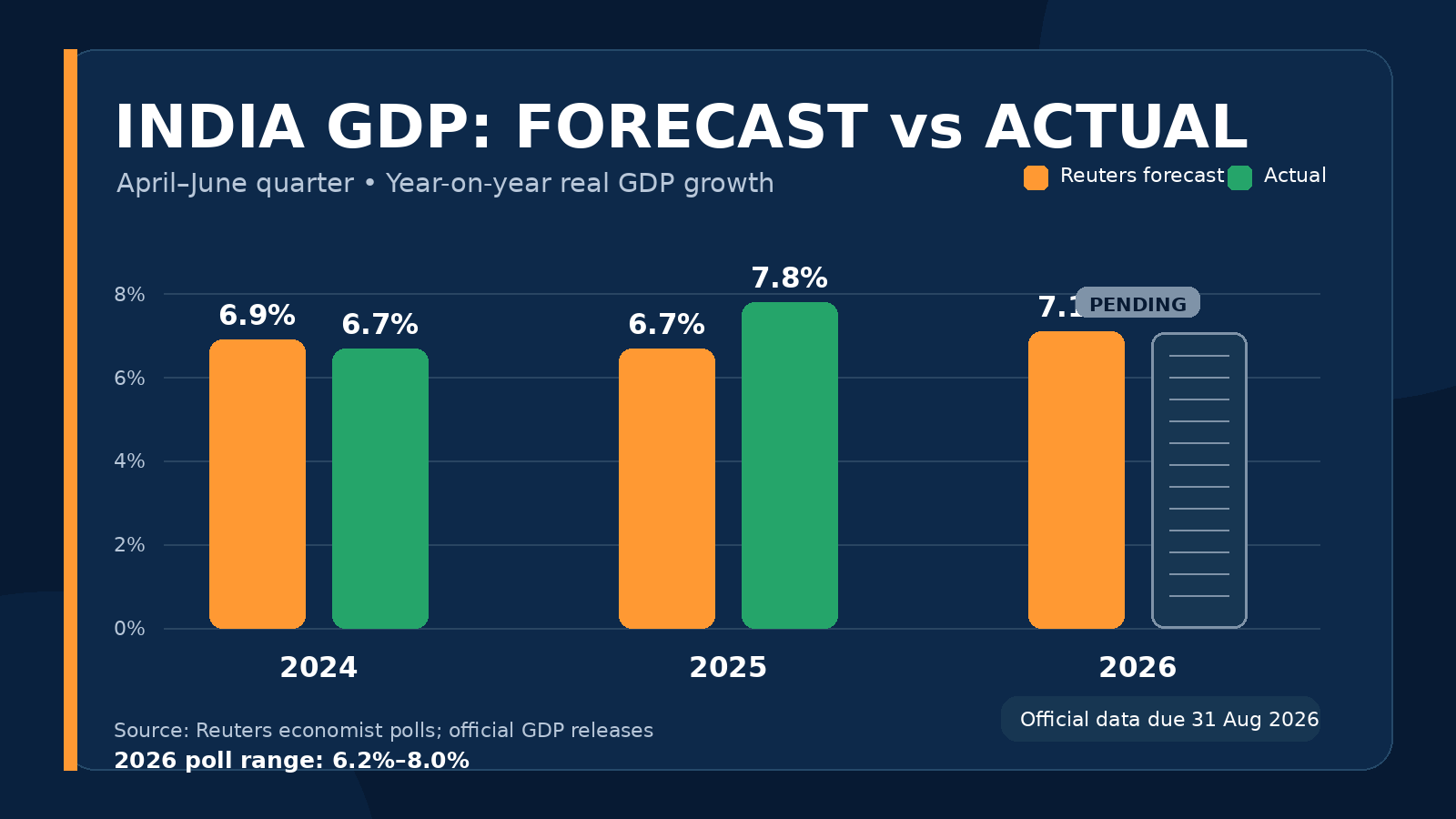
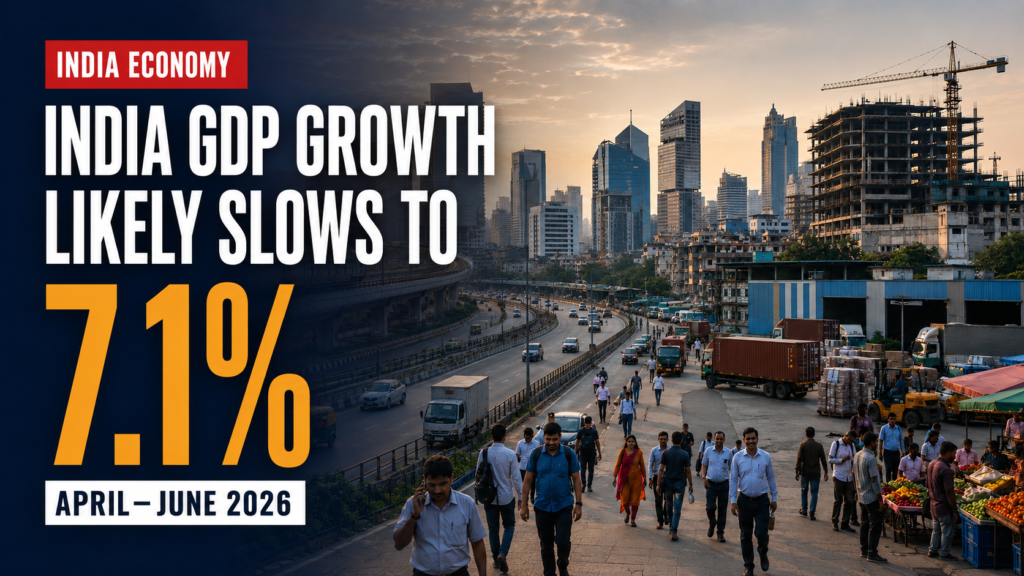
India’s economy likely expanded by 7.1% year-on-year in the April–June 2026 quarter, slowing from the stronger-than-expected 7.8% growth recorded in January–March, according to a Reuters survey of 58 economists.
Even at the projected slower pace, India would retain its position as the world’s fastest-growing major economy. Household consumption, public expenditure and export growth are believed to have supported activity during the first quarter of the 2026–27 financial year.
GDP Estimates Range From 6.2% to 8%
The Reuters poll, conducted from August 17 to August 24, produced forecasts ranging from 6.2% to 8%. The wide spread highlights uncertainty about the strength of investment and the extent to which high energy costs affected businesses and households.

| April–June quarter | Reuters forecast | Official growth | Difference |
|---|---|---|---|
| 2024 | 6.9% | 6.7% | −0.2 percentage points |
| 2025 | 6.7% | 7.8% | +1.1 percentage points |
| 2026 | 7.1% | Pending | Data due August 31 |
Gross Value Added—which measures output after excluding product taxes and subsidies—is estimated to have grown by approximately 7.2%. Economists expect momentum to moderate further to around 6.6% in July–September and 6.5% in October–December.
Consumer and Government Spending Support Growth
Domestic consumption remains the most important support for the economy. Goods and Services Tax rate reductions and income-tax relief introduced in the previous year likely increased disposable income and helped households absorb part of the pressure from rising prices.

Government capital expenditure—particularly on transport, logistics and public infrastructure—is also expected to have supported activity while private businesses remained cautious about major expansion plans.
Exports provided another cushion. India’s goods and services exports increased by more than 11% year-on-year during the quarter, according to the Reuters report, helping offset some weakness elsewhere.
Private Investment Remains the Weak Link
The most important weakness in the growth story is the limited strength of private-sector investment. Although corporate capital spending showed early signs of recovery in the second half of the previous financial year, economists said the improvement has not yet become broad-based or durable.

Companies are reassessing capacity expansion because of higher raw-material costs, supply-chain disruption and uncertainty surrounding the conflict involving the United States and Iran. Until confidence improves, government-led capital spending may continue to carry a disproportionate share of investment growth.
Oil Above $90 Creates Inflation Risk
Crude oil is one of the biggest external risks to India because the country imports more than 85% of its oil requirements. Prices above $90 a barrel can increase the import bill, widen external imbalances and feed into fuel, transport, manufacturing and logistics costs.
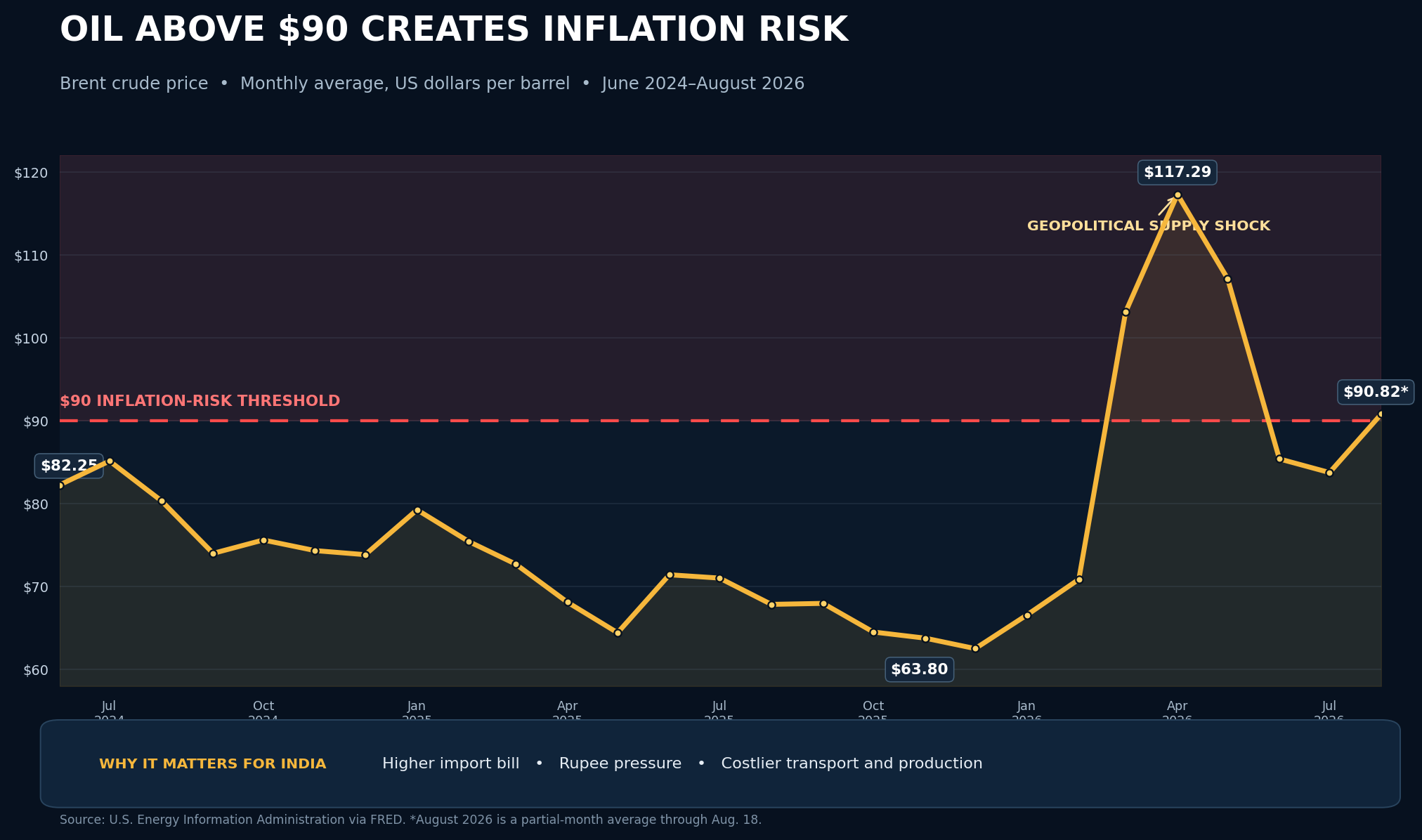
Brent reached $95.29 on August 18 before falling to about $89.10 on August 25. The pullback offers some relief, but the rapid price movements demonstrate how geopolitical developments can quickly change India’s inflation and growth outlook.
Higher energy costs reduce household purchasing power and raise operating expenses for businesses. Companies can either absorb the additional costs—hurting margins—or pass them on to consumers, adding to inflation.
Weaker Rupee Raises Business Costs
The rupee has also weakened substantially against the US dollar. USD/INR moved from around ₹83.56 in June 2024 to ₹95.41 on August 25, 2026, an increase of approximately 14%. The currency touched a record low of ₹96.96 per dollar in May.
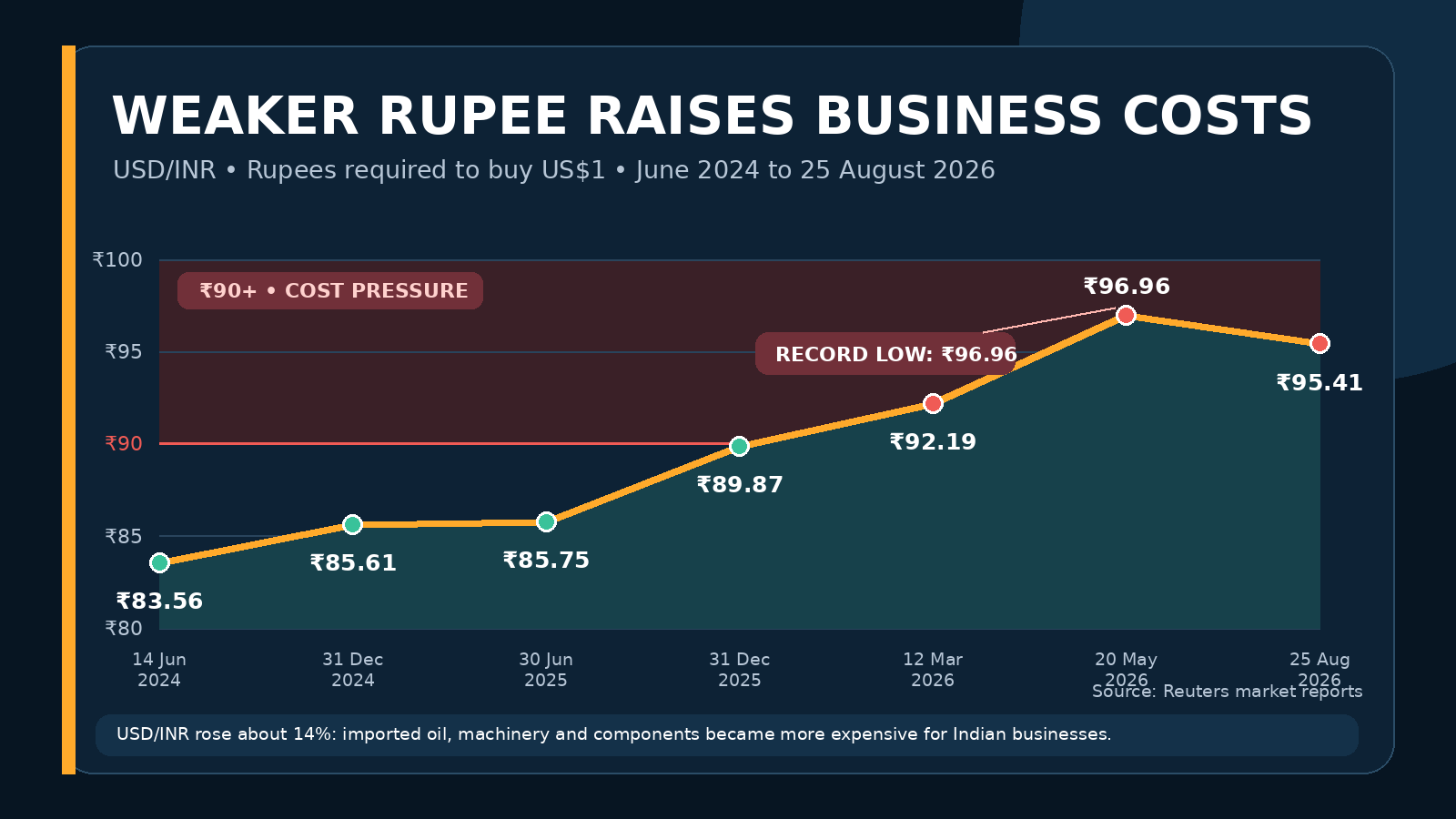
A weaker currency makes imported crude oil, machinery, electronics and components more expensive. This can intensify inflation and discourage capital expenditure by companies that depend on overseas equipment or dollar-denominated inputs.
Growth May Moderate Further
The economists surveyed expect GDP growth to average approximately 6.7% in FY2026–27, broadly in line with the Reserve Bank of India’s projection. The poll also indicated that the RBI is likely to keep interest rates unchanged for at least six months while it evaluates inflation, growth and currency pressures.
- July–September 2026: Growth forecast at about 6.6%.
- October–December 2026: Growth forecast at about 6.5%.
- FY2026–27: Full-year growth expected to average around 6.7%.
Why This Matters for India
A 7.1% expansion would still be a strong performance compared with other large economies. India’s vast domestic market, public infrastructure programme and resilient exports give it substantial protection from external weakness.
The central challenge
India must convert strong headline growth into durable private investment, productive capacity and employment. Government spending can support momentum, but sustained growth above 7% will eventually require businesses to invest more confidently and broadly.
The August 31 release will show how successfully the economy navigated expensive energy, a weaker currency and geopolitical disruption during the opening quarter of FY2026–27. Until then, 7.1% should be treated as a well-supported forecast—not an official result.