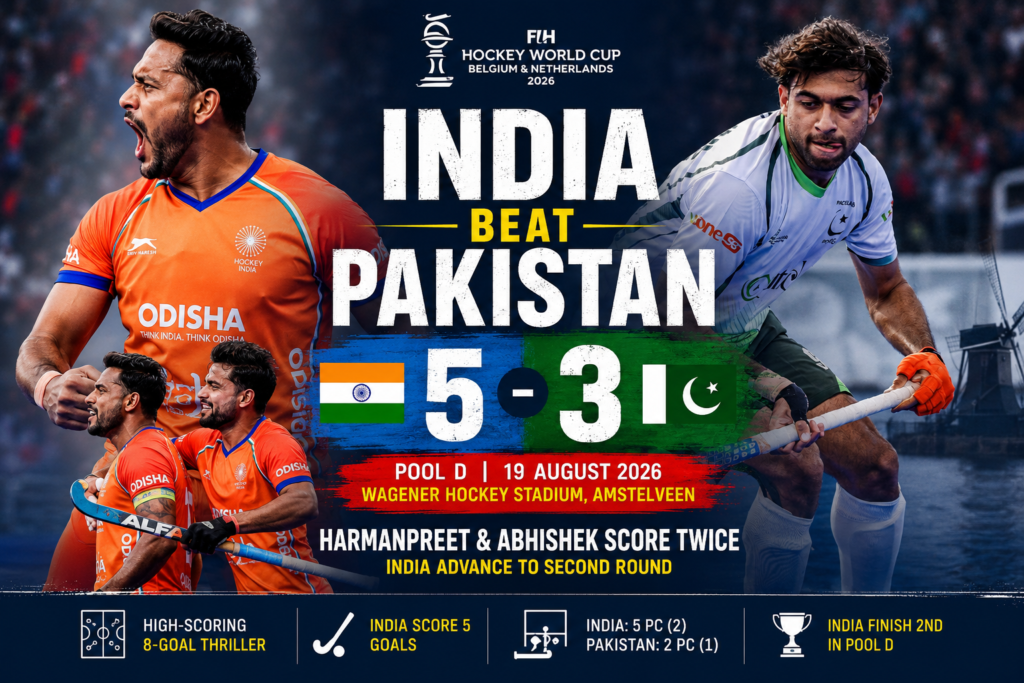
India defeated Pakistan 5-3 in a pulsating eight-goal Pool D contest in Amstelveen, with captain Harmanpreet Singh and Abhishek scoring twice each as India secured qualification for the second round and ended Pakistan’s title hopes.
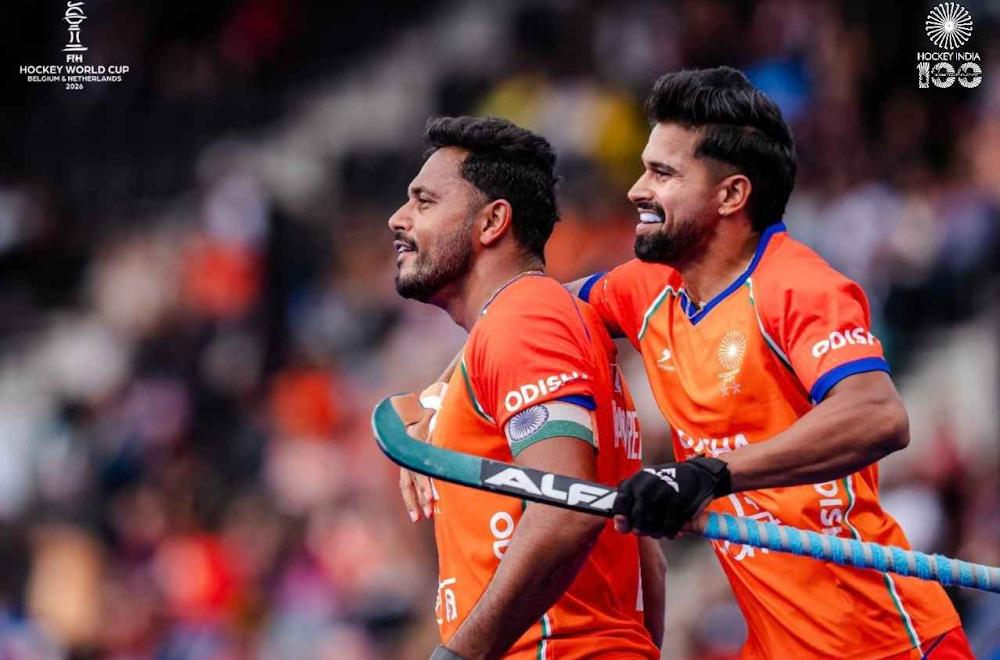
India delivered when the pressure was at its highest.
In a rivalry match carrying major qualification consequences, India defeated Pakistan 5-3 in a frantic Pool D encounter at the FIH Men’s Hockey World Cup 2026.
Captain Harmanpreet Singh struck twice, Abhishek added another brace and Hardik Singh converted a penalty stroke as India produced enough attacking quality to overcome a Pakistan side that repeatedly threatened to fight its way back into the contest.
The victory took India to six points from three matches, securing second place in Pool D behind England and confirming their passage into the next phase.
Harmanpreet Gives India the Perfect Start
India entered the contest needing victory to remove any uncertainty surrounding their qualification prospects, and their captain delivered almost immediately.
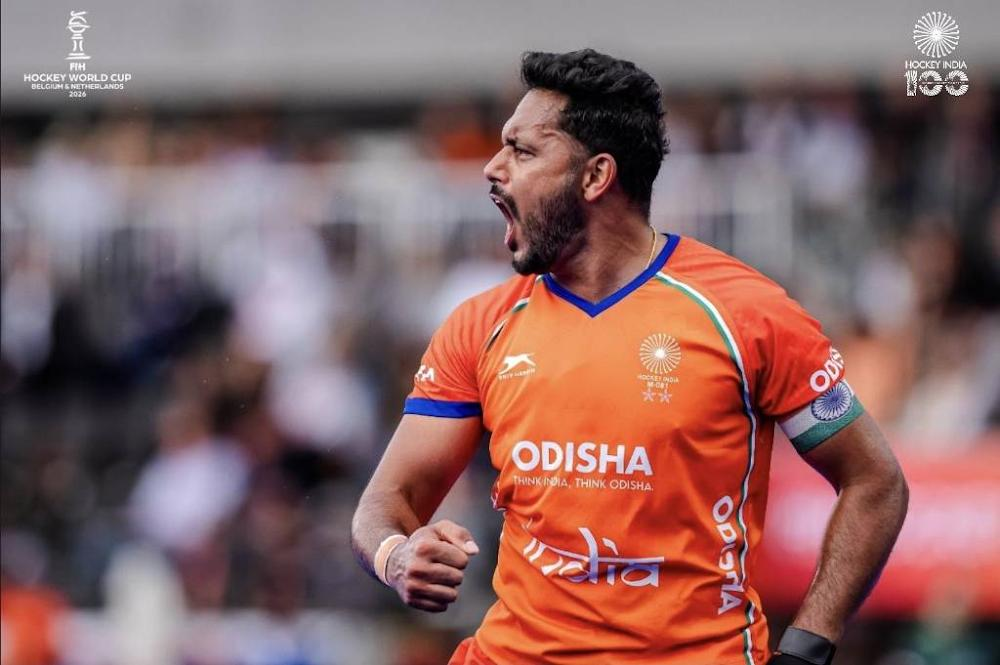
In the 5th minute, India earned their first penalty corner. Harmanpreet Singh stepped up and drove a low drag-flick into the goal to give India the ideal start.
The early breakthrough allowed India to press even more aggressively.
Pakistan attempted to play through the first line of pressure, but India’s midfield repeatedly closed passing lanes and recycled possession back towards the attacking 23.
Abhishek Doubles India’s Advantage
India continued to move the ball rapidly through midfield, using width to pull Pakistan’s defensive unit apart before accelerating into the circle.
The second goal arrived in the 11th minute.
Abhishek reacted sharply inside the circle and converted from close range after an attacking move involving Mandeep Singh.
India were 2-0 ahead before the end of the opening quarter, and Pakistan were already being forced away from their preferred counter-attacking game plan.
India Build a 3-0 Lead – Then the Match Explodes
The second quarter produced the most chaotic and entertaining phase of the contest.
Harmanpreet struck again in the 21st minute, finishing a penalty-corner variation to make it 3-0.
At that moment India appeared capable of running away with the match.
Pakistan responded almost immediately.
Hannan Shahid capitalised on a rebound in the 22nd minute to reduce the deficit to 3-1.
Two minutes later, the match erupted into another rapid exchange of goals.
Abhishek produced excellent close-control skills inside the circle to score his second and restore India’s three-goal cushion at 4-1.
Pakistan answered again almost immediately through Sufyan Khan, whose penalty-corner drag-flick made it 4-2.
India vs Pakistan Match Timeline
Harmanpreet converts India’s first penalty corner with a low drag-flick to give India an early lead.
Abhishek reacts quickly inside the circle and converts from close range as India double their advantage.
Harmanpreet scores his second following a clever penalty-corner variation.
Pakistan respond immediately as Hannan Shahid reacts to a rebound and pulls one back.
Abhishek displays excellent 3D stickwork inside the circle before finishing his second goal.
Sufyan Khan responds from a penalty corner to keep Pakistan alive in the contest.
Hardik Singh converts a penalty stroke into the bottom corner and restores India’s three-goal cushion.
Hannan Shahid breaks forward on the counter and scores his second to reduce the margin again.
India close out an eight-goal thriller and secure their place in the second round.
India operated in a fluid structure that frequently resembled a 3-4-3 in possession, with the defensive line stepping high and midfielders supporting the forwards aggressively.
Hardik Singh and Manpreet Singh were important to India’s ability to move the ball through the centre before switching play into wider channels. India’s forwards also pressed Pakistan’s exits aggressively, preventing them from building calmly from deep.
The weakness remained India’s transition defence. Pakistan repeatedly showed that direct running through the central channel could expose space behind India’s advanced midfield, particularly when Hannan Shahid was able to receive the ball at pace.
Hardik Singh Controls the Midfield Battle
India’s aggressive attacking structure depended heavily on the work of Hardik Singh.
His ability to receive under pressure, carry the ball beyond the first defender and accelerate India’s attacks helped India maintain control for long periods.
Hardik was also heavily involved in India’s counter-press, immediately attempting to regain possession whenever attacks broke down.

Hardik’s Penalty Stroke Gives India Breathing Room
Pakistan’s two second-quarter goals had ensured the contest remained dangerous despite India’s attacking superiority.
India therefore needed another goal after the interval to regain control.
That moment arrived in the 35th minute.
India were awarded a penalty stroke and Hardik Singh stepped forward to finish calmly, pushing the score to 5-2.
The goal restored a three-goal cushion and forced Pakistan to take even greater risks in possession.
Hannan Shahid Keeps Pakistan Fighting
Pakistan’s greatest attacking threat throughout the match was Hannan Shahid.
His acceleration and willingness to attack the space behind India’s midfield repeatedly caused problems.
After scoring Pakistan’s first goal in the second quarter, Hannan struck again in the 46th minute, breaking forward on a counterattack and finishing past Suraj Karkera to make it 5-3.
The goal ensured India could not relax during the final quarter, but Pakistan were unable to produce the two additional breakthroughs needed to force their way back into the match.
- Explosive start: India scored twice inside the opening 11 minutes and forced Pakistan to chase the match.
- Harmanpreet’s set-piece quality: India’s captain scored twice and again demonstrated his importance from penalty corners.
- Abhishek’s finishing: Two field goals gave India another major attacking route beyond penalty corners.
- Midfield progression: Hardik Singh and Manpreet Singh repeatedly moved possession through Pakistan’s first line of pressure.
- Clinical scoring: India repeatedly restored their advantage whenever Pakistan threatened to reduce the deficit.
- Pakistan’s defensive instability: India’s movement and circle entries created too many high-value scoring situations.
India’s Concern: Three Goals Conceded Again
The victory secured qualification, but India’s defensive performance will give coach Craig Fulton plenty to examine before the second round.
India conceded four goals against England and another three against Pakistan.
Against Pakistan, the biggest issue was not sustained defensive pressure but the vulnerability created when possession changed hands.
India’s high attacking structure naturally leaves space behind the midfield line. When the counter-press fails, opponents can attack India’s defenders before the entire structure has recovered.
Stronger second-round opponents are likely to target exactly those spaces.
Harmanpreet and Abhishek Deliver in a Must-Win Match
India entered the rivalry encounter needing their leading players to respond after the disappointment against England.
Harmanpreet and Abhishek did exactly that.
The captain’s two goals gave India control of the match, while Abhishek’s brace demonstrated the individual skill and finishing quality India need from open play.
Having multiple routes to goal will become increasingly important as India move into a second-round group featuring stronger defensive structures.
India Extend Recent Dominance Over Pakistan
The result also continued India’s extraordinary recent run in the historic rivalry.
Pakistan still hold the advantage across the long-term head-to-head record, but India have dominated the modern phase of the rivalry.
The 5-3 World Cup victory extended India’s unbeaten run against Pakistan since 2016 and underlined the shift in competitive balance between the two teams over the past decade.
Penalty Corners Prove Crucial Again
Set pieces remained a major part of the contest.
India earned five penalty corners and converted two, while Pakistan generated two penalty corners and scored from one.
Harmanpreet’s effectiveness gives India the confidence to aggressively attack defenders’ feet inside the circle because even a single penalty-corner opportunity can change the momentum of a match.
Final Pool D Points Table
| Pos | Team | P | W | D | L | Pts | Status |
|---|---|---|---|---|---|---|---|
| 1 | England | 3 | 3 | 0 | 0 | 9 | Advanced |
| 2 | India | 3 | 2 | 0 | 1 | 6 | Advanced |
| 3 | Pakistan | 3 | 0 | 1 | 2 | 1 | Classification |
| 4 | Wales | 3 | 0 | 1 | 2 | 1 | Classification |
India Advance to the Second Round
With six points from three matches, India finish second behind England and progress from Pool D.
The tournament now becomes considerably more demanding.
India move into Pool E, which combines the leading teams from Pool D with the qualifying teams from Pool A.
India will not face England again during this stage. Instead, their upcoming matches will come against the qualifiers emerging from Pool A.
What India Must Improve in Pool E
India’s attacking numbers are encouraging, but the second round will punish defensive mistakes far more severely.
Three areas stand out.
- Transition defence: India must recover more quickly when their high press is broken.
- Control after taking the lead: India led Pakistan 3-0 and 4-1 but repeatedly allowed the opponent back into the contest.
- Maintain penalty-corner efficiency: Harmanpreet remains one of India’s most important match-winning weapons.
- Protect the central channel: Hannan Shahid demonstrated how damaging direct running through midfield can be.
- Keep open-play scoring alive: Abhishek’s brace showed India cannot depend solely on penalty corners.
From Rivalry Pressure to World Cup Ambition
India have successfully negotiated the first major pressure point of their campaign.
Defeat against England had created uncertainty. A loss against Pakistan would have placed qualification in jeopardy and dramatically changed the mood around the team.
Instead, India responded with five goals in one of the tournament’s most emotionally charged fixtures.
The challenge now changes.
Pool D was about qualification. Pool E will be about whether India possess the tactical discipline, defensive resilience and attacking efficiency required to compete for a place in the World Cup semi-finals.
India answered a must-win rivalry clash with five goals, qualification and another memorable victory over Pakistan.
Harmanpreet Singh delivered as captain, Abhishek produced two excellent attacking finishes and Hardik Singh controlled important phases of the midfield battle before adding the fifth from the penalty spot.
Yet the 5-3 scoreline also carried a warning. India again conceded too much space during defensive transitions, with Hannan Shahid repeatedly demonstrating how vulnerable the high press can become when the first counter-pressure is beaten.
Against Pakistan, India’s attacking quality was enough to cover those weaknesses. Against the stronger teams awaiting in the second round, the margins will become considerably smaller.
India are through. The rivalry has been won. Now the real World Cup test begins.