📅 May 11, 2026 | By Pulse India News Desk
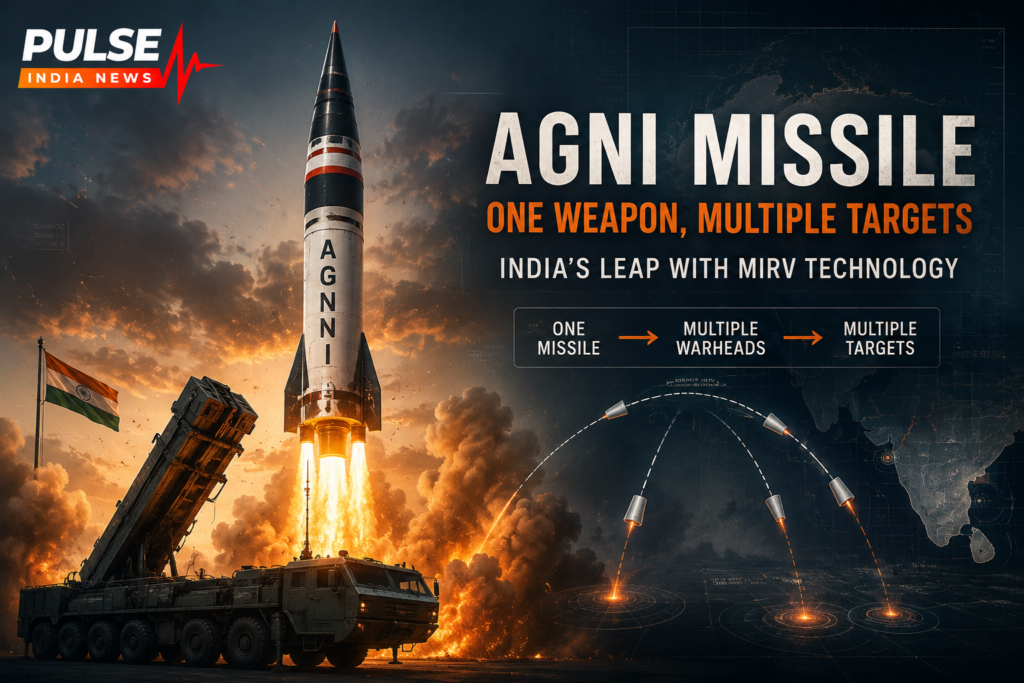
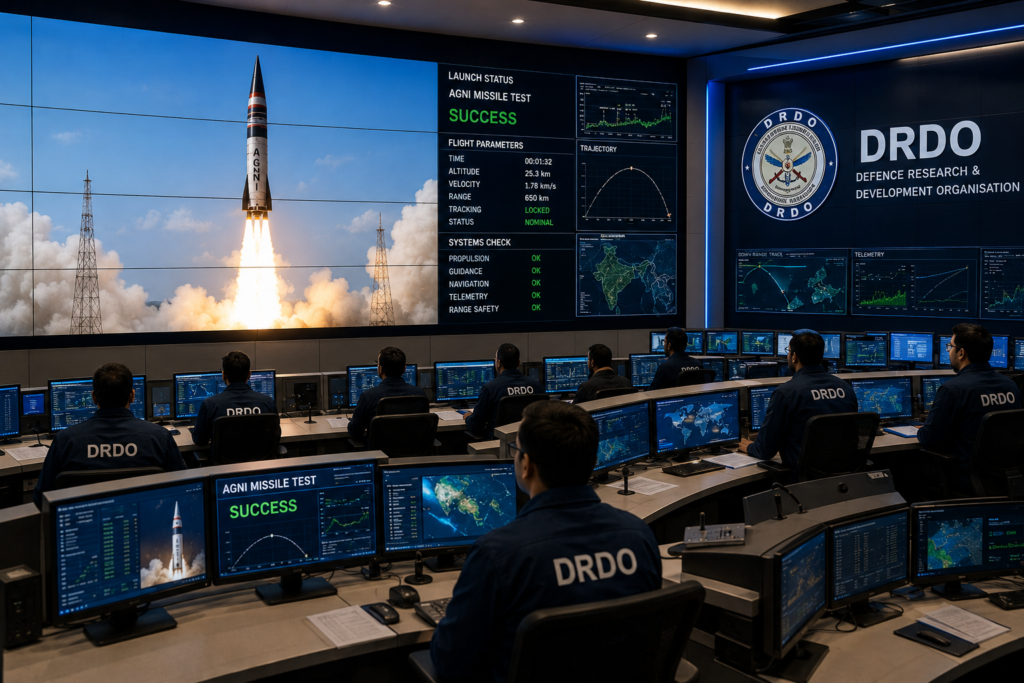
India has taken a major step forward in strengthening its strategic deterrence capability with the successful trial of an advanced Agni ballistic missile equipped with MIRV technology.
The test, conducted from Dr APJ Abdul Kalam Island off the Odisha coast, marks a significant milestone for India’s long-range missile programme and places the country among a select group of nations possessing Multiple Independently Targetable Re-entry Vehicle (MIRV) capability.
Defence experts say the successful mission demonstrates India’s growing indigenous missile technology strength at a time when global strategic competition and regional security tensions continue to rise.
What Is MIRV Technology?
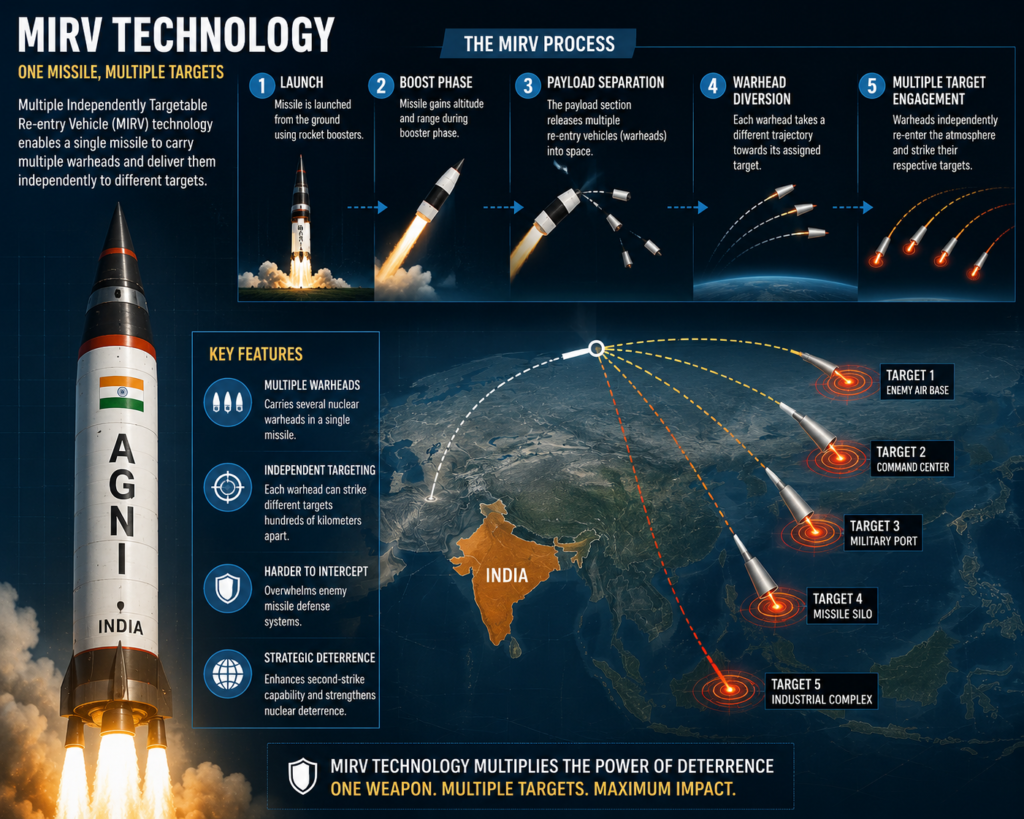
MIRV stands for Multiple Independently Targetable Re-entry Vehicle, a technology that allows a single ballistic missile to carry multiple nuclear warheads capable of striking different targets independently.
Unlike traditional ballistic missiles that carry a single warhead, MIRV-equipped missiles can release several warheads mid-flight, each programmed to hit separate strategic locations.
In simple terms:
- One missile can attack multiple cities or military targets
- Warheads separate during the terminal phase of flight
- Each warhead follows an independent trajectory
- Enemy missile defence systems become far harder to intercept
This technology is currently possessed by only a handful of countries, including the United States, Russia and China.
OneMissile → Multiple Warheads → Multiple Targets
Why This Test Matters
Defence analysts say the successful trial significantly boosts India’s nuclear deterrence posture, especially amid growing regional security challenges involving China and Pakistan.
The new capability enhances:
🔰 Second-Strike Capability
Even if India’s military infrastructure comes under a surprise attack, MIRV-equipped missiles ensure the country can still launch a powerful retaliatory strike. This strengthens the credibility of India’s nuclear doctrine and discourages adversaries from considering a first-strike option.
🛡️ Strategic Survivability
By carrying multiple independently targetable warheads in a single missile, the system improves the survivability of India’s nuclear arsenal. It reduces dependence on launching multiple missiles separately and increases operational flexibility during conflict scenarios.
🎯 Long-Range Precision Targeting
Advanced guidance and navigation systems allow individual warheads to strike different strategic targets with high accuracy, even at extremely long distances. This enhances India’s capability to target critical military infrastructure, command centres and missile bases.
🚨 Ability to Overwhelm Missile Defence Shields
Modern air defence systems are designed to intercept incoming missiles, but MIRV technology complicates interception efforts. Multiple warheads — and possible decoys — can saturate enemy defence networks, increasing the probability of successful penetration.
Stronger “Credible Minimum Deterrence”
The development further strengthens India’s long-standing nuclear doctrine of maintaining a “credible minimum deterrent.” It ensures India can maintain strategic balance without entering an uncontrolled arms race.
Advanced Capabilities of the Missile
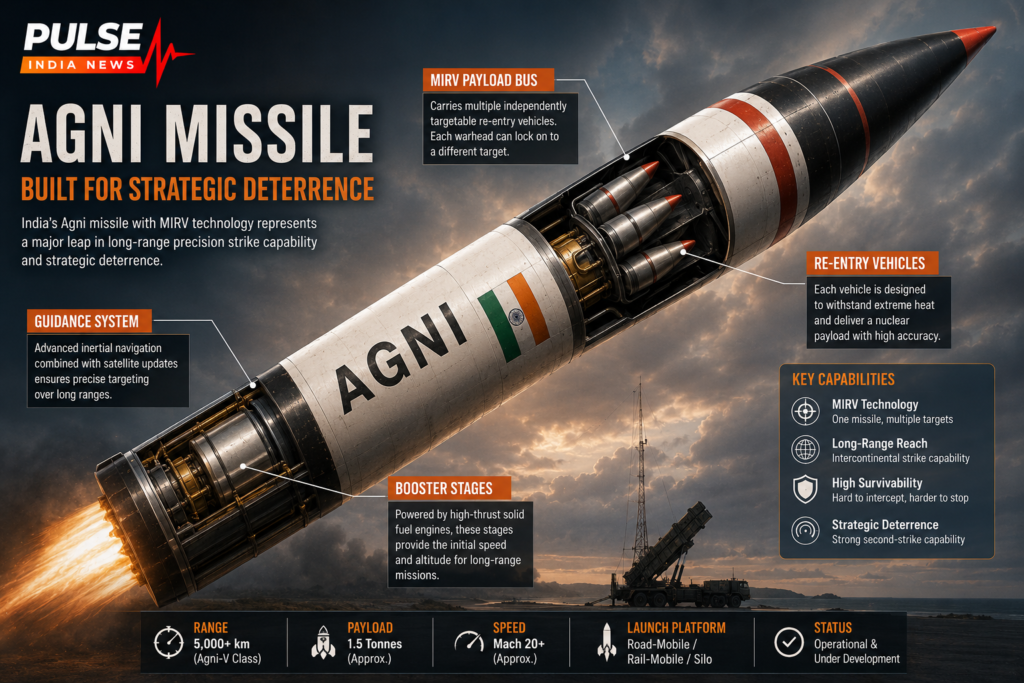
While official technical details remain classified, experts believe the advanced Agni variant tested during the mission may include several next-generation strategic technologies.
Key Features
🔥 MIRV-Enabled Multiple Warheads
A single missile can carry several nuclear warheads, each capable of hitting separate targets independently. This dramatically increases strike efficiency and strategic reach.
🌍 Long-Range Strategic Strike Capability
The missile is believed to possess intercontinental or near-intercontinental range capability, allowing India to maintain deterrence across a wide geographic area.
⚡ High-Speed Re-entry Vehicles
The warheads re-enter Earth’s atmosphere at hypersonic speeds, making interception extremely difficult for enemy missile defence systems.
🛰️ Improved Guidance and Navigation Systems
Advanced onboard computers, inertial navigation systems and satellite-assisted corrections may provide greater targeting accuracy and mission reliability.
🛡️ Better Penetration Against Enemy Air Defence Networks
The missile may use evasive manoeuvres, decoys and staggered warhead deployment patterns to bypass sophisticated missile defence systems.
📡 Advanced Payload Deployment Mechanism
The MIRV bus or payload delivery vehicle likely separates warheads with precise timing and trajectory control, ensuring independent targeting during the terminal phase.
🔋 High Operational Readiness
The system is expected to feature quicker launch preparation, improved mobility and better storage stability, allowing rapid deployment during emergencies.
🚀 Foundation for Future Agni Variants
Experts believe technologies tested here could eventually support future systems like Agni-VI, including longer range, larger payload capacity and possibly manoeuvrable hypersonic warheads.
India’s Growing Strategic Missile Strength
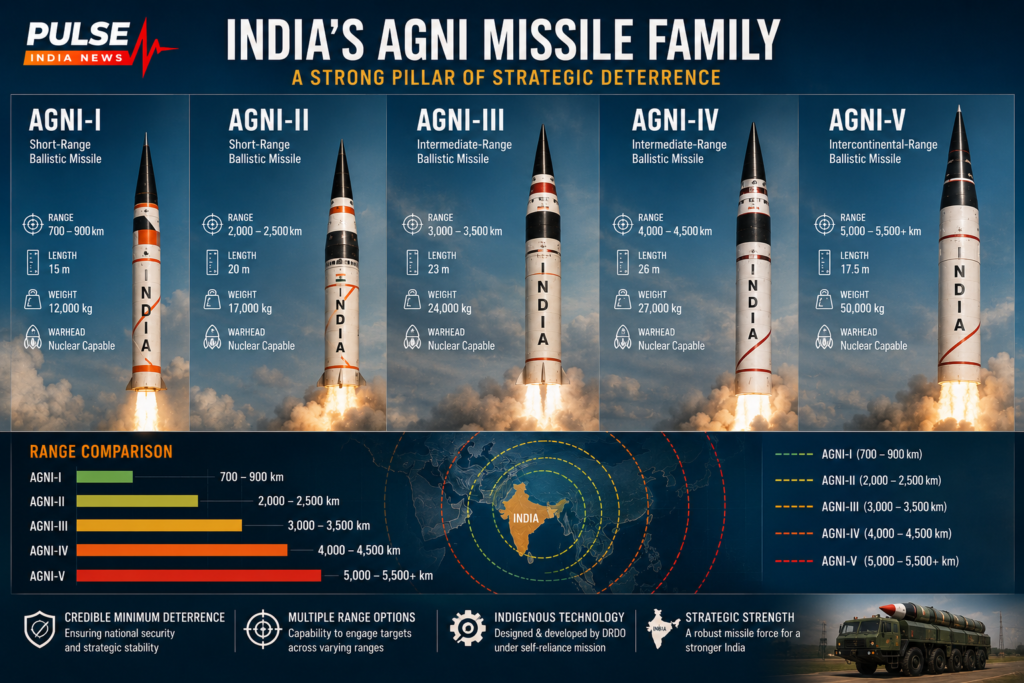
The Agni missile family already forms the backbone of India’s strategic forces.
Different variants currently provide short, intermediate and intercontinental-range strike capabilities, enabling India to maintain deterrence across multiple theatres.
The integration of MIRV technology now adds another layer of sophistication to India’s strategic arsenal.
Security experts believe this advancement will improve India’s ability to maintain deterrence stability in an increasingly complex geopolitical environment.
A Message Beyond the Region
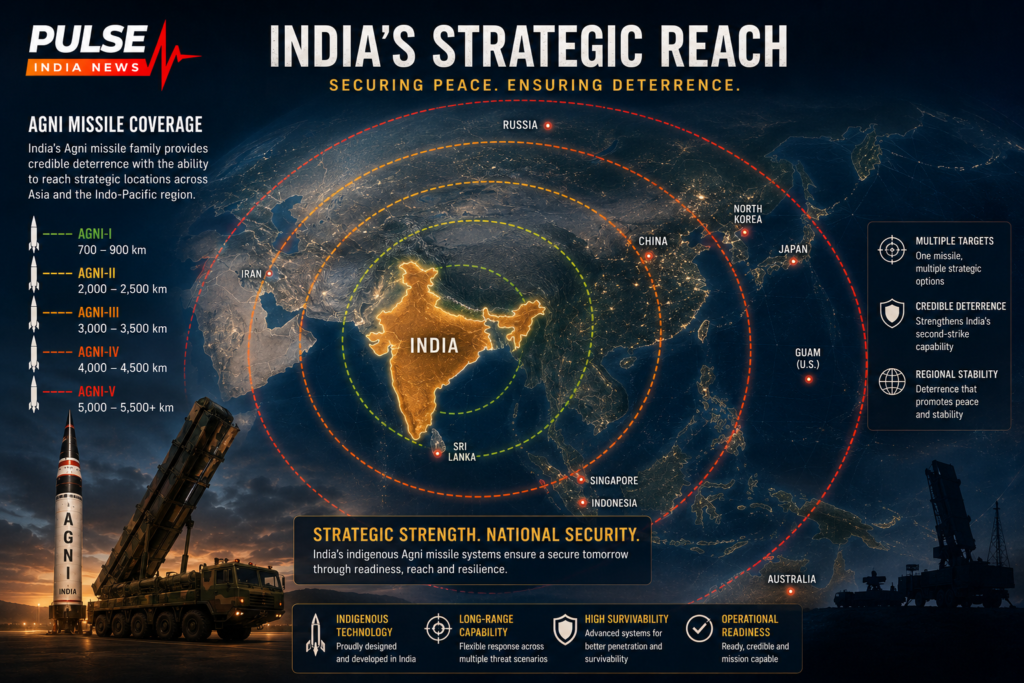
The successful test is being viewed not only as a technological achievement but also as a strategic signal to the international community.
As major powers continue modernising their nuclear arsenals and missile defence systems, India’s progress in MIRV technology reflects its growing self-reliance in advanced defence systems under the DRDO-led missile development programme.
Experts say the technologies demonstrated during the trial could pave the way for future systems such as Agni-VI and more advanced long-range deterrence platforms in the coming years.
Final Analysis
India’s successful MIRV enabled Agni missile trial represents far more than another weapons test.
It demonstrates:
👉 Advanced indigenous missile engineering
👉 Stronger long-range strike capability
👉 Improved nuclear deterrence posture
👉 Greater survivability during future conflict scenarios
👉 India’s entry into an elite strategic technology club
In strategic terms, the message is clear:
India is steadily strengthening its long-range precision strike and nuclear deterrence capabilities in response to evolving regional and global security challenges.