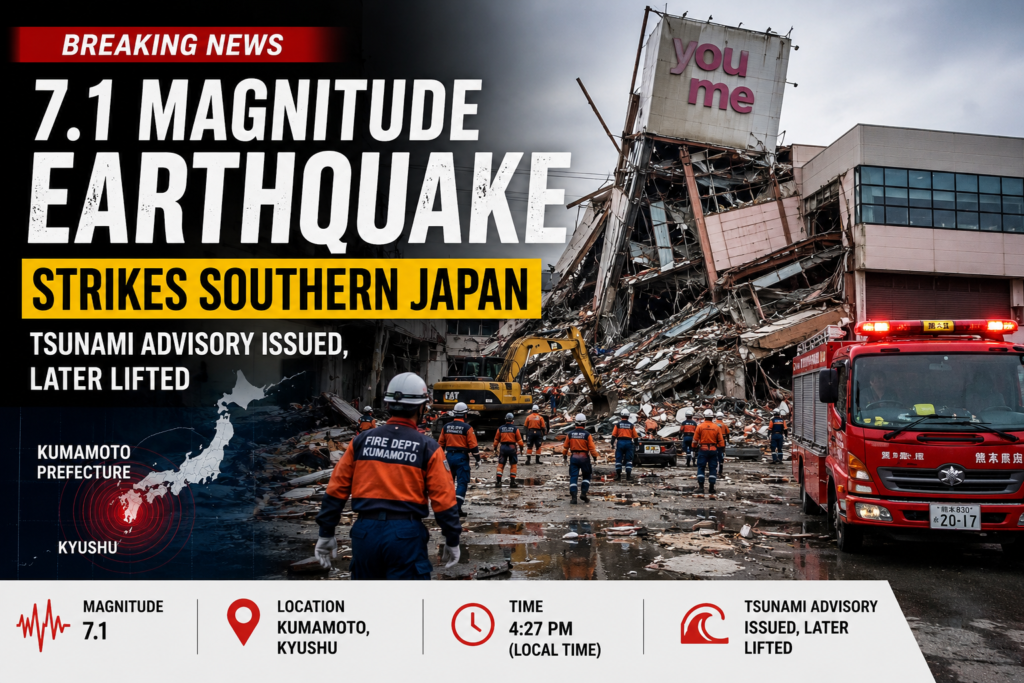
The powerful earthquake struck Kumamoto Prefecture on Japan’s southern island of Kyushu, damaging buildings, disrupting transport and triggering an emergency response across the region.
A powerful earthquake with a preliminary magnitude of 7.1 struck Kumamoto Prefecture on Japan’s southern island of Kyushu on Tuesday afternoon, prompting a tsunami advisory and an extensive emergency response.
The earthquake occurred at approximately 4:27 p.m. local time and produced intense shaking across parts of Kumamoto and surrounding prefectures. The Japan Meteorological Agency initially warned that waves of up to one metre could affect coastal areas around the Ariake and Yatsushiro seas.
Residents in coastal communities were advised to move away from the shoreline while authorities monitored sea levels. The advisory was subsequently lifted after officials determined that the immediate tsunami threat had passed.
Quick read
- A preliminary magnitude 7.1 earthquake struck Kumamoto Prefecture in southern Japan.
- The earthquake occurred at a shallow depth, intensifying the shaking experienced at the surface.
- A tsunami advisory was issued for coastal areas before being lifted.
- Buildings, roads and other infrastructure were damaged in parts of the affected region.
- Rail services and airport operations were disrupted while safety inspections were conducted.
- Authorities warned residents to remain alert for strong aftershocks and landslides.
Damage reported as rescue operations begin
Emergency services were deployed across the region as reports emerged of damaged buildings, fires, road disruption and power outages. Authorities were working to determine the full scale of the damage as rescue teams searched affected structures.
A shopping centre in the Kumamoto region reportedly suffered extensive structural damage, with emergency personnel responding to reports that several people may have been trapped inside.
Hospitals in the affected area treated a number of people for earthquake-related injuries. Officials cautioned that casualty and damage figures could change as assessments continued and rescuers gained access to heavily affected locations.
Transport services suspended for inspections
Shinkansen bullet trains and local railway services in Kyushu were temporarily suspended as operators inspected tracks, bridges and signalling systems for possible earthquake damage.
Operations at Aso Kumamoto Airport were also disrupted while officials examined the runway and airport facilities. Travellers were advised to check directly with airlines and transport operators before beginning their journeys.
Road damage and debris created additional challenges for rescue teams attempting to reach some affected communities.
Government establishes emergency response
The Japanese government established a task force to collect information, coordinate emergency agencies and prepare additional rescue assistance.
Defence aircraft were dispatched to survey the affected region from the air, while local fire departments, police units and disaster-management teams assessed damage on the ground.
Officials said protecting lives and reaching people in damaged buildings remained the immediate priority.
Authorities warn of strong aftershocks
The Japan Meteorological Agency warned that further strong earthquakes could occur in the coming days. Residents were urged to avoid unstable buildings, damaged walls, steep slopes and areas vulnerable to landslides.
Shallow earthquakes can cause particularly intense surface shaking because seismic energy travels a relatively short distance before reaching populated areas. This can increase the risk of structural damage close to the epicentre.
Public safety guidance
Residents should follow instructions issued by Japanese authorities, avoid damaged buildings and coastal areas, keep emergency supplies available and prepare for possible aftershocks. People should rely on official disaster alerts rather than unverified social-media reports.
No abnormalities reported at nuclear plants
Japan’s Nuclear Regulation Authority said inspections had found no abnormalities at three nuclear power facilities near the affected region.
Nuclear plants automatically conduct safety checks following strong earthquakes, with operators examining reactors, cooling systems, power supplies and radiation-monitoring equipment.
Kumamoto region has history of destructive earthquakes
Why Kumamoto remains vulnerable
Kumamoto was struck by a destructive earthquake sequence in April 2016. The disaster caused widespread building damage, landslides and major disruption across the prefecture.
Japan lies along the seismically active Pacific Ring of Fire, where several tectonic plates meet. The country has developed strict construction standards, early-warning systems and extensive disaster-response procedures, but powerful shallow earthquakes can still cause serious damage.
Full impact still being assessed
Authorities continued checking homes, commercial buildings, roads, bridges and public infrastructure as darkness approached in the affected region.
The lifting of the tsunami advisory reduced the immediate risk to coastal communities, but officials stressed that the emergency was not over. Aftershocks, damaged structures and disrupted utilities remained significant concerns.
The number of injuries and the extent of damage may be revised as rescue operations and inspections continue.