📅 May 13, 2026 | By Pulse India News Desk
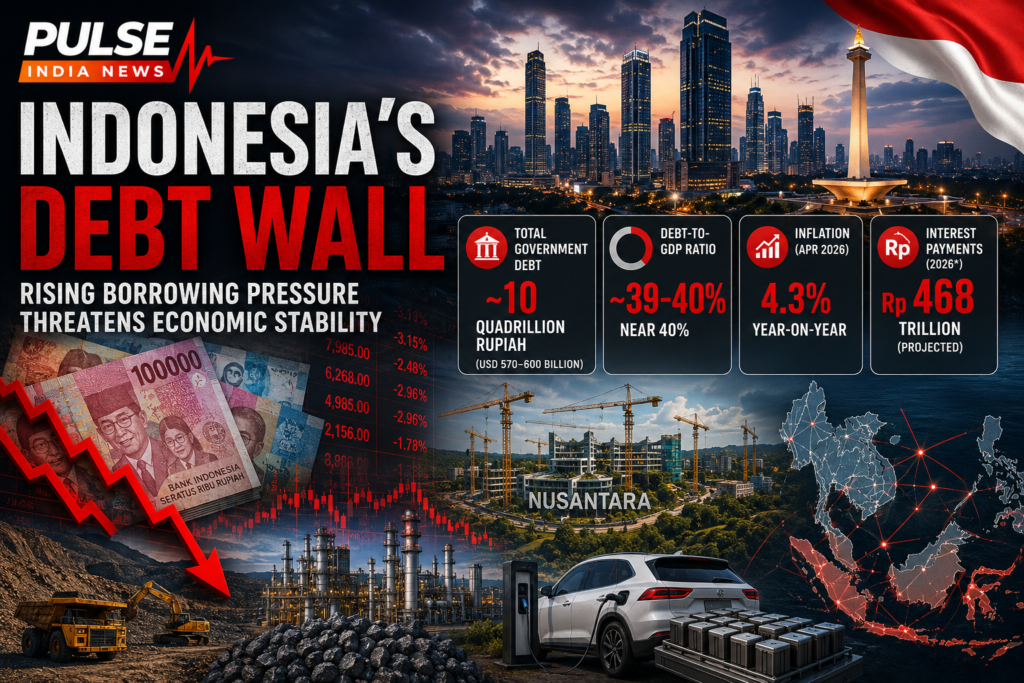
Indonesia, Southeast Asia’s largest economy, is facing mounting financial pressure as rising debt repayments, weakening currency conditions, and slowing economic momentum trigger fresh concerns among economists and global investors.
A recent report by Asia Times warned that Indonesia may be approaching a critical “debt wall” phase, a period where large volumes of government debt mature within a short span, forcing the country to refinance aggressively at potentially higher borrowing costs.
Analysts say the situation is exposing deeper structural weaknesses in an economy increasingly dependent on debt-funded growth.
📉 Indonesia’s Debt Continues to Climb
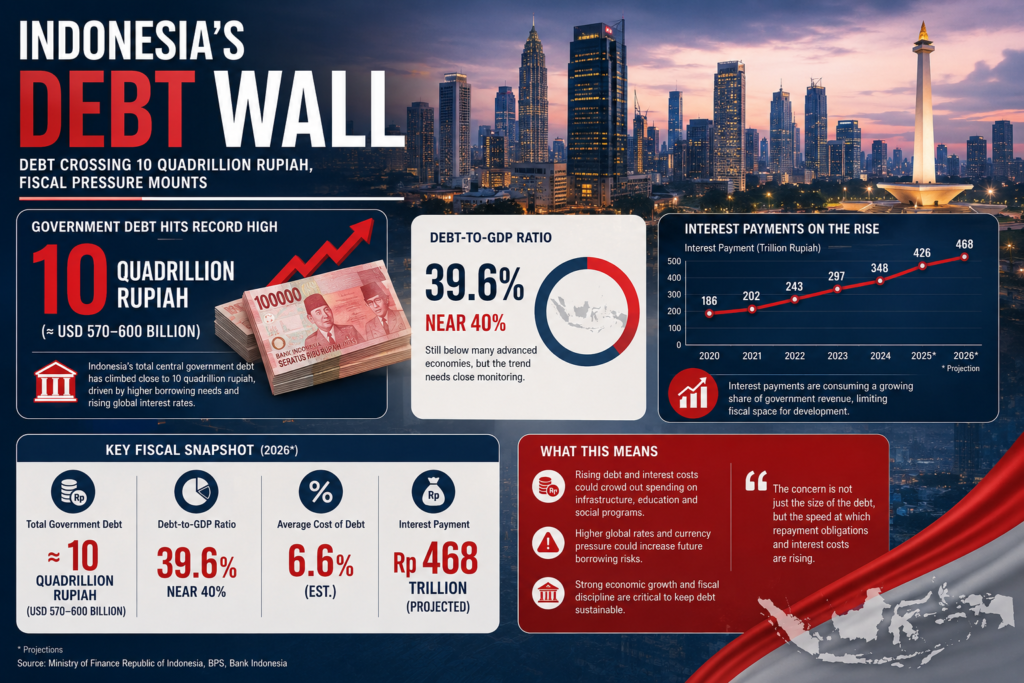
Indonesia’s total central government debt has reportedly climbed close to 10 quadrillion rupiah (around $570–600 billion).
Despite the large figure, Indonesia’s debt-to-GDP ratio currently remains around 39–40%, which is still lower than many advanced economies.
However, economists warn that the concern is not just the debt ratio itself, but the pace at which debt servicing costs are rising.
A growing portion of government revenue is now being used to pay interest obligations rather than funding development projects, infrastructure, or welfare programs.
Analysts fear that if borrowing costs continue rising faster than economic growth, Indonesia could gradually enter an “interest payment spiral” where new debt is increasingly used to repay older loans.
📈 Inflation and Currency Pressure Adding Stress
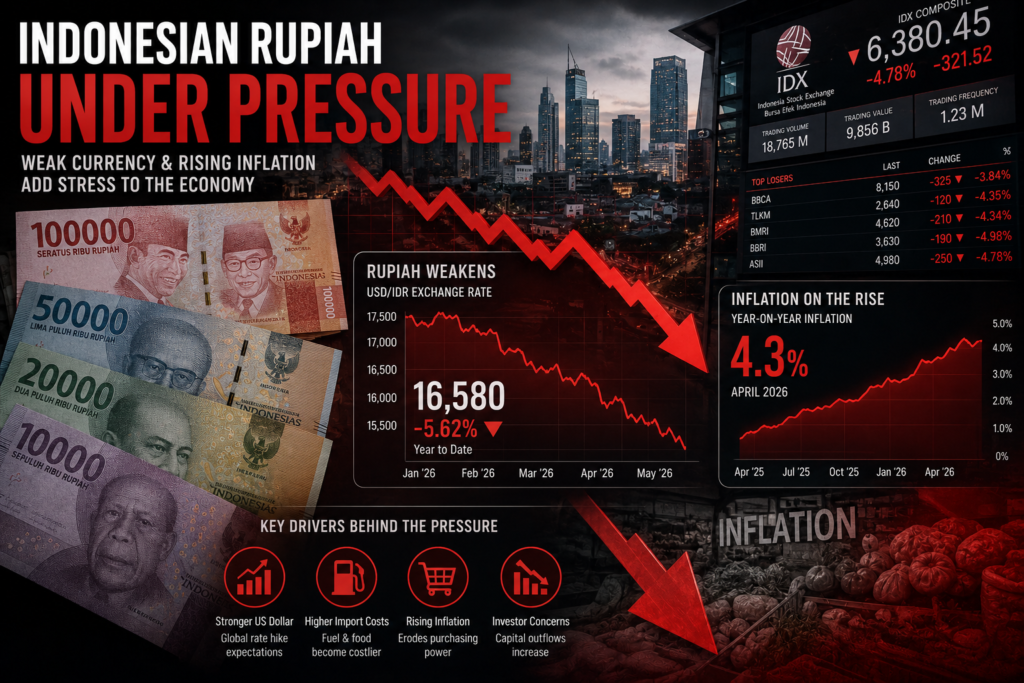
Indonesia has also been battling inflationary pressures over the past two years.
The country’s inflation rate has fluctuated between 3% and 5%, driven mainly by:
- Higher global energy prices
- Food inflation
- Currency weakness
- Import cost increases
The weakening Indonesian rupiah has become another major challenge.
A softer currency increases the burden of foreign-denominated debt and raises import costs for fuel, machinery, electronics, and industrial raw materials.
Foreign exchange reserves have also shown signs of pressure in recent months, adding to investor nervousness.
Some analysts have cautiously drawn comparisons with the 1997 Asian Financial Crisis, when Indonesia suffered a massive currency collapse and economic meltdown.
However, experts note that Indonesia’s banking system and reserve buffers today are considerably stronger than during the 1997 crisis.
🏗️ Sectors Likely To Be Hit Hardest
If debt stress and currency volatility continue rising, several major sectors of Indonesia’s economy could face significant pressure.
⚡ Energy Sector
Indonesia still relies heavily on imported fuel and energy-linked commodities.
A weaker rupiah makes imports more expensive, increasing subsidy burdens on the government and raising operational costs for industries.
🏭 Manufacturing Sector
Indonesia’s manufacturing industry depends heavily on imported machinery, electronics components, and industrial materials.
Currency weakness and higher borrowing costs could reduce production efficiency and hurt export competitiveness.
🚗 EV & Nickel Industry

Indonesia has positioned itself as a global hub for nickel processing and electric vehicle battery supply chains.
However, slowing global demand, falling commodity prices, or reduced foreign investment could directly affect this strategically important sector.
🏗️ Infrastructure & Construction

Large infrastructure projects, including the development of Indonesia’s new capital city Nusantara, require enormous financing.
If borrowing costs rise further, several projects could face delays, cost overruns, or funding constraints.
🏦 Banking & Financial Sector
Banks may also come under pressure if corporate loan defaults rise due to slower economic growth.
Higher interest rates can weaken consumer spending, reduce credit growth, and increase financial market volatility.
⚠️ Ratings Agencies Watching Closely
Global ratings agencies are now closely monitoring Indonesia’s fiscal trajectory.
Analysts are increasingly concerned about:
- Expanding budget deficits
- Rising debt servicing costs
- Currency volatility
- Weakening investor confidence
Any downgrade in sovereign credit outlook could significantly increase borrowing costs further and trigger capital outflows from emerging markets.
🌏 Why Indonesia’s Economy Matters Globally
Indonesia is not just another emerging economy.
It plays a major role in:
- ASEAN economic stability
- Global nickel supply chains
- Electric vehicle battery production
- Maritime trade routes
- Southeast Asian manufacturing networks
Any prolonged financial instability in Indonesia could create ripple effects across Asian markets, commodity prices, supply chains, and investor sentiment toward emerging economies.
📊 The Bigger Economic Question
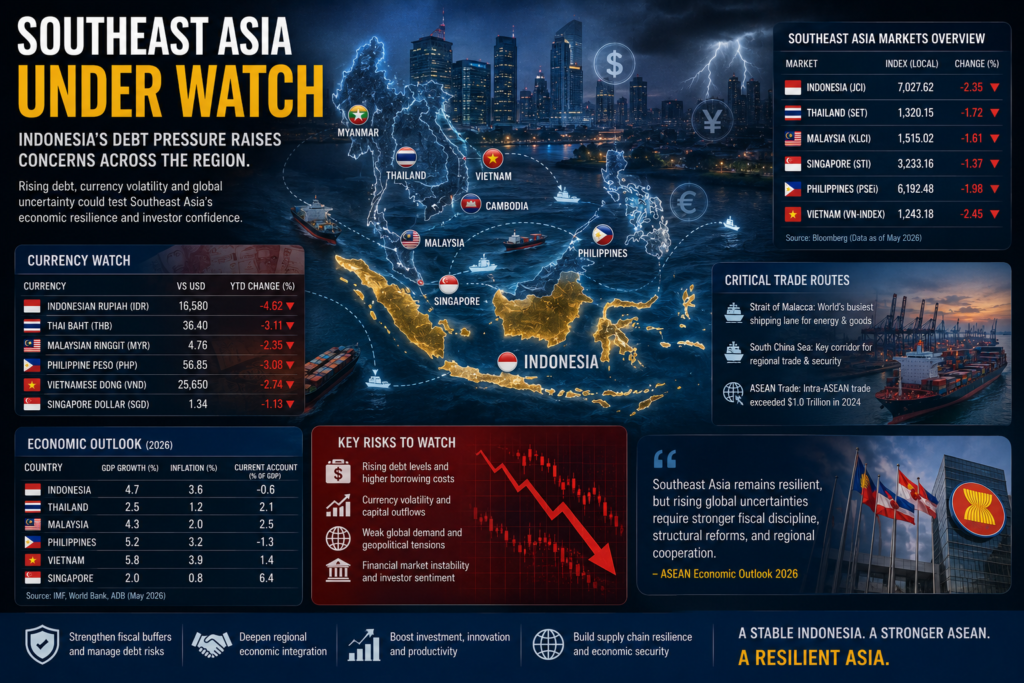
The situation has reignited a wider debate across developing economies about whether emerging markets can continue sustaining growth through large-scale borrowing at a time when global interest rates remain elevated.
For Indonesia, the answer could shape the country’s economic trajectory for the rest of the decade.
While the government insists that debt levels remain manageable and economic fundamentals remain stable, investors will continue closely watching whether growth can outpace the rapidly rising cost of borrowing.
Until then, Indonesia’s economy may continue operating under increasing financial pressure, and on what critics describe as “borrowed time.”