📅 July 12, 2026 | By Pulse India News Desk
Historic Auckland meeting delivers new maritime-security arrangements, a NZ$7-billion trade target and deeper cooperation in agriculture, tourism, education and disaster resilience
India and New Zealand have formally elevated their bilateral relationship to a Strategic Partnership, opening a new chapter in ties during Prime Minister Narendra Modi’s historic visit to Auckland.
Prime Minister Modi and New Zealand Prime Minister Christopher Luxon endorsed the India–New Zealand Strategic Partnership: Roadmap to 2030, which will guide cooperation between the two countries over the next four years.
The visit, held on July 10 and 11, was the first by an Indian Prime Minister to New Zealand in 40 years. It included a ceremonial welcome at Government House, restricted and delegation-level talks, meetings with business leaders and an address to the Indian community.
The two leaders described the relationship as being built on shared democratic values, growing economic opportunities, strong people-to-people connections and common interests in a stable and prosperous Indo-Pacific.
Roadmap to 2030 Gives Bilateral Ties a New Structure
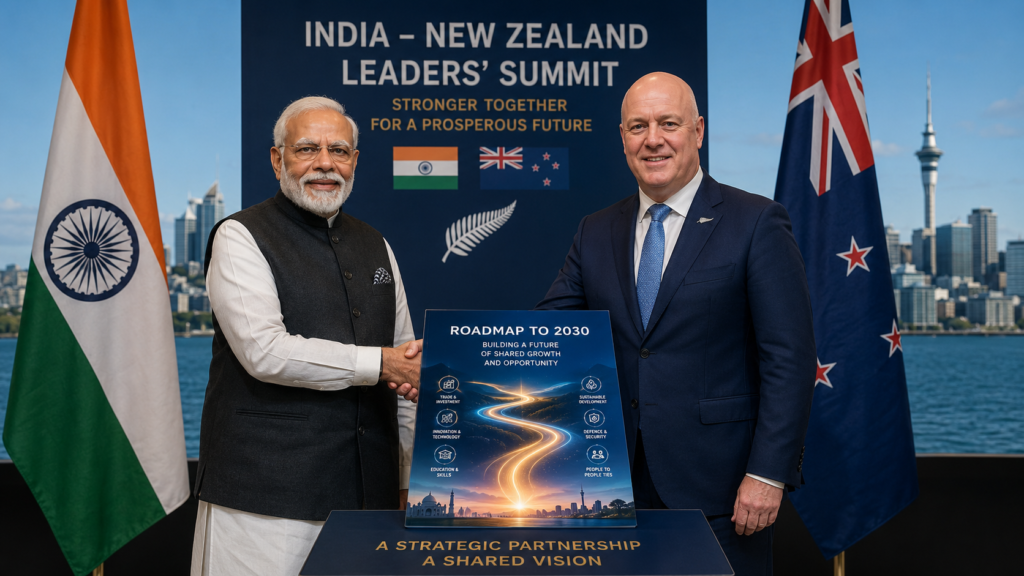
The Roadmap to 2030 is intended to convert growing political goodwill into sustained cooperation across trade, defence, maritime security, technology, agriculture, education, tourism, culture and sport.
India and New Zealand agreed to establish a regular Foreign Ministers’ Dialogue to provide strategic direction and review progress under the roadmap. Annual consultations between senior officials of India’s Ministry of External Affairs and New Zealand’s Ministry of Foreign Affairs and Trade will also be strengthened.
The two sides further supported more frequent exchanges involving ministers, parliamentarians, officials, businesses and academic institutions.
The roadmap represents a significant expansion of a relationship that had traditionally been driven primarily by education, migration, tourism, agriculture and cricket.
Bilateral Trade Target Set at NZ$7 Billion by 2030
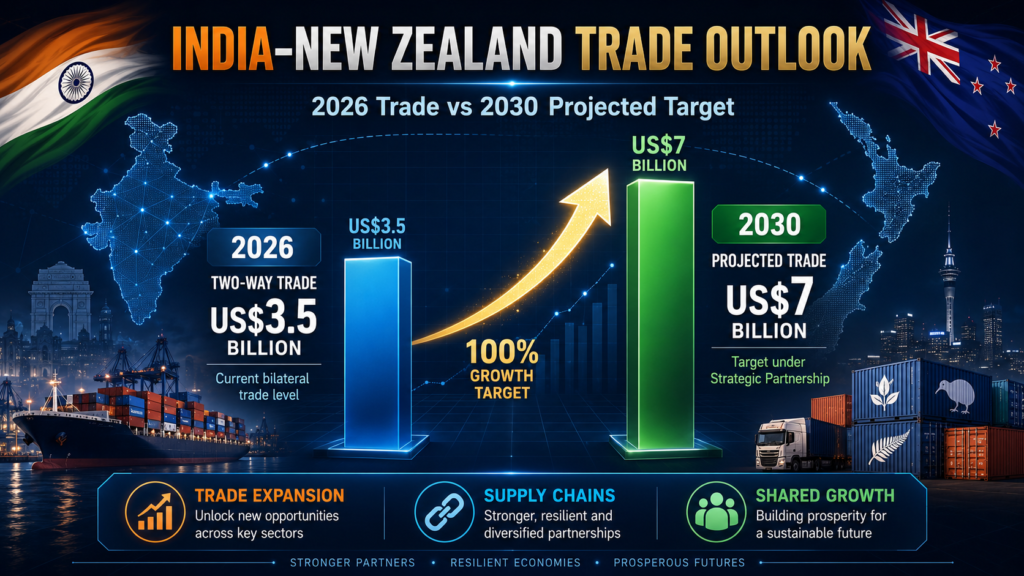
A major economic outcome of the summit was the decision to work towards doubling two-way trade in goods and services to NZ$7 billion, or approximately ₹35,000 crore, by 2030.
Current India–New Zealand two-way trade is estimated at around NZ$3.95 billion annually, indicating that both governments are seeking a substantial expansion in commercial activity over the remainder of the decade.
The leaders encouraged companies from both countries to increase investment, develop supply-chain partnerships and explore opportunities in sectors including advanced manufacturing, agricultural technology, clean energy, digital transformation, education and tourism.
The two governments also reiterated their support for the early entry into force and effective implementation of the India–New Zealand Free Trade Agreement.
FTA Becomes Economic Foundation of Strategic Partnership
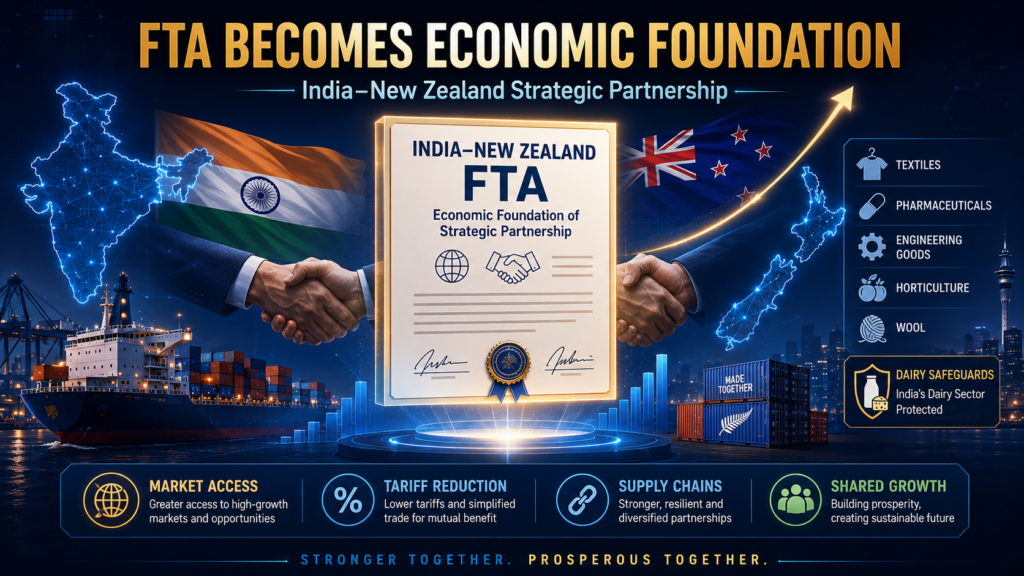
The India–New Zealand FTA was signed in New Delhi on April 27, 2026, following the conclusion of negotiations in December 2025. Negotiations had been launched in March 2025 and were completed in approximately nine months, making it one of India’s fastest trade negotiations with a developed economy.
Under the agreement, New Zealand will provide duty-free access to Indian exports across all tariff lines once the pact enters into force.
The arrangement is expected to benefit Indian textiles, apparel, carpets, leather products, footwear, pharmaceuticals, engineering goods, automobiles, auto components, gems and jewellery, ceramics and processed foods.
Several Indian products had previously faced New Zealand import duties of up to 10%. Their elimination could improve the competitiveness of labour-intensive Indian industries while creating opportunities for MSMEs, artisans and women-led businesses.
Strict rules of origin will determine whether products qualify for preferential tariffs, limiting the possibility of goods from third countries being rerouted through India merely to obtain duty-free access.
For New Zealand, the agreement will reduce or eliminate tariffs on 95% of its exports to India once fully implemented. Around 57% of New Zealand exports covered by the agreement are expected to receive tariff-free access from the first day of implementation.
The FTA will enter into force only after both countries complete their domestic ratification procedures.
Indian Dairy Sector Remains Protected
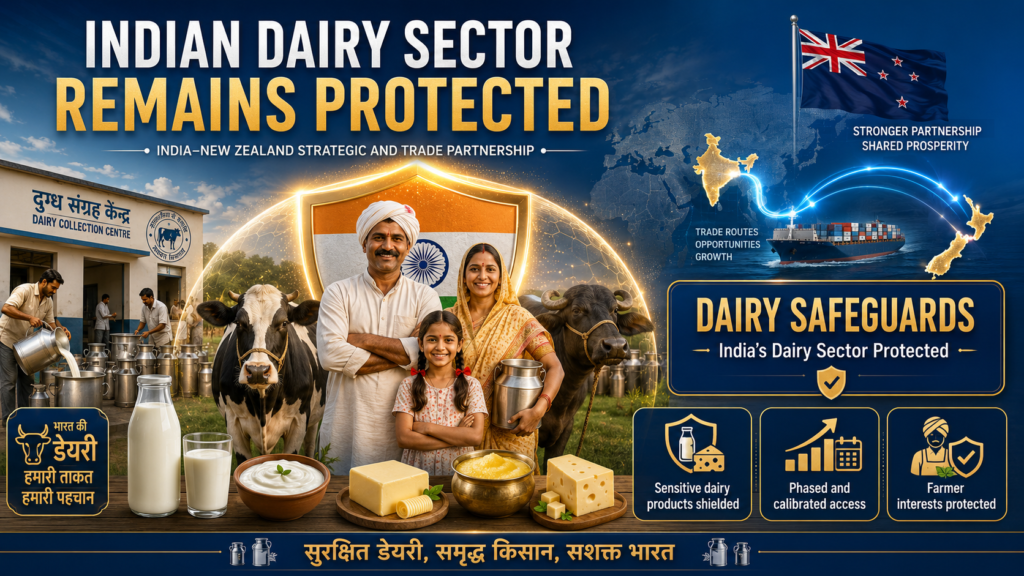
Agriculture and dairy were among the most sensitive subjects during the trade negotiations because New Zealand is one of the world’s leading dairy exporters while India supports millions of small and marginal dairy farmers.
The final agreement was presented by India as a calibrated arrangement designed to expand trade without exposing vulnerable domestic agricultural sectors to destabilising import competition.
India maintained protections for sensitive agricultural and dairy products while opening selected areas for cooperation in agricultural productivity, technology, animal husbandry and food processing.
Rather than creating unrestricted access for New Zealand’s mass-market dairy exports, the partnership focuses heavily on knowledge sharing, improved breeding practices, food safety, sustainability, post-harvest infrastructure and agricultural value chains.
This approach allows India to benefit from New Zealand’s technical expertise while retaining policy space to protect rural livelihoods and domestic price stability.
USD 20-Billion Investment Commitment
The FTA framework includes an expected USD 20-billion investment commitment from New Zealand into India over 15 years.
The proposed investment is expected to support India’s Viksit Bharat 2047 goals through cooperation in manufacturing, services, innovation, agricultural productivity, renewable energy, education, skills and technology.
The investment pledge also reflects New Zealand’s interest in gaining a stronger economic position in one of the world’s largest and fastest-growing major markets.
Both governments are expected to promote closer links between businesses, investors, start-ups, research institutions and industry organisations to translate the investment target into commercially viable projects.
Stronger Maritime and Defence Cooperation
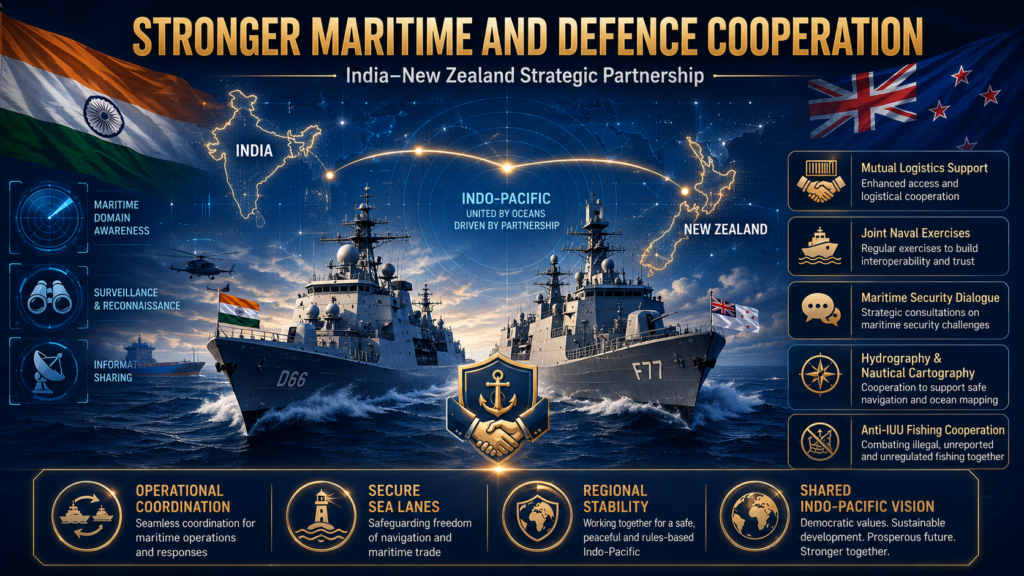
Maritime security emerged as one of the most strategically important elements of the Auckland summit.
India and New Zealand concluded a Maritime Cooperation Arrangement, an implementing arrangement covering hydrography and nautical cartography, and a Mutual Logistics Support Arrangement focused on the maritime domain.
The logistics arrangement will provide a framework for the two countries’ armed forces to support each other during authorised maritime activities, including through access to logistics, supplies and refuelling services.
The Maritime Cooperation Arrangement is expected to facilitate naval engagement, professional exchanges and bilateral exercises, improving interoperability between the Indian Navy and the New Zealand Defence Force.
The hydrography and nautical-cartography arrangement will support cooperation in surveying sea lanes, producing maritime charts and improving navigational safety.
Together, the agreements signal a shift from occasional defence engagement towards more regular and operationally focused maritime cooperation.
Annual Maritime Security Dialogue Announced
The leaders agreed to establish an annual Maritime Security Dialogue to improve coordination, exchange perspectives and strengthen information sharing.
New Zealand also nominated maritime security as its priority pillar under the India-led Indo-Pacific Oceans Initiative.
Future cooperation could cover maritime-domain awareness, navigational safety, humanitarian assistance, disaster relief, protection of shipping routes and measures against illegal maritime activities.
The summit also highlighted India and New Zealand’s earlier cooperation under Combined Task Force 150. In 2025, New Zealand commanded the multinational maritime task force while India served as deputy commander, contributing to efforts against narcotics smuggling, terrorism and illicit activity in the Middle East and Western Indian Ocean.
Shared Commitment to a Free and Open Indo-Pacific
Modi and Luxon reaffirmed their support for a free, open, peaceful and prosperous Indo-Pacific where sovereignty, territorial integrity and international law are respected.
They stressed the importance of freedom of navigation and overflight and called for maritime disputes to be resolved peacefully in accordance with international law, particularly the United Nations Convention on the Law of the Sea.
The two sides also backed ASEAN centrality and continued cooperation through regional platforms such as the East Asia Summit, ASEAN Regional Forum and ASEAN Defence Ministers’ Meeting Plus.
New Zealand reiterated its support for India becoming a permanent member of a reformed and expanded United Nations Security Council.
It also acknowledged the value of India joining the Nuclear Suppliers Group, particularly in the context of India’s clean-energy requirements and non-proliferation record.
Counter-Terrorism, Cybercrime and Organised Crime
India and New Zealand reaffirmed their commitment to closer cooperation against terrorism, cyber threats and transnational organised crime.
The two countries plan to strengthen practical coordination against narcotics trafficking, financial crime, cyber-enabled offences, people smuggling and human trafficking.
They also agreed to work towards the early formalisation of arrangements between relevant Indian and New Zealand agencies covering counter-narcotics and law-enforcement cooperation.
The security partnership is expected to include more regular dialogue, institutional contacts and collaboration through regional and multilateral forums.
Agriculture and Animal Husbandry Cooperation
Agricultural cooperation will remain an important pillar of the bilateral relationship.
The two governments welcomed an Agricultural Productivity Partnership under the FTA, with initial action plans covering kiwifruit, apples and honey.
New Zealand will support the establishment and development of Centres of Excellence for kiwifruit in India, combining research, training, improved cultivation techniques and post-harvest practices.
The two sides also concluded a Memorandum of Cooperation on Animal Husbandry and Dairying.
The arrangement is expected to promote technical exchanges in breeding, animal health, productivity, food safety, sustainability and dairy-farm management.
For India, the objective is to use international expertise to raise farmer incomes and productivity without compromising protections for its domestic dairy market.
Tourism and Prospect of Direct Flights
India and New Zealand signed a Memorandum of Arrangement on Tourism aimed at increasing visitor flows, institutional cooperation and promotion of both countries as travel destinations.
The two leaders again encouraged airlines to explore direct, non-stop flights between India and New Zealand.
Direct air connectivity could significantly reduce travel time, support tourism and business links and benefit the large Indian-origin community living in New Zealand.
It could also strengthen New Zealand’s appeal among Indian students and tourists while improving access to the Indian market for New Zealand businesses.
Education, Research and Student Mobility
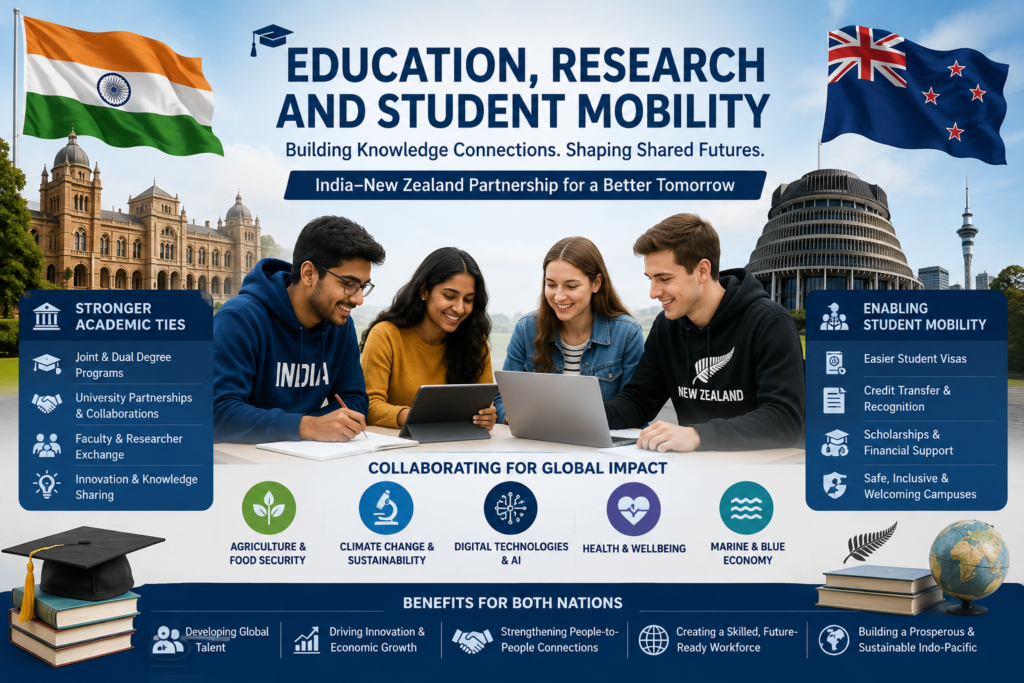
Education was recognised as a central pillar of the partnership.
Both governments agreed to encourage collaboration between universities, research organisations and companies in areas such as agriculture, climate science, digital transformation, innovation and emerging technologies.
The FTA’s mobility provisions are expected to create additional opportunities for Indian students and skilled professionals.
Official Indian trade documents state that eligible STEM bachelor’s and master’s graduates could receive post-study work rights of up to three years, while doctoral graduates could receive rights of up to four years.
The agreement also provides for a dedicated quota of 5,000 temporary employment-entry visas for Indian professionals.
These measures could strengthen New Zealand’s position as an education destination while helping its employers address skill shortages.
Disaster Management and Climate Resilience
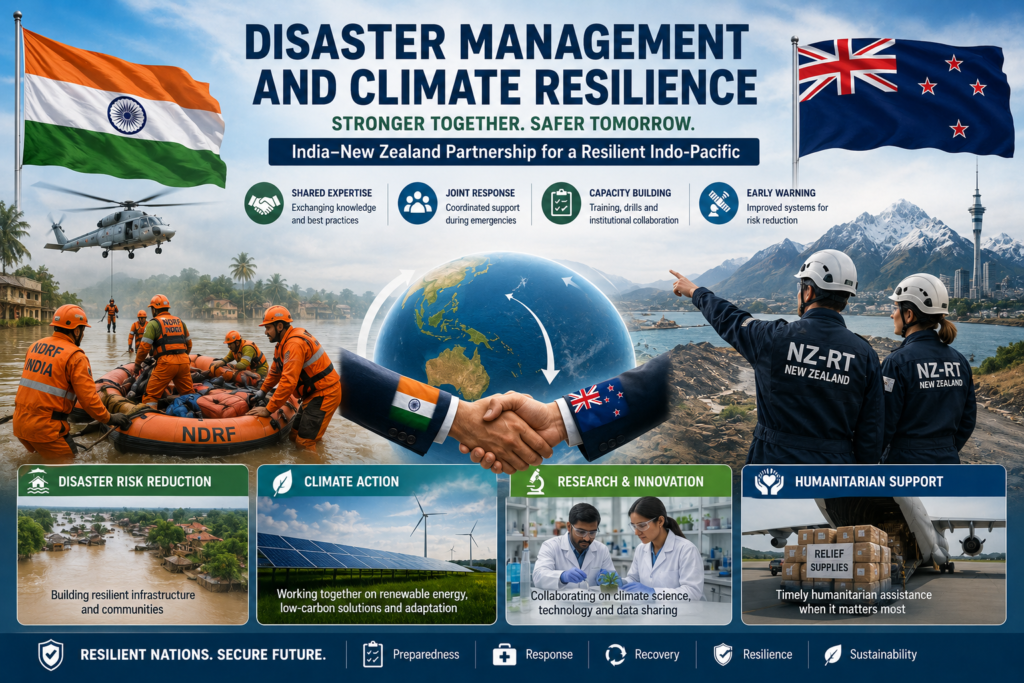
India’s National Disaster Management Authority and New Zealand’s National Emergency Management Agency signed a Memorandum of Cooperation covering disaster preparedness, response, recovery and resilience.
The partnership is particularly relevant because both countries face serious natural hazards, including earthquakes, tsunamis, cyclones, flooding and coastal risks.
Cooperation could involve early-warning systems, emergency planning, resilient infrastructure, professional training and the exchange of operational experience.
The two countries will also deepen engagement through the International Solar Alliance and the Coalition for Disaster Resilient Infrastructure.
Prime Minister Modi welcomed New Zealand’s decision to join the Global Biofuels Alliance.
Sports Partnership Expands Beyond Cricket

India and New Zealand marked 100 years of sporting connections in 2026 and welcomed a new India–New Zealand Joint Action Plan on Sport.
The plan covers high-performance training, coaching, sports science, grassroots participation, sports business and exchanges between national sporting organisations.
While cricket remains the most visible sporting link, the framework is designed to expand cooperation into other disciplines and create institutional partnerships between athletes, coaches, academies and sports-science organisations.
New Zealand’s expertise in rugby, sailing, rowing and high-performance sports systems could complement India’s rapidly expanding sports infrastructure and athlete-development programmes.
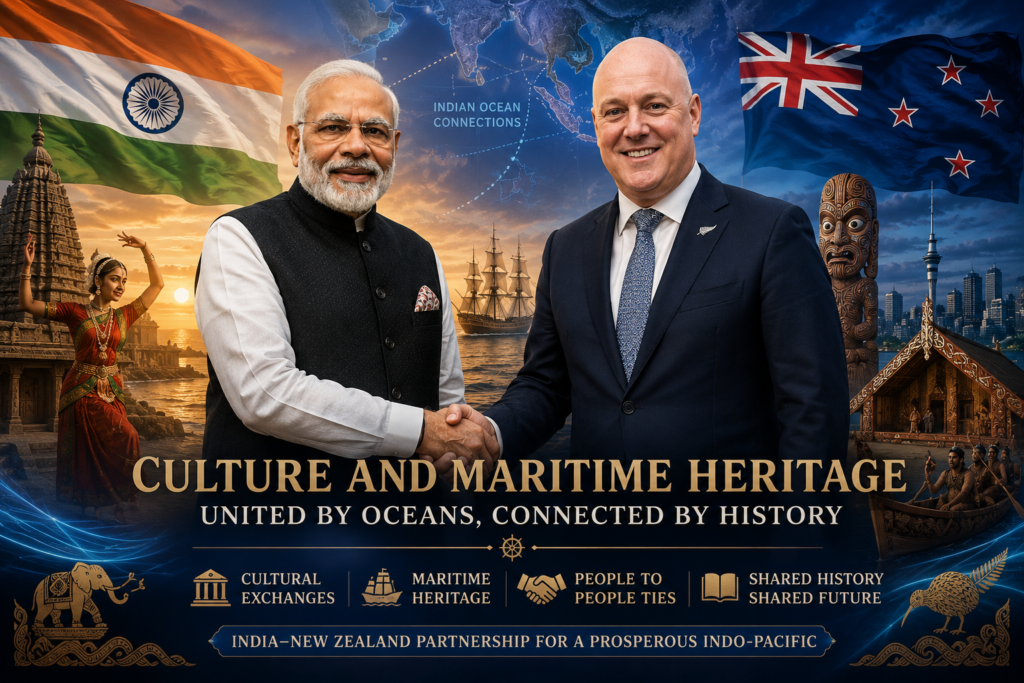
Culture and Maritime Heritage
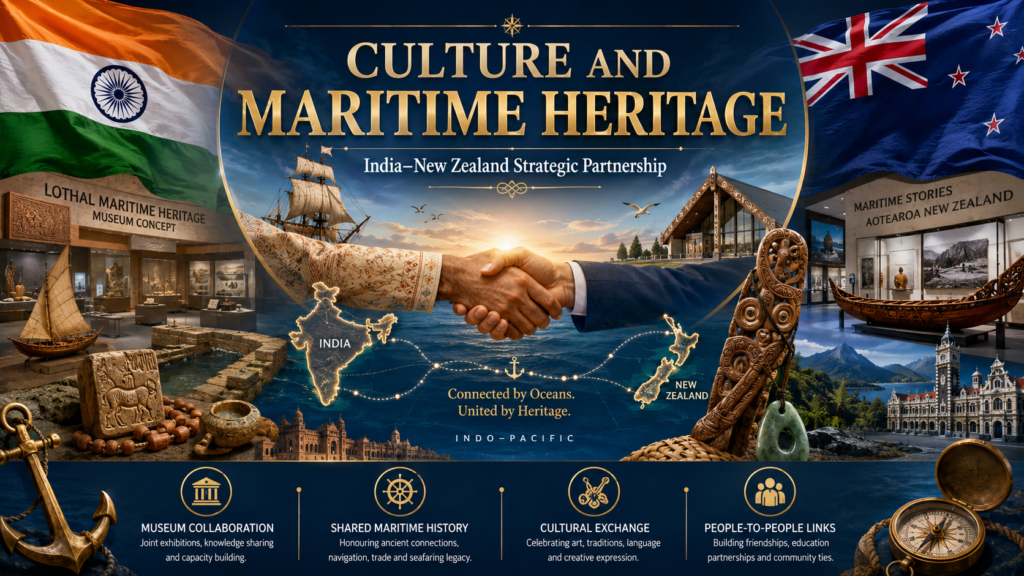
The two governments also supported deeper cultural cooperation, including engagement on traditional medicine and a new arrangement involving the National Maritime Heritage Complex at Lothal and the New Zealand Maritime Museum.
The partnership is intended to showcase the countries’ maritime histories, support museum exchanges and strengthen public understanding of historical links across the Indo-Pacific.
Both sides also highlighted the Indian community’s contribution to New Zealand’s economy, politics, culture, education and sporting life.
Prime Minister Modi addressed a gathering of more than 10,000 members of the Indian diaspora during the visit, with Prime Minister Luxon also participating.
What the Strategic Partnership Means
The Auckland summit marks a transition in India–New Zealand relations from a largely people-driven partnership to a broader strategic and economic relationship.
The FTA provides the commercial foundation, while the Roadmap to 2030 gives the partnership political direction and measurable goals.
For India, closer ties with New Zealand strengthen its outreach to the Pacific, expand opportunities for exporters and professionals and add another partner to its Indo-Pacific maritime network.
For New Zealand, the partnership provides improved access to India’s vast market, stronger links with a major Indo-Pacific power and opportunities to diversify trade beyond its traditional economic partners.
The success of the new strategic partnership will ultimately depend on how quickly the two countries implement the FTA, convert investment pledges into projects, establish regular security mechanisms and deliver direct benefits to businesses, farmers, students and professionals.
Nevertheless, the first visit by an Indian Prime Minister to New Zealand in four decades has produced a significantly more ambitious framework for bilateral ties, one centred on trade, technology, maritime security and long-term cooperation through 2030.