📅July 16, 2026 | By Pulse India News Desk
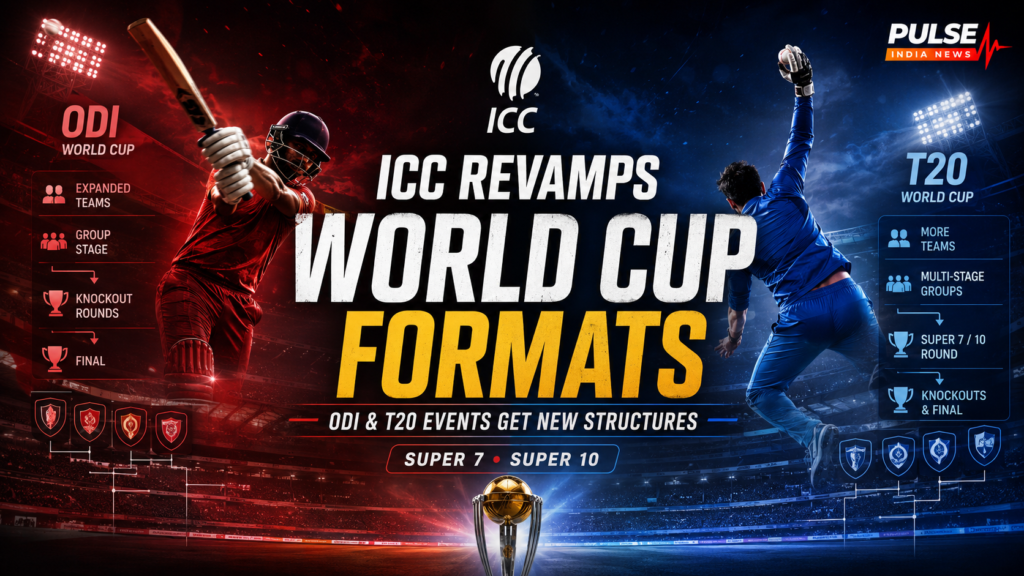
The International Cricket Council has proposed major changes to the formats of the men’s ODI World Cup and T20 World Cup, introducing additional rounds and new qualification systems designed to make more matches competitive and meaningful.
The changes were announced following the ICC’s annual meetings in Edinburgh. According to the governing body, the revamped formats are intended to improve competitive standards, create more high-stakes contests and deliver a better tournament experience for players and supporters.
The new ODI World Cup structure could be introduced from the 2027 tournament, while the revised T20 World Cup format and qualification pathway would affect future editions, including the 2028 competition.
Men’s ODI World Cup Format: What Is Changing?
The biggest change to the ODI World Cup is the expansion of the tournament from ten teams to 14 teams.
The 2019 and 2023 editions featured only ten teams competing in a single round-robin league before the semi-finals. The last ODI World Cup to include 14 teams was held in 2015.
Under the proposed structure, the tournament will contain four different rounds, including a newly introduced Super 7 stage before the semi-finals.
Round 1: Three Teams Compete for One Place
The three lowest-ranked participating teams, listed as teams 12, 13 and 14, will compete in the opening round.
Only the top team from this preliminary stage will progress to Round 2, where it will join the other 11 teams.
Round 2: Two Groups of Six
The remaining 12 teams will be divided into two groups of six teams each.
The top three teams from both groups will qualify for the Super 7 stage. One additional place will be awarded to the best-performing team that finishes outside the automatic qualifying positions across the two groups.
| ODI World Cup Stage | Format | Teams Advancing |
|---|---|---|
| Round 1 | Three-team preliminary round | One team |
| Round 2 | Two groups of six | Seven teams in total |
| Super 7 | Round-robin league | Top four reach semi-finals |
| Knockouts | Two semi-finals and final | Champion decided |
Super 7 Replaces the Super 6
The Super 7 will be one of the most important features of the new format. All seven qualified teams will face one another in a round-robin competition, with the top four teams progressing to the semi-finals.
Unlike some previous World Cup formats, teams will play every opponent in the Super 7 even if they have already faced that side during Round 2.
For example, if India and Pakistan are placed in the same Round 2 group and both qualify for the Super 7, they could meet for a second time during the tournament.
The ICC believes this system will ensure that every Super 7 fixture carries significant value and that teams cannot depend heavily on points or results carried forward from an earlier stage.
How Will the ODI World Cup Semi-Finals Work?
The top four teams in the Super 7 standings will qualify for the knockouts.
- Semi-final 1: First-placed team versus fourth-placed team
- Semi-final 2: Second-placed team versus third-placed team
The winners of the two semi-finals will advance to the World Cup final.
2027 ODI World Cup to Feature 57 Matches
The expanded tournament is expected to contain 57 matches, nine more than the 48 games played during the 2023 ODI World Cup.
The increase will provide more opportunities for emerging cricket nations while also ensuring that leading teams play several high-pressure matches before reaching the knockout rounds.
Men’s T20 World Cup Format: What Is Changing?
The ICC has also proposed a major restructuring of the men’s T20 World Cup, particularly the opening group stage and the second round.
The tournament will continue to feature 20 teams, but they will be divided into five groups of four instead of four groups of five.
The top two teams from each group will progress to the next stage, producing a ten-team second round.
Super 10 to Replace the Super 8
The existing Super 8 stage will be replaced by a Super 10 containing two groups of five teams each.
This change means that ten teams will reach the second phase of the competition instead of eight, potentially giving emerging cricket nations a greater chance of competing deeper into the tournament.
| T20 World Cup Stage | Proposed Structure |
|---|---|
| First Round | Five groups of four teams |
| Qualification | Top two teams from each group advance |
| Super 10 | Two groups of five teams |
| Knockout Qualification | Group winners qualify directly for semi-finals |
| Eliminators | Second and third-placed teams contest cross-group matches |
Group Winners Qualify Directly for Semi-Finals
The team finishing first in each Super 10 group will receive direct entry into the semi-finals.
This gives teams a strong incentive to finish at the top of their group rather than simply securing a place in the top three.
IPL-Style Eliminator Matches Introduced
Teams finishing second and third will still have an opportunity to reach the semi-finals through two cross-group Eliminator matches.
- The second-placed team from one group will face the third-placed team from the other group.
- The second-placed team from the opposite group will play the remaining third-placed team.
The winners of the two Eliminators will complete the semi-final line-up alongside the two Super 10 group winners.
The tournament will then proceed with two semi-finals followed by the final.
How the Proposed T20 World Cup Knockouts Will Work
- Five groups of four teams compete in the first round.
- The top two teams from every group reach the Super 10.
- The Super 10 is divided into two groups of five.
- The winner of each group qualifies directly for the semi-finals.
- Teams finishing second and third play cross-group Eliminators.
- The Eliminator winners advance to the semi-finals.
- The two semi-final winners contest the T20 World Cup final.
T20 World Cup 2028 Qualification Pathway Also Changed
The ICC has also revised the qualification pathway for the 2028 men’s T20 World Cup.
Scotland, who entered the 2026 tournament as a late replacement for Bangladesh, will receive direct entry into the Europe Regional Final.
Other teams that participated in the 2026 edition but failed to secure automatic qualification for 2028 will enter the Global Qualifier.
The remaining eight places in the Global Qualifier will be filled through regional competitions in:
- Africa
- Asia
- Europe
- Americas
- East Asia-Pacific
The highest-placed team from each region will qualify for the 2028 T20 World Cup. The next three best-performing teams across the regional qualification system will also secure places.
These eight qualifiers will join the 12 teams that secure direct qualification, completing the 20-team tournament.
Why Has the ICC Proposed These Changes?
The ICC wants to reduce the number of low-stakes matches and ensure that teams have more opportunities to recover from an early defeat without making the opening rounds meaningless.
The governing body also hopes that the expanded second stages will allow more emerging nations to compete against established teams in important matches, helping improve the overall standard of international cricket.
Will the New Formats Definitely Be Introduced?
Not yet.
The proposals have received endorsement from the ICC after being recommended by the Development Committee and the Chief Executives’ Committee.
However, they still require a final review by the ICC Finance and Commercial Affairs Committee, which is expected to consider the changes in November.
Until that approval is completed, the new ODI and T20 World Cup structures should be treated as proposed formats rather than fully confirmed competition rules.
Final Verdict
The proposed World Cup reforms represent one of the biggest changes to ICC tournament formats in recent years.
The ODI World Cup would expand to 14 teams and introduce a Super 7 round, while the T20 World Cup would move from a Super 8 to a Super 10 and add IPL-style Eliminator matches.
Supporters could see more matches between leading teams, including possible repeat contests during the same tournament. Emerging nations would also have a better chance of reaching the later stages and playing meaningful games against cricket’s biggest sides.
At the same time, the additional rounds could make the competitions longer and more complicated for casual viewers. Much will depend on how clearly the ICC schedules and presents the new structures.
For now, the cricketing world must wait until the Finance and Commercial Affairs Committee completes its review before the revamped formats receive final approval.