📅 May 05, 2026 | By Pulse India News Desk
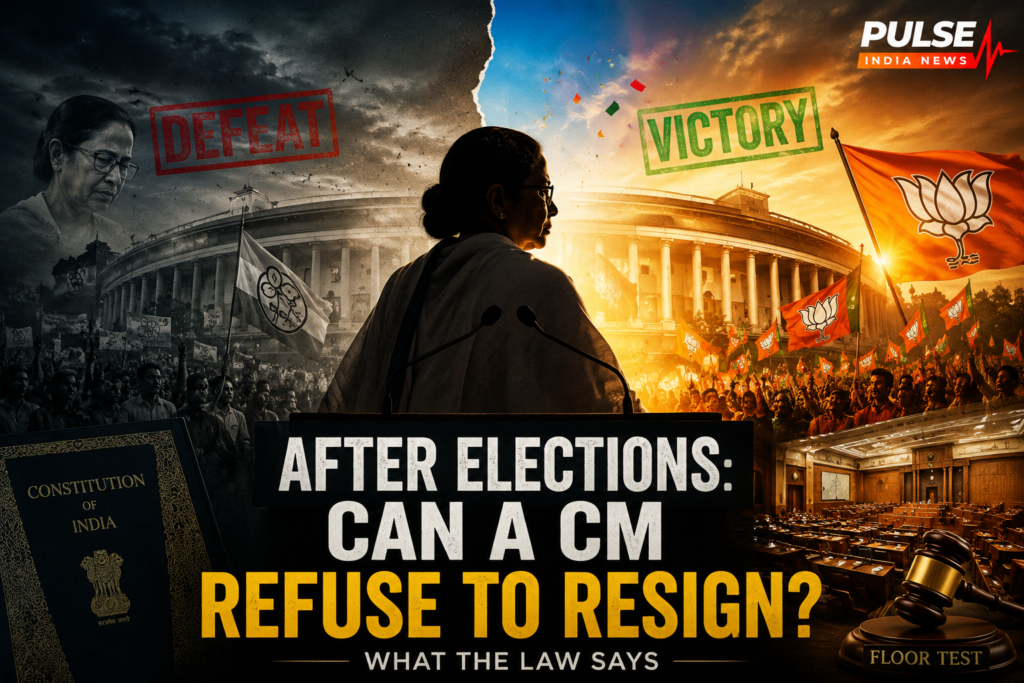
Kolkata: A constitutional question has come into focus after Mamata Banerjee indicated she would not immediately resign following her party’s defeat in the West Bengal Assembly elections.
With the opposition securing a clear majority, the spotlight now shifts to the legal and constitutional process governing transfer of power.
🔰 Does a Chief Minister Have to Resign After Defeat?
Under India’s constitutional framework, a Chief Minister does not automatically vacate office after election results are declared.
However, the position is contingent on majority support in the Legislative Assembly. Once that support is lost, the Chief Minister is expected to step down.
🧭 What Happens If the CM Refuses to Resign?
If a Chief Minister refuses to step down, the role of the Governor of the State becomes crucial.
The Governor can:
- Ask the CM to prove majority (floor test)
- If majority is clearly lost → direct the CM to resign
- If refusal continues → dismiss the government
⚖️ Role of the Governor
The responsibility to ensure a smooth transition lies with the Governor of West Bengal.
In such a situation, the Governor may:
- Seek clarity on whether the incumbent government retains majority
- Ask the Chief Minister to resign if majority is lost
- Invite the leader of the majority party to form the government
If the incumbent declines to step down, the Governor has the authority to act to facilitate government formation.
🧪 Is a Floor Test Required?
A floor test is typically used to determine majority on the Assembly floor.
But when election results clearly show a decisive majority for another party, a floor test may not be necessary. The outcome itself reflects the mandate.
🔄 What Happens Next?
The process generally unfolds in stages:
- The term of the outgoing Assembly comes to an end on May 07, 2026.
- The Governor invites the majority party to form government
- A new Chief Minister is sworn in along with the Council of Ministers
This ensures continuity of governance in line with constitutional norms.
⚠️ Can Refusal to Resign Delay the Process?
A refusal to resign does not alter the constitutional position.
The incumbent government cannot continue without majority support, and the Governor is empowered to ensure that the newly elected Assembly’s mandate is implemented.
🧾 The Bottom Line
India’s Constitution prioritises legislative majority over incumbency.
While a Chief Minister is not removed automatically after defeat, continuation in office depends entirely on proving majority.
In cases where the verdict is clear, the transition of power is expected to follow without delay.
🔗 Related News
- Tamil Nadu Hung Assembly 2026: What Happens Next, Who Will Form Government?
- Election Results 2026 LIVE Updates: State-Wise Results, Winners & Key Trends
- West Bengal Election Results 2026: BJP Victory Explained, What It Means Politically
- What is a Hung Assembly in India? Simple Explanation With Examples