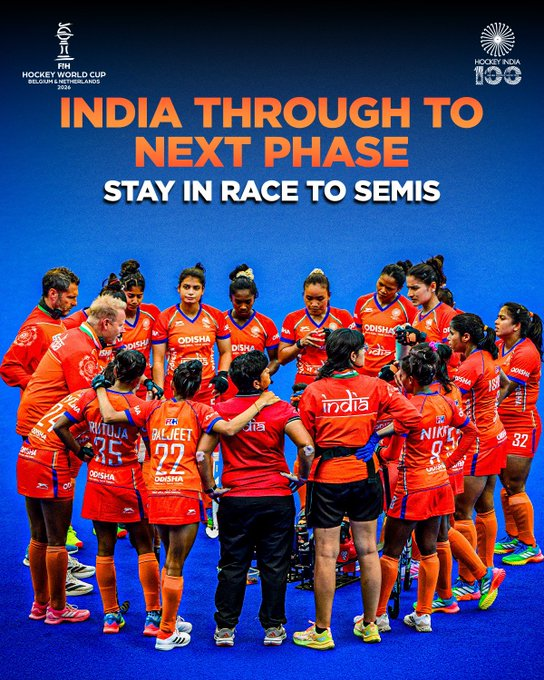
India produced a disciplined defensive performance to hold England 0-0 in their final Pool D match in Amstelveen, securing the point they needed to advance to the second round of the FIH Women’s Hockey World Cup 2026.
India entered the final Pool D match knowing exactly what was required: avoid defeat and qualification would be secured.
They achieved that objective with a composed and tactically disciplined 0-0 draw against England at the Wagener Hockey Stadium in Amstelveen.
It was not the free-flowing attacking performance India produced in the 6-1 victory over South Africa, but this was a different type of challenge.
England needed a victory and gradually increased the pressure, particularly after half-time, while India prioritised compact defensive spacing, controlled transitions and protecting the centre of the circle.
The result moved India to five points from three matches and secured their place in the tournament’s second round alongside China.
India complete Pool D unbeaten with one victory and two draws. The goalless result against England delivers the point required to send Salima Tete’s side into the second-stage Pool E.
Tense Opening as India Protect the Middle
The first quarter quickly established the tactical character of the contest.
England attempted to build patiently through their defensive line and push possession into wider attacking areas, while India remained compact through the middle.
Rather than pressing recklessly, India attempted to choose their moments to jump onto England’s receivers.
Salima Tete and the Indian midfield worked aggressively to close central passing lanes, forcing England to circulate possession away from dangerous areas.
India also threatened going forward and had a goal ruled out in the opening quarter, denying them the early advantage that could have dramatically altered the contest.
England Increase the Pressure
England’s position in the group meant a draw was not enough for them, placing increasing pressure on the side to attack as the match developed.
That urgency became more evident after the interval.
England pushed more players forward, attempted to increase the speed of their circle entries and looked to create opportunities from penalty-corner situations.
India responded by dropping into a more secure defensive structure rather than becoming stretched.
The backline stayed disciplined, while the midfield repeatedly recovered into defensive positions before England could exploit the space between the lines.
India’s structure frequently resembled a balanced 3-4-3 when attempting to move forward, but the defensive shape became considerably more compact whenever England controlled possession.
The priority was denying England clean central entries. India’s midfield narrowed quickly, forcing England towards the sidelines and reducing the number of direct attacks into the heart of the defensive circle.
When possession changed hands, India looked to release Navneet Kaur, Lalremsiami and the wide runners quickly rather than attempting long phases of possession.
England controlled more attacking territory as the match progressed, but India’s defensive block remained organised enough to prevent that pressure from producing the decisive goal England required.
India’s Defensive Discipline Makes the Difference
The most impressive aspect of India’s performance was their ability to defend without losing structure.
England had to attack because of the qualification equation, but India avoided becoming overly aggressive in their challenges around the circle.
That mattered because unnecessary fouls would have increased England’s penalty-corner opportunities.
India’s defenders instead focused on staying between the attacker and goal, delaying England’s progress and allowing supporting players to recover.
The deeper the match went, the more important that discipline became.
Goalkeeping and the Backline Hold Firm
England’s late pressure required concentration from India’s defensive unit and goalkeeper.
With England committing additional numbers forward, India faced a series of moments in and around the defensive circle where one missed tackle or failed clearance could have changed the qualification picture.
Instead, the backline remained composed and the goalkeeper dealt with the opportunities that reached the target.
The clean sheet ultimately became the foundation of India’s progression.
India vs England Match Timeline
India match England’s early intensity and look dangerous during quick attacking transitions.
India briefly appear to have broken the deadlock, but the effort is ruled out and the score remains 0-0.
A tactical opening half ends goalless, with India maintaining the result required for qualification.
England push higher in search of the victory they need, forcing India into longer defensive phases.
England commit numbers forward, but India’s defensive block and goalkeeping continue to deny a breakthrough.
India secure the point required to advance from Pool D into the second round.
Why the 0-0 Draw Was Enough for India
India’s qualification position had been transformed by their emphatic victory over South Africa.
Having entered the England match with four points, India needed only one additional point to guarantee progression.
The draw took them to five points, removing any dependence on other results.
England, by contrast, were unable to secure the victory required to move above India in the qualification race.
- Defensive structure: India protected the central corridor and forced England into wider attacking areas.
- Game management: India understood that they did not need to chase the match unnecessarily.
- Goalkeeping: Important saves helped India withstand England’s second-half pressure.
- Counter-attacking threat: India’s pace prevented England from committing every player forward without risk.
- Composure: India remained disciplined as England’s urgency increased late in the contest.
India’s Pool D Campaign
| Match | Opponent | Result | Points |
|---|---|---|---|
| 1 | China | 2-2 Draw | 1 |
| 2 | South Africa | 6-1 Win | 3 |
| 3 | England | 0-0 Draw | 1 |
India finish the opening phase unbeaten, collecting five points from three matches.
Pool D Qualification Picture
China and India advance from Pool D into the second stage of the competition.
India’s combination of an opening draw against China, the emphatic 6-1 victory over South Africa and the disciplined 0-0 draw with England proved enough to secure progression.
England’s failure to find a winner in the final fixture ends their challenge for one of the two qualifying places from the pool.
What Next for India?
Qualification is secured, but the difficulty level now increases considerably.
India move into Pool E alongside China and two of the tournament’s strongest sides: the Netherlands and Australia.
Under the second-stage format, India’s 2-2 result against China carries forward, meaning India do not play China again.
Instead, India will play crossover fixtures against the Netherlands and Australia, with the top two teams from Pool E advancing to the semi-finals.
Netherlands Present India’s Biggest Test Yet
India’s first crossover fixture represents a significant step up in difficulty.
The Netherlands possess the technical quality, pressing intensity and attacking depth to punish even small defensive mistakes.
India therefore cannot rely exclusively on the deep defensive structure that worked against England.
They will need to retain possession for longer phases, escape the Dutch press and create enough attacking threat to prevent the Netherlands from controlling the entire match inside India’s half.
Australia Add Another Physical Challenge
Australia’s pace, directness and physical intensity will provide a different challenge in India’s second crossover fixture.
India will need to protect possession under pressure and remain particularly alert during defensive transitions.
With only two new matches in the crossover phase, every point becomes extremely valuable.
A single victory could transform India’s semi-final qualification prospects, while two poor results could quickly end their title challenge.
India’s defensive organisation against England was excellent, but the second stage will require more than resilience.
India must improve their ability to retain possession after defensive recoveries. Against elite pressing teams, repeatedly clearing the ball without controlled possession will simply invite another wave of pressure.
Salima Tete and Navneet Kaur will therefore become even more important in carrying the ball through midfield, while Deepika’s penalty-corner threat remains a potential route to crucial goals.
- Escape the first press: India must move possession cleanly out of defence against the Netherlands and Australia.
- Convert limited chances: Opportunities are likely to be fewer than they were against South Africa.
- Penalty-corner efficiency: Deepika’s set-piece threat could become decisive in tight matches.
- Maintain defensive discipline: The structure displayed against England must remain a foundation.
- Attack with confidence: India cannot simply defend for 60 minutes against the world’s strongest teams.
India’s World Cup Campaign Enters a New Phase
India’s first objective has been achieved.
They have emerged from Pool D unbeaten and demonstrated three different qualities across their opening matches.
Against China, India showed resilience in a 2-2 draw. Against South Africa, they demonstrated attacking depth in a 6-1 victory. Against England, they displayed defensive discipline and game management.
The challenge now is combining all three qualities against stronger opposition.
The Netherlands and Australia will provide a far clearer indication of whether India are capable not simply of progressing through the World Cup, but of competing for a place in the semi-finals.
India did not need a spectacular performance against England. They needed discipline, patience and one point — and they delivered exactly that.
The 0-0 draw showcased a different side of Salima Tete’s team. After scoring six against South Africa, India demonstrated that they can also defend collectively when the tournament situation demands it.
England’s second-half pressure tested India’s concentration, but the defensive structure remained intact and the clean sheet secured qualification.
The reward, however, is a considerably tougher second stage featuring the Netherlands and Australia.
India are safely through Pool D. From this point onward, survival is no longer enough. To reach the World Cup semi-finals, they will have to prove they can compete with the tournament’s elite.