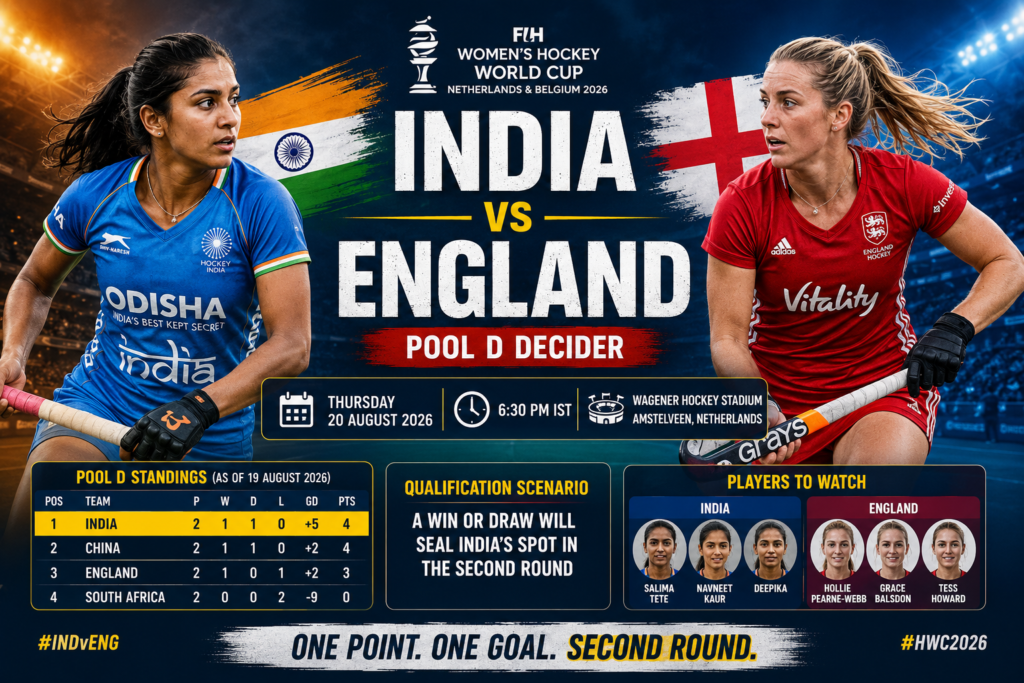
Pool D leaders India face England in a decisive final group-stage clash in Amstelveen, with Salima Tete’s side needing only a draw to guarantee qualification for the second round of the FIH Women’s Hockey World Cup 2026.
India enter their final Pool D fixture at the top of the standings with four points and a superior goal difference after drawing with China and defeating South Africa 6-1.
A win or draw against England guarantees India’s place in the second round. A defeat, however, could leave India’s qualification dependent on the result of China against South Africa.
India arrive at their biggest match of the group stage carrying momentum, confidence and a favourable qualification equation.
The emphatic 6-1 victory over South Africa transformed the Pool D standings and pushed India to the top of the group on goal difference ahead of China.
England, meanwhile, have no such luxury. With three points from two matches, they enter the contest knowing victory would place them firmly in the qualification positions.
That contrast in incentives could shape the tactical character of the game: England must attack, while India can afford to remain patient without becoming passive.
How India and England Enter the Match
Six different Indian players scored as India produced their strongest attacking display of the tournament and dramatically improved their goal difference.
England’s defensive structure came under pressure against China’s transition game, leaving them needing a strong result against India in the final pool fixture.
India Enter With Momentum After Six-Goal Statement
India’s victory over South Africa was significant not simply because of the margin, but because of the variety of their attacking play.
Sunelita Toppo, Navneet Kaur, Sushila Chanu, Deepika, Lalremsiami and Sakshi Rana all found the net as India repeatedly penetrated the South African circle.
The result demonstrated that India do not have to rely entirely on one scorer or one penalty-corner variation.
Against England, however, the space available in the attacking third is likely to be reduced considerably.
India are expected to use a fluid attacking structure resembling a 4-3-3, with Salima Tete driving the midfield press and the wide players pushing aggressively into advanced channels.
Without possession, India’s structure can become more compact, allowing midfield runners to close central passing lanes before triggering the press.
England are expected to favour a more patient build-up, attempting to move India from side to side before releasing attackers into the wide channels.
The key tactical question is whether India can press aggressively enough to disrupt England without opening spaces behind the midfield line.
Why England Could Leave Space for India to Counter
England’s qualification position means they cannot simply defend for a draw.
As the match progresses, particularly if the score remains level, England may have to push their midfield and defensive line higher in search of a winning goal.
That could create exactly the spaces India prefer to attack.
Salima Tete’s acceleration through midfield, Navneet Kaur’s intelligent movement and Lalremsiami’s pace can turn a defensive recovery into an attacking circle entry within seconds.
Three Battles That Could Decide India vs England
Salima Tete vs England’s Midfield Press
India’s captain will be crucial when England attempt to compress the centre. Her carrying ability can break the first line of pressure and turn defensive possession into attack.
Deepika vs Grace Balsdon – The Set-Piece Battle
Both teams possess dangerous penalty-corner options. Deepika provides India with a major scoring route, while Grace Balsdon can punish defensive errors at the other end.
Navneet Kaur vs England’s Central Defence
Navneet’s movement around the circle could become particularly important if England’s defensive line pushes higher while chasing victory.
India Probable Playing XI
Final starting combinations will be confirmed closer to pushback. Based on India’s available squad and recent combinations, the following represents a probable core XI.
- Goalkeeper: Savita
- Defence: Udita, Ishika Chaudhary, Sushila Chanu, Jyoti
- Midfield: Salima Tete (C), Neha, Nikki Pradhan
- Attack: Lalremsiami, Navneet Kaur, Deepika
- Goalkeeper: Sabbie Heesh
- Defence: Hollie Pearne-Webb (C), Anna Toman, Laura Roper, Grace Balsdon
- Midfield: Flora Peel, Lily Owsley, Shona McCallin
- Attack: Hannah Martin, Tess Howard, Elena Rayer
Note: These are probable combinations for match-preview purposes. Official starting line-ups may differ when announced before the match.
India Players to Watch
India’s midfield engine. Her acceleration, ball carrying and counter-pressing will be central to India’s ability to control transitions.
Her movement between defenders can become especially dangerous if England are forced to push numbers forward.
India’s major penalty-corner weapon can turn a tight game with one clean set-piece opportunity.
England Players India Must Watch
England’s experienced defensive organiser will be important in controlling India’s movement around the circle.
A dangerous direct set-piece option who gives India another reason to avoid unnecessary fouls around the defensive circle.
Her movement and work rate in advanced areas can stretch India’s defensive structure and create space for supporting runners.
- Control the opening quarter: India do not need to force the match and should avoid giving England an early momentum boost.
- Counter-press immediately: England must not be allowed clean exits after Indian attacks break down.
- Use the wide channels: Salima, Navneet and Lalremsiami can exploit the spaces created when England’s midfield pushes high.
- Win penalty corners: Deepika’s set-piece threat could decide a tight contest.
- Protect the defensive circle: Grace Balsdon makes unnecessary penalty corners particularly dangerous.
- Manage the scoreline: India need only a draw, but becoming overly defensive could invite sustained England pressure.
Pool D Standings Before India vs England
| Pos | Team | P | W | D | L | GD | Pts |
|---|---|---|---|---|---|---|---|
| 1 | India | 2 | 1 | 1 | 0 | +5 | 4 |
| 2 | China | 2 | 1 | 1 | 0 | +2 | 4 |
| 3 | England | 2 | 1 | 0 | 1 | +2 | 3 |
| 4 | South Africa | 2 | 0 | 0 | 2 | -9 | 0 |
India Qualification Scenarios Explained
| India Result | Points | Qualification Impact |
|---|---|---|
| India Win | 7 | India qualify automatically and remain strongly placed to finish top of Pool D. |
| Draw | 5 | India guarantee a top-two finish and advance to the second round. |
| India Lose | 4 | England move above India and qualification becomes dependent on China vs South Africa and the final tie-break calculations. |
Why a Draw Is Enough – But Playing for One Could Be Dangerous
India’s qualification equation is simple: avoid defeat and progression is guaranteed.
The tactical challenge is ensuring that the equation does not influence India into playing too conservatively.
Allowing England uninterrupted possession around the attacking 23 would increase the risk of penalty corners, circle entries and sustained pressure.
India’s safest route to qualification may therefore be to continue attacking with the same confidence displayed against South Africa rather than attempting to protect a scoreline for the entire match.
What Happens If India Qualify?
The top two sides from Pool D advance into the tournament’s second-stage crossover group.
India would then move into Pool E, where the qualified Pool D teams are combined with the leading teams from Pool A.
The next phase dramatically raises the stakes because only the strongest performers from the crossover stage remain in contention for the World Cup semi-finals.
For India, therefore, the England match is not simply about surviving Pool D. A strong result could provide valuable momentum before the tournament enters its decisive phase.
England’s need for victory should produce an aggressive contest, but that urgency could also create space for India’s fast transition game. Expect both teams to generate chances in a high-tempo encounter, with India capable of securing the draw required to guarantee progression.
India enter their final Pool D match in the position every team wants: top of the group, high on confidence and with qualification in their own hands.
The 6-1 victory over South Africa demonstrated India’s attacking depth, while the opening draw against China showed they can compete under pressure against stronger opposition.
England, however, represent a very different tactical challenge. Their experience, physical intensity and need for victory should make this a far more demanding contest.
For India, the key will be balance. They cannot retreat simply because a draw is enough, but they also do not need to chase the match recklessly.
If Salima Tete can drive the midfield press, Deepika remains dangerous from penalty corners and India’s forwards exploit the space England may leave while pushing for victory, India should have enough to earn the point they need and move into the second round.