📅April 23, 2026 | By Pulse India News Desk
🔴 Top Line
West Bengal has entered a decisive stage of its assembly elections, with first-phase voting underway across 152 constituencies in what is expected to be a closely contested battle. As the state begins its multi-phase polling process, the focus is firmly on how early trends could influence the direction of the overall election.
Polling stations witnessed steady voter turnout from the morning hours, with people lining up to cast their votes under tight security arrangements. With several key constituencies in this phase considered politically sensitive, the results could set the tone for the remaining rounds and shape the broader electoral narrative in the state.
“If you don’t vote, you lose the right to question those who govern.”
— Public awareness message
📊 What’s Happening Today?
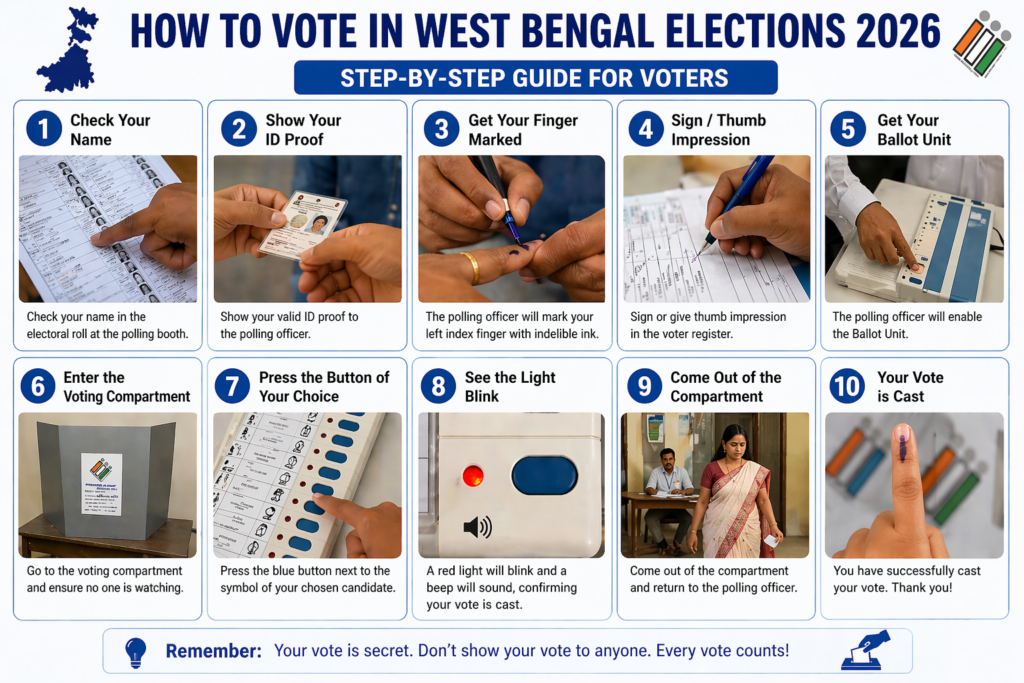
🗳️ How Voting Works
At polling booths, voting follows a clear and structured process to ensure smooth participation. Voters are required to complete identity verification using an approved document such as a voter ID card, Aadhaar card, passport or driving licence. After verification, polling officials apply indelible ink on the voter’s finger, following which the voter proceeds to cast their vote on the Electronic Voting Machine (EVM).
👉 Voter slips are usually distributed by Booth Level Officers (BLOs) or local election staff in advance.
👉 If you have not received your slip, you can check your details online here:
https://electoralsearch.eci.gov.in/
👉 You can also visit your polling station help desk to find your booth and serial number.
⚔️ Key Political Battle
The West Bengal assembly election is being viewed as a high-stakes contest, with the ruling Trinamool Congress (TMC) aiming to retain power under Chief Minister Mamata Banerjee. The opposition challenge is led by the Bharatiya Janata Party (BJP), which is seeking to expand its footprint and pose a strong challenge across key constituencies.
At the same time, the Communist Party of India (Marxist) (CPI(M))-led Left Front and the Indian National Congress alliance are also in the fray, attempting to regain relevance in select regions. While the primary contest remains between the TMC and BJP, the presence of multiple players could influence outcomes in closely contested seats.
👉 The outcome of this phase is likely to shape the momentum for the remaining rounds of polling, making early trends crucial in determining the overall direction of the election.
📊 Current Seats by Party in West Bengal Assembly
Before the 2026 election, the outgoing Assembly is dominated by the Trinamool Congress (TMC) with 213 seats, followed by the BJP with 77. Other parties and independents hold 4 seats. Total: 294 seats.
🚔 Massive Seizures During Election Checks
During election enforcement checks, large quantities of valuables including cash, gold, liquor and other items have been seized across West Bengal as polling begins. Authorities have intensified surveillance at check-posts, border areas and sensitive locations to prevent the illegal movement of money and goods during the election period.
Officials said multiple operations have led to the confiscation of significant amounts of unaccounted cash and valuables, as well as liquor stock meant for illegal distribution. Security agencies and flying squads have been actively monitoring movement across districts, particularly in constituencies going to polls in the first phase.
Authorities stated that the large-scale seizures reflect strict enforcement of election guidelines and heightened vigilance to ensure a fair and transparent polling process.
⚠️ Voter List Row Over Special Intensive Revision (SIR)
The ongoing Special Intensive Revision (SIR) of electoral rolls in West Bengal has triggered a political controversy, with the removal of several names sparking sharp reactions ahead of polling. Reports suggest that individuals suspected of being illegal immigrants have been excluded during the revision process.
The ruling Trinamool Congress has strongly criticised the exercise, with Chief Minister Mamata Banerjee alleging that the revision is politically motivated and could lead to the exclusion of genuine voters.
In response, the Bharatiya Janata Party has defended the SIR process, stating that electoral roll verification is necessary to ensure only eligible citizens are allowed to vote, calling it a matter of national security and electoral integrity.
👉 The issue has emerged as a key flashpoint in the election, adding to the intensity of the political contest in the state.
🔵 TMC Candidate Strategy Ahead of Polls
The Trinamool Congress (TMC) is expected to approach the elections with a balanced candidate strategy, focusing on retaining strong performers while making selective changes in constituencies where anti-incumbency is a concern.
Political observers note that the party leadership is likely to prioritise winnability and local feedback, ensuring that candidates with strong grassroots support are retained. At the same time, adjustments in certain seats could be aimed at addressing local dissatisfaction and improving electoral prospects.
Unlike large-scale reshuffles seen in some other states, TMC’s approach is expected to be more calibrated, focusing on targeted changes rather than sweeping replacements.
👉 The effectiveness of this strategy will depend on how well the party manages local dynamics and maintains organisational cohesion during the campaign.
🔴 BJP Strategy Focuses on Expansion and Consolidation
The Bharatiya Janata Party (BJP) is approaching the West Bengal elections with a strategy aimed at expanding its footprint while consolidating gains made in previous elections. The party is expected to focus heavily on constituencies where it performed strongly in the past, while also targeting swing seats to improve its overall tally.
Rather than a large-scale reshuffle, the BJP is likely to adopt a selective candidate strategy, balancing experienced leaders with new faces in key constituencies. Emphasis is being placed on candidate winnability, organisational strength and local outreach, particularly in regions where the party has seen growing support.
Political observers note that the BJP’s campaign is also centred around national-level issues, governance narratives and regional concerns, positioning itself as a strong alternative to the ruling establishment.
👉 The effectiveness of this approach will depend on how successfully the party converts its organisational strength and campaign momentum into votes across diverse regions of the state.
🎁 Freebies Take Centre Stage in West Bengal Poll Battle
Welfare promises and targeted benefits have once again emerged as a key feature of the West Bengal election campaign, with major parties attempting to appeal to different voter groups through a range of schemes. From financial assistance and subsidised services to support for women and rural households, campaign narratives have been heavily shaped by welfare-focused commitments.
The Trinamool Congress (TMC) has highlighted its existing welfare programmes and continuity in social schemes, while the Bharatiya Janata Party (BJP) has positioned its promises around expanding benefits and introducing new support measures. Other political players have also attempted to tap into voter sentiment through targeted welfare initiatives.
👉 While supporters view these schemes as essential social support, critics argue that the growing reliance on freebies reflects increasing competitive populism and raises concerns over long-term fiscal sustainability.
🎁 Top Freebie Promises by Party in West Bengal
| Party | Key Promise 1 | Key Promise 2 | Key Promise 3 |
|---|---|---|---|
| TMC | Doorstep medical care expansion | Continuation of existing women-focused welfare schemes | Education and public-service delivery promises |
| BJP | ₹3,000 monthly aid for women | Youth-focused financial support promises | New pay commission / employee relief pitch |
| Congress-Left | Jobs and employment focus | Public-service and welfare delivery promises | Industrial revival and livelihood support |
📊 West Bengal Debt vs Welfare: Key Data Points
🧠 Final Analysis
The West Bengal assembly election has entered a crucial phase, shaped by intense political rivalry, multi-phase voting dynamics and strong campaign narratives from competing alliances. The contest remains primarily centred around the Trinamool Congress and the Bharatiya Janata Party, making it one of the most closely watched electoral battles in the country.
Welfare schemes and targeted voter outreach have played a central role in the campaign, reflecting the importance of social support programmes in influencing voter sentiment across both rural and urban regions. At the same time, strict election monitoring, voter list controversies and heightened security deployment underline the intensity of the electoral process.
The ruling Trinamool Congress is aiming to retain power by highlighting its welfare model and governance record, while the BJP is focusing on expanding its support base and positioning itself as a strong alternative. The role of smaller parties, particularly the Left-Congress alliance, could also be significant in select constituencies where margins are expected to be tight.
With voting taking place in multiple phases, early trends are likely to influence voter behaviour in subsequent rounds, adding another layer of strategic complexity. Voter turnout, regional dynamics and constituency-level factors will ultimately determine the final outcome.
Related News
- Tamil Nadu Elections 2026: Voting Begins Across 234 Seats – Full Coverage
- DMK Drops 60 Sitting MLAs: What It Means for the Election Battle
- Ghatak UCAV Explained: India’s Stealth Drone for Future Warfare
- Freebies in Elections: Why Welfare Promises Dominate Campaigns
- How EVM Voting Works in India: A Simple Guide for Voters