📅 March 30, 2026 | By Pulse India News Desk
🔰 Big Move on Surveillance Security
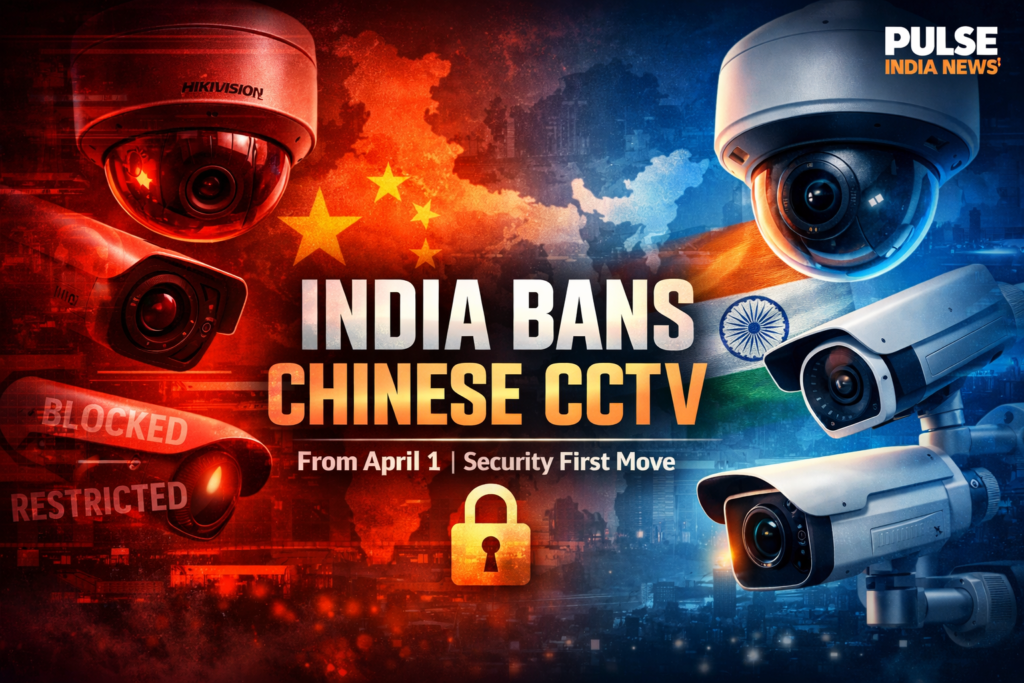
In a major step aimed at strengthening national security and data protection, the Indian government is set to ban the sale of internet-connected CCTV cameras from Chinese companies like Hikvision, Dahua, and TP-Link starting April 1, 2026.
The decision comes as part of new Standardisation Testing and Quality Certification (STQC) rules, making government approval mandatory for all CCTV products sold in India.
🧾 What is STQC Certification?
STQC (Standardisation Testing and Quality Certification) is a certification system run by the Indian government under the Ministry of Electronics and Information Technology (MeitY).
It ensures that electronic and IT products meet strict security, safety, and quality standards before being sold in India.
🔍 Key Requirements Under STQC for CCTV:
- 🔐 Cybersecurity Testing – Devices are checked for hacking risks and vulnerabilities
- 🧠 Firmware & Software Audit – Ensures no hidden backdoors or malicious code
- 🌐 Data Protection Compliance – Prevents unauthorized data transmission outside India
- 🧩 Component Transparency – Manufacturers must disclose chipsets and origin
- ✅ Government Approval Mandatory – Only certified devices can be legally sold
👉 Simply If a CCTV device is not STQC certified, it cannot be sold in India from April 1.
⚙️ What Are the New Rules?
Under the updated regulations:
- All CCTV cameras must obtain STQC certification
- Manufacturers must disclose origin of hardware components
- Devices must pass strict cybersecurity testing
- Non-certified products will be banned from sale
Authorities are reportedly denying certification to Chinese-origin systems or those using Chinese chipsets, effectively blocking brands like Hikvision, Dahua, and TP-Link.
🚫 Why Is India Taking This Step?
The move is driven by growing national security concerns, including:
- Risk of remote surveillance access
- Potential data leaks to foreign servers
- Use of compromised devices in critical infrastructure
With millions of CCTV cameras installed across India, ensuring secure surveillance networks has become a top priority.
📊 Major Impact on CCTV Market
This decision is expected to reshape the industry:
📊 Chinese vs Indian CCTV Brands – Key Comparison
| Feature | Chinese Brands (Hikvision, Dahua, TP-Link) | Indian Brands (CP Plus, Qubo, Matrix, Sparsh) |
|---|---|---|
| Price | Lower / Budget Friendly | Slightly Higher |
| Security | ⚠️ Concerns raised globally | ✅ Better compliance with Indian norms |
| Data Storage | May route via foreign servers | Mostly local / controlled |
| Government Approval | ❌ Likely to fail STQC | ✅ Easier compliance |
| Market Presence | ~30% earlier share | 80%+ growing rapidly |
| Future in India | 🚫 Restricted / Banned | 🚀 Strong growth expected |
- Chinese brands previously held ~30% market share
- Indian brands now dominate with 80%+ share
- Domestic companies like CP Plus, Qubo, Prama, Matrix, Sparsh likely to benefit
- Premium segment continues with Bosch, Honeywell
💰 Will CCTV Prices Increase?
- Prices may increase slightly in short term
- Compliance and certification costs will impact pricing
- Long-term: local manufacturing may stabilise prices
👥 What About Existing Users?
- No immediate impact on existing installations
- Ban applies only to new sales of non-certified devices
- Gradual shift expected toward certified and Indian brands
Boost for ‘Make in India’
The move aligns with:
- Atmanirbhar Bharat (Self-Reliant India)
- Stronger cybersecurity infrastructure
- Reduced dependence on foreign surveillance tech
🔚 Final Take
India’s move to enforce STQC certification and restrict Chinese CCTV brands marks a major shift toward secure and trusted surveillance systems.
While there may be short-term disruptions, the long-term impact will likely be stronger domestic growth, improved data security, and better regulatory control.