
Gold has always been one of the most trusted investments in India. Apart from its cultural significance in weddings and festivals, the yellow metal is also considered a safe financial asset during uncertain times. Over the decades, gold prices in India have witnessed an extraordinary rise. In 1947, the price of 10 grams of gold was around ₹88, while today it is approaching ₹90,000 to ₹1,00,000 per 10 grams in many markets.
This remarkable increase highlights how gold has preserved value across generations and why many investors consider it a long-term store of wealth.
Gold Price Growth: 1947 to 2026
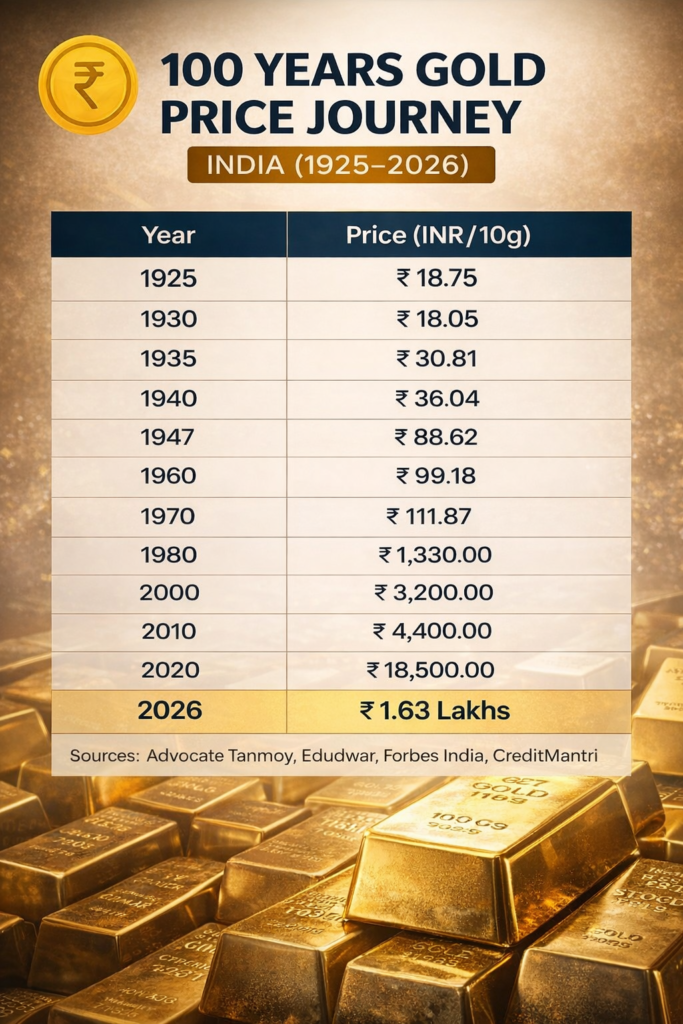
Gold prices in India have grown steadily over the years due to inflation, currency depreciation, and global economic trends.
The image clearly shows that gold prices have increased multiple times over the past seven decades.
Major Gold Price Milestones
1947–1960: Stable Prices
After independence, gold prices remained relatively stable due to controlled economic policies and limited global trade influence.
1970s: First Major Surge
During the 1970s, global economic instability and oil crises triggered a sharp rise in gold prices worldwide.
1980–1990: Rapid Growth
Gold crossed ₹1,000 per 10 grams in the early 1980s and reached around ₹3,200/ 10 Grams by 1990.
2000–2010: Investment Boom
Gold became a popular investment option, with prices rising sharply from around ₹4,400/ 10 Grams in 2000 to over ₹18,000/ 10 Grams by 2010.
2020–2026: Record Highs
Global uncertainty during the pandemic, rising inflation, and geopolitical tensions pushed gold prices to historic levels to a much as ₹1.63 Lakhs/ 10 Grams
Why Gold Prices Keep Rising
Inflation
Gold is widely seen as a hedge against inflation. When inflation rises, the purchasing power of currency falls, prompting investors to move their money into gold. This increased demand often pushes gold prices higher over time.
Global Economic Uncertainty
During global crises such as wars, pandemics, or financial instability, investors prefer safer assets. Gold is considered a reliable store of value during uncertain times. As demand increases, gold prices typically rise.
Rupee Depreciation
India imports a large share of its gold, and international prices are set in US dollars. When the Indian rupee weakens against the dollar, importing gold becomes more expensive. This directly leads to higher gold prices in the domestic market.
Central Bank Buying
Many central banks are increasing their gold reserves to diversify their assets. Large-scale purchases by central banks boost global demand for gold. This rising demand contributes to higher gold prices in international markets.
Gold as an Investment
Gold has historically provided stable long-term returns. Over the past 70 years, gold prices have increased thousands of percent, making it one of the most reliable stores of value.
Financial experts generally recommend allocating 5–15% of an investment portfolio to gold for diversification and risk protection.
Gold Demand in India
India is one of the largest consumers of gold in the world. The demand comes mainly from jewelry purchases during weddings and festivals such as Diwali, Dhanteras, and Akshaya Tritiya.

However, when prices rise sharply, consumers often postpone purchases, waiting for price corrections.
Future Outlook for Gold
Market analysts believe gold prices could remain strong in the coming years due to several global factors including inflation concerns, economic uncertainty, and central bank demand.
If these trends continue, gold may remain one of the most important safe-haven assets for investors worldwide.
Conclusion
Gold has proven to be one of the most reliable long-term investments in India. From just ₹88 per 10 grams in 1947 to nearly ₹1 lakh today, the precious metal has delivered remarkable growth over decades. Whether used for jewelry or investment purposes, gold continues to hold a special place in India’s economy and financial planning.

Pingback: Pakistan Faces Severe Fuel Crisis: Crude Oil Reserves May Last Only 11 Days - Pulse India News