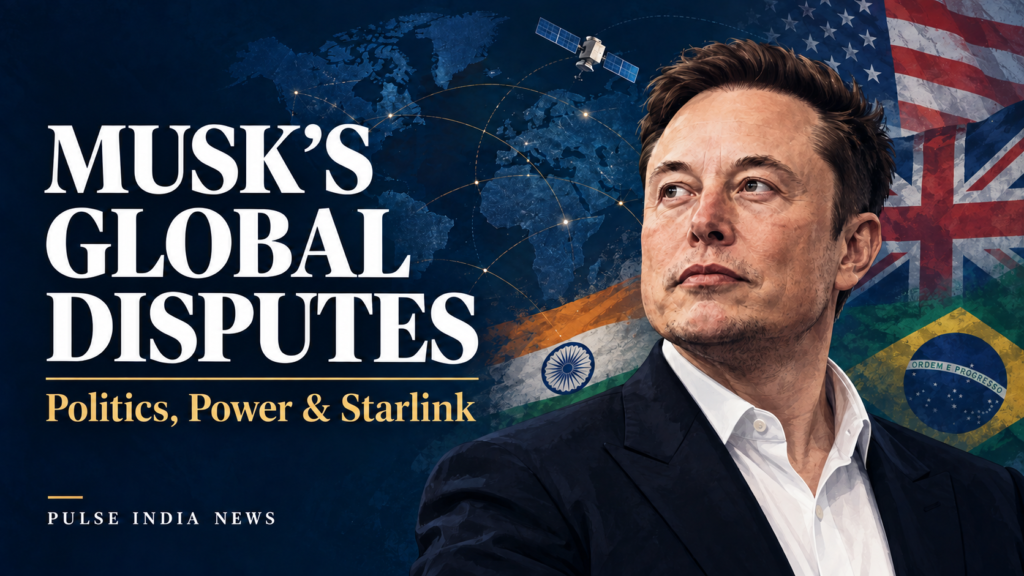
From Britain’s farm inheritance tax to Brazil’s court orders and Germany’s elections, Elon Musk has repeatedly entered political controversies. His enormous influence raises a question: where should a businessman draw the line?
Electric cars, rockets, satellite internet and a powerful social media platform – Elon Musk’s businesses have given him a worldwide presence. A single post from him can attract international attention.
But his influence now extends well beyond technology. He has criticised elected leaders, promoted parties in foreign elections, challenged judges and supported calls for Canadian provinces to separate.
These disputes are different, but a common concern connects them: business success does not give anyone an elected mandate to shape another country’s future.
Farm Inheritance Tax Drew a “Stalin” Remark
Musk’s arguments with Britain’s government included its changes to inheritance tax relief for farms.
The changes announced in the October 2024 Budget meant some agricultural estates would face inheritance tax when passed to the next generation. Farmers protested, arguing that valuable farmland did not necessarily mean families had enough cash to pay the tax. They feared some families could have to sell land to meet the bill.
Musk entered that debate in November 2024, accusing Britain of “going full Stalin.” His comparison turned a disputed tax policy into an accusation of authoritarian government.
His attacks were not limited to taxation. He also criticised Prime Minister Keir Starmer, called for his replacement and backed the right-wing Reform party.
Farmers’ concerns deserved serious answers. But describing the government in such extreme terms did little to explain the policy or help people assess it. Britain’s voters must judge those decisions through their own democratic process.
Removed Staff, Then Reversed Course
In Brazil, Musk’s confrontation with the judiciary became a dispute over whether X would follow court orders.
Supreme Court Justice Alexandre de Moraes ordered the platform to block accounts under investigation. Musk challenged the demands, describing them as censorship.
In August 2024, X closed its Brazilian office and dismissed its local staff. The company said it was protecting employees after alleged threats of legal action against its representative.
However, leaving the country without a legal representative created another problem. Brazilian authorities required one, and the platform was suspended after failing to meet the court’s requirements.
The stakes were substantial. A prolonged suspension put access to that large audience at risk.
X then changed course. In September, it appointed a legal representative again. It subsequently complied with the court’s demands, blocked specified accounts and paid outstanding fines. The court authorised its return in October.
The commercial pressure was clear. Remaining outside a market with millions of users carried serious consequences, and analysts described the eventual compliance as a pragmatic business decision.
Musk’s public defiance attracted attention. Ordinary users, meanwhile, lost access to the service. Ultimately, X had to meet the requirements it had resisted.
Open Support for the AfD
Musk also entered Germany’s election campaign.
Ahead of the February 2025 federal election, he supported the far-right Alternative for Germany party, known as the AfD. On January 9, he hosted its leader, Alice Weidel, on X and urged Germans to vote for the party. His intervention prompted concerns about outside influence during the campaign.
The concern was heightened by his ownership of X. Musk was promoting his preferred political outcome on a major platform that he controlled.
His endorsement does not prove that he determined the result. Nevertheless, it is reasonable to question the influence of a foreign billionaire campaigning for one party while owning a prominent venue for political debate.
His investments in Germany gave him a business interest in the country, not authority over its voters.
Supporting Calls for Separation
Musk’s recent comments on Canada went beyond criticism of a leader or policy. He supported Quebec, Alberta and Saskatchewan separating from the country.
Prime Minister Mark Carney responded on October 8 that Canadians would decide Canada’s future.
Separation could affect jobs, taxes, public services, trade and families. Such decisions require careful debate among the people who would live with the consequences.
For a billionaire abroad, it may be an online recommendation. For residents, it concerns the future of their country. Musk should recognise that difference.
A country’s future belongs to its people. Wealth and social media reach cannot replace their voice.
Starlink Put Private Power in the Spotlight
Musk’s influence also comes from the infrastructure his companies provide.
In September 2023, he said he had refused a Ukrainian request to activate Starlink coverage around Sevastopol for an attack on Russia’s fleet. He said he feared becoming involved in a major escalation.
His stated concern deserves consideration. But the controversy revealed the risks when military communications depend heavily on a private company.
Governments need clear agreements and oversight for essential services. Decisions with national security consequences should not rest on one businessman’s personal judgment.
The “One Big Beautiful Bill” Sparked a Bitter Feud
Musk’s relationship with Donald Trump showed how quickly a political alliance could collapse.
After supporting Trump’s return to the White House, Musk became closely associated with the administration’s government cost-cutting effort. But Trump’s major tax-and-spending package, known as the One Big Beautiful Bill Act, became a point of conflict.
On June 3, 2025, Musk called the legislation a “disgusting abomination.” He argued that its spending would increase the federal deficit—the gap between government revenue and expenditure.
The disagreement soon became personal. Trump threatened to cut government contracts involving Musk’s companies, while Musk escalated his attacks online. A dispute over public spending had turned into a confrontation involving major businesses and their relationship with the government.
Musk later expressed regret over some of his posts, saying they had gone too far.
This episode is different from his interventions abroad. As a US citizen, Musk has every right to participate in American politics and challenge legislation.
Still, it demonstrated how personal disputes between powerful figures can become entangled with public contracts, businesses and employees’ livelihoods.
Starlink Dispute Turns Into Attacks on Ambani and BJP Links
India has also become part of Musk’s growing list of public disputes. This time, the disagreement centres on delays in launching Starlink’s satellite internet services.
Musk alleged that powerful business interests were blocking Starlink to protect their position in India’s telecom market. He then directly targeted Reliance Industries chairman Mukesh Ambani, asking whether he was the “real boss of India.”
In another post, Musk sarcastically addressed the industrialist as “Prime Minister Ambani” and questioned whether he would allow Starlink to compete. A disagreement over business approvals had become a public attack suggesting that an industrialist controlled government decisions.
Musk widened the controversy on October 10 by sharing older media reports about alleged connections between Reliance-linked businesses and the Bharatiya Janata Party. The reports concerned political donations and a Reliance-funded firm’s alleged role in promoting BJP campaigns on social media.
The Indian government rejected allegations of favouritism. It said the approval process was fair and that satellite operators had to satisfy security requirements before starting commercial services.
Importantly, Starlink was not the only company waiting. Jio’s satellite venture and Bharti-backed OneWeb were also awaiting the remaining approvals needed to launch. Starlink had already received its telecom authorisation in June 2025, but that did not complete every requirement for commercial operations.
Competition could give Indian consumers more choices, particularly in areas with poor connectivity. Musk is entitled to question delays and seek clear answers. Equally, the government should explain its requirements and apply them consistently to every operator.
But suggesting that a businessman runs the country is a serious accusation. It requires evidence, not sarcasm. Musk’s commercial interest in entering India does not make his explanation for the delay an established fact.
A Powerful Voice Needs Responsibility
Governments, courts and political parties should face criticism. Musk has the same right as anyone else to express his views.
But his reach and business power make responsible conduct especially important. An election endorsement can attract worldwide attention. A confrontation with a court can disrupt services for millions. A decision about communications infrastructure can affect military operations.
Citizens must be able to debate these questions without treating a billionaire’s opinion as an instruction.
Musk can build businesses across borders and offer opinions across borders. The authority to decide a country’s future still belongs to its people.