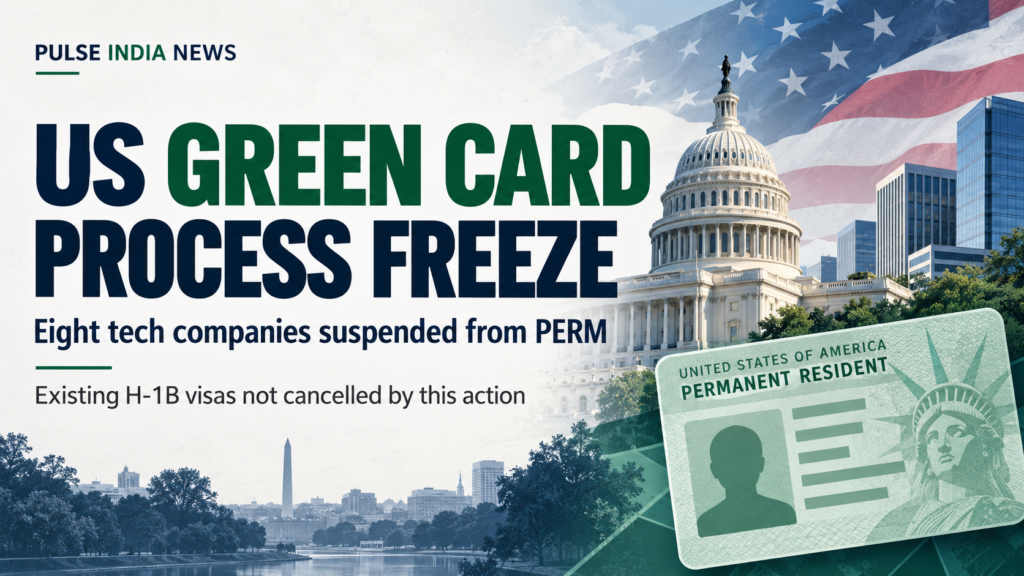
Microsoft, Adobe and six major IT services companies face a PERM suspension. Here is what has been halted, how companies have responded and why the impact depends on each employee’s immigration stage.
The US has suspended these companies from PERM, a key step in many employer-sponsored green card cases. The announcement does not itself cancel existing H-1B visas or already-issued green cards.
The United States has suspended eight major technology and IT services companies from its Permanent Labor Certification programme, escalating scrutiny of how businesses sponsor foreign workers for permanent employment.
Announced on October 8, the action prevents the Department of Labor from accepting new PERM applications or processing pending applications involving the named companies. For affected employees, it creates uncertainty over a route to permanent residence, particularly where immigration deadlines are approaching.
What exactly has been suspended?
New and pending PERM applications
The affected companies cannot submit new permanent labor certification applications, and pending PERM cases will not be processed under the announced suspension.
Existing H-1B status
The announcement does not itself revoke employees’ existing H-1B visas. Their ability to remain and work depends on their individual status, authorised stay and applicable immigration requirements.
H-1B and PERM serve different purposes. H-1B permits qualifying temporary employment in a specialty occupation. PERM is a labor certification process used in many applications for permanent residence. An employee can hold H-1B status while an employer separately pursues a green card case.
Which eight companies are affected?
| Company | Announced action |
|---|---|
| Microsoft | Suspended from PERM |
| Adobe | Suspended from PERM |
| Tata Consultancy Services — TCS | Suspended from PERM |
| Infosys | Suspended from PERM |
| Wipro | Suspended from PERM |
| HCL Technologies — HCLTech | Suspended from PERM |
| Cognizant | Suspended from PERM |
| Capgemini | Suspended from PERM |
Why wording matters: A freeze on PERM applications is not the same as cancelling every employee’s visa or suspending all green card categories across the United States.
Why has the administration taken this action?
The administration alleges that companies have misused foreign-worker immigration programmes at the expense of American workers. Vice President JD Vance criticised Microsoft’s layoffs alongside its use of immigration routes for skilled workers. Labor Secretary Keith Sonderling announced the PERM restrictions amid scrutiny of employer practices.
At the centre of the dispute is whether employers genuinely consider available US workers before sponsoring foreign employees and whether they follow recruitment and wage requirements.
Allegations and findings are different: The announcement should not be read as a final court judgment that all eight companies committed fraud.
What have the companies said?
Most H-1B filings concerned existing employees
Microsoft said approximately 80% of its H-1B applications in the previous fiscal year concerned extensions or changes of status for current employees rather than new recruitment.
The company also said H-1B employees receive the same pay as other employees doing comparable work. Its response challenges the assumption that every H-1B application represents a new foreign hire replacing an American worker.
No expected impact on workforce strategy or client engagements
TCS said it does not expect the suspension to affect its workforce strategy or customer engagements and would comply with Department of Labor directives.
It highlighted local recruitment, its presence across 31 US offices and delivery centres, and its intention to hire 15,000 people in the country over five years. TCS said its PERM applications were in single digits over the last two years.
Other companies: Adobe, Cognizant, Infosys, Wipro, HCLTech and Capgemini had not immediately responded to requests for comment in the initial reporting reviewed for this article. That reflects the reporting point, rather than a claim that no later response will follow.
What does US law require?
Employers must meet a labour-market test
Section 212(a)(5)(A) of the Immigration and Nationality Act generally requires a finding that sufficient able, willing, qualified and available US workers are unavailable for the position. Employing the foreign worker must also not adversely affect the wages and working conditions of comparable US workers.
The PERM framework is set out in 20 CFR Part 656. It requires prescribed recruitment and documentation, and applications may be approved, denied or selected for audit.
Layoffs can trigger additional requirements
Under 20 CFR 656.17(k), certain layoffs during the six months before filing require employers to notify and consider potentially qualified laid-off US workers. The rule concerns the relevant or a related occupation in the area of intended employment.
A company-wide layoff figure alone does not establish whether a particular PERM application broke the rules. The positions, location, timing and recruitment evidence matter.
PERM approval does not itself grant permanent residence
For cases requiring PERM, certification normally comes before an employer files a Form I-140 immigrant petition. Permanent residence requires additional steps, eligibility and an available immigrant visa.
A separate legal question: These rules explain the normal certification process. Whether the new company-wide suspensions meet applicable legal and procedural requirements is a distinct issue.
What does this mean for employees?
Two employees at the same company may face very different consequences. The key questions are how far their green card cases have progressed and how much authorised stay remains.
| Your immigration stage | What needs attention |
|---|---|
| PERM not yet filed | The affected employer cannot begin that filing while the restriction applies. |
| PERM pending | Processing is halted under the announcement, delaying the next stage. |
| PERM already approved | Review subsequent filing deadlines and any further government instructions. |
| I-140 already approved | Extension eligibility and later-stage immigration options require an individual assessment. |
| Near the H-1B six-year limit | A delayed filing may affect the ability to establish a basis for further extensions. |
| Already a green card holder | The PERM announcement does not itself revoke existing permanent residence. |
Why the six-year limit matters
H-1B status generally has a six-year maximum, subject to exceptions. Qualifying workers may obtain extensions beyond that limit based on sufficiently old labor certification or immigrant-petition filings, or an approved immigrant petition where applicable visa limits prevent permanent residence.
This makes a filing freeze especially concerning for someone who has not yet established an extension basis. Someone with an existing qualifying filing may have different options. A pending PERM case does not automatically guarantee an extension.
A simple example
An employee with substantial H-1B time remaining may primarily face a delay in long-term settlement plans. An employee close to the maximum stay, without a qualifying extension basis, may face a more urgent immigration deadline. The same suspension can therefore create different levels of risk.
Families may also face uncertainty over dependent status, schooling and future employment decisions. These are potential consequences of a prolonged delay, rather than evidence that affected workers must immediately leave the United States.
How could companies be affected?
The immediate restriction concerns permanent labor certification. Wider business effects will depend on filing volumes, employee deadlines and the duration of the suspension.
Employee retention
Workers seeking permanent residence may reassess career plans if their employer-sponsored route remains blocked.
Compliance workload
Recruitment records, wage practices and immigration files may require closer review and additional legal resources.
Staffing decisions
Employees approaching immigration limits may need individual plans, potentially affecting project staffing.
Local recruitment
Employers may place greater emphasis on hiring workers who already have US work authorisation.
These are possible consequences, not confirmed outcomes across all eight companies. TCS’s statement illustrates why exposure differs: a business with very few recent PERM filings may anticipate limited direct disruption.
What happens next?
Implementation details
Written guidance will be important for identifying affected employing entities, the treatment of pending applications and the conditions for restoring access.
Investigations and employer submissions
Further findings, company responses and compliance measures may shape whether the restrictions continue or change.
Possible legal challenges
Companies could seek administrative or judicial relief over the authority, procedure or scope of the action. That is a possible next step, not a claim that a verified lawsuit has already been filed.
Individual employee assessments
Employers’ immigration teams will need to identify workers facing immediate deadlines and distinguish them from employees with more time or existing extension options.
No fixed reopening date: The announcement did not provide a confirmed end date. Employees and companies therefore cannot yet plan around a guaranteed resumption of PERM processing.
Quick answers to the biggest questions
Has the US cancelled H-1B visas for these eight companies?
The announced action targets PERM applications. It does not itself cancel existing H-1B visas. Each employee must still meet the conditions of their immigration status.
Must affected employees immediately leave the US?
The PERM suspension alone does not create an immediate departure requirement for every employee. Authorised stay, employment status and extension eligibility must be assessed individually.
Does this cancel an already-approved green card?
The announcement does not itself revoke already-issued green cards. Permanent residents are at a different immigration stage from workers awaiting PERM certification.
Can an employee move to another employer?
A move may be possible where the employee qualifies under applicable immigration rules. Changing an H-1B employer and continuing or restarting a green card case are separate questions; an existing PERM case should not be assumed to transfer automatically.
What should employees ask their immigration team?
Ask whether PERM has been filed or approved, whether an I-140 exists, when authorised stay expires, and what basis—if any—supports an extension. Also ask how the suspension affects the next scheduled step in the case.
When will the suspension end?
There is no confirmed end date in the announcement. Further government guidance, investigation outcomes and any legal proceedings will be important developments to watch.
Why this story matters
For employees, the central concern is an interrupted path to permanent residence. For employers, it is the challenge of retaining talent and managing immigration deadlines while their recruitment practices face scrutiny. The eventual impact will depend on the suspension’s duration, its implementation and each worker’s individual immigration position.