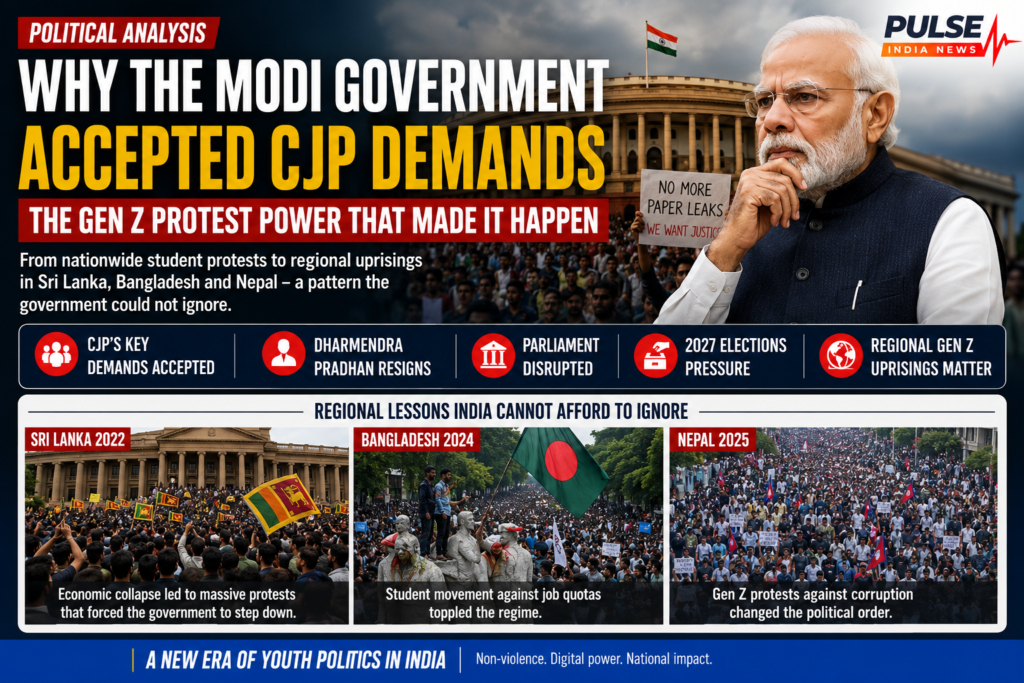
Dharmendra Pradhan’s resignation and the government’s concessions ended the immediate confrontation. The larger political calculation involved a rapidly expanding youth movement, pressure inside Parliament and the risk of alienating students and middle-class families before major state elections.
Published: July 26, 2026 | Political Analysis
The government was right to prevent the confrontation from escalating, but accepting demands cannot become a substitute for lasting examination reform.
India’s political establishment should treat the CJP agitation as a democratic warning. Students and their families cannot be expected to accept alleged paper leaks, administrative opacity or delayed accountability. The real measure of this settlement will be whether institutions become more transparent, examinations become more secure and future candidates are protected from the same uncertainty.
- Dharmendra Pradhan resigned after the CJP made his removal a central demand.
- The government agreed to withdraw protest-related cases and continue talks on compensation and examination reforms.
- The agitation was spreading beyond Delhi and becoming a political liability among young voters and their families.
- Regional youth uprisings in Sri Lanka, Bangladesh and Nepal provide context, but there is no official evidence that fear of those exact scenarios drove the Indian government’s decision.
New Delhi: The Narendra Modi government’s decision to accept the central demands of the Cockroach Janta Party on July 25 marked a sharp change after weeks of resistance.
Union Education Minister Dharmendra Pradhan resigned, the President accepted his resignation with immediate effect, and Pralhad Joshi was assigned additional charge of the Education Ministry.
The wider settlement included the withdrawal of cases connected to the agitation and continued deliberation on compensation and examination reforms. The CJP subsequently called off its protest and urged supporters to leave protest sites peacefully.
Officially, the development was framed as a response to students’ concerns and a step towards restoring confidence. Politically, however, the decision also appeared designed to prevent an expanding youth movement from developing into a prolonged national crisis.
The resignation ended the immediate confrontation, but it also showed how seriously the government had begun to view the political power of a digitally connected youth movement.
What the Government Agreed To
The agreement followed negotiations between government representatives and CJP organisers. The resignation of the Education Minister addressed the movement’s most visible political demand.
The government also agreed to withdraw cases registered against protesters and continue discussions on relief for affected families and a wider examination-reform charter.
- Dharmendra Pradhan resigned as Education Minister.
- Pralhad Joshi received additional charge of the Education Ministry.
- Protest-related cases are to be withdrawn.
- Relief and compensation are to be examined under applicable procedures.
- Further talks will consider examination security and reform proposals.
The Protests Were Spreading Beyond Delhi
What began as an online campaign and a demonstration at Jantar Mantar developed into a broader network of protests, solidarity gatherings and student actions in several cities.
Campuses, professional colleges and youth groups began responding independently. Images of detentions, alleged police action and large gatherings circulated widely, bringing more young people into the movement.
The continuation of the agitation despite administrative announcements indicated that the controversy could no longer be contained through technical measures alone.
Parliament and the Risk of a Prolonged Political Standoff
The protests also threatened to dominate the Monsoon Session of Parliament. Opposition parties had linked cooperation on examination legislation to political accountability over the controversy.
A prolonged standoff risked disrupting legislative business while keeping student anger, alleged police excesses and examination failures at the centre of national debate.
Accepting the resignation offered the government an immediate route to lowering tensions both on the streets and inside Parliament.
Fear of Alienating Gen Z and Middle-Class Families
The controversy affected far more than those physically present at protest sites. Competitive examinations shape the futures of millions of students and influence the hopes of entire families.
Parents often spend years of savings on coaching, accommodation and preparation. Allegations of paper leaks or unfair processes therefore strike directly at trust in social mobility and public institutions.
Allowing the agitation to continue risked creating lasting resentment among first-time voters, graduates, aspirants and middle-class households—groups no major political party can afford to ignore.
The movement connected examination integrity with wider concerns about unemployment, fairness, corruption allegations and trust in government. That combination could have transformed a single controversy into a durable youth backlash.
The 2027 Assembly Elections Raised the Stakes
The agitation also unfolded ahead of a politically important election cycle. Uttar Pradesh, Punjab, Goa, Manipur and Uttarakhand are due for Assembly elections in 2027, while Gujarat is expected to vote later that year.
Uttar Pradesh is especially important because of its 403 Assembly constituencies and 80 Lok Sabha seats. A shift in sentiment among students and first-time voters there can influence national politics.
Punjab, Goa, Manipur and Uttarakhand will also present difficult political contests. An unresolved national student movement could have followed ruling parties into every campaign rally, university town and examination centre.
Defusing the agitation in 2026 gave the government time to separate examination reform from the 2027 election narrative and reduce the risk of youth anger becoming a coordinated campaign issue.
Preventing Political Co-option
The CJP presented itself as independent of both the ruling party and the established Opposition. As the agitation intensified, however, opposition parties increasingly supported the students and used the protests to attack the government.
Continued delay risked allowing a student-led campaign to become the centre of a wider anti-government coalition.
Direct negotiations with protest organisers enabled the government to resolve the confrontation without making the Opposition the principal intermediary.
Regional Youth Uprisings Provided a Powerful Warning
There is no official evidence that the Modi government accepted the CJP’s demands because it feared an exact repeat of events in Sri Lanka, Bangladesh or Nepal.
Yet those regional movements provide important political context. Each showed how a specific grievance can expand when youth anger, economic anxiety, allegations of corruption, digital mobilisation and distrust of institutions begin reinforcing one another.
The Indian protests remained focused on examination accountability and ended through negotiation. They did not become a movement to remove the government. The comparisons are therefore cautionary rather than identical.
Sri Lanka: Economic Anger Became a National Uprising
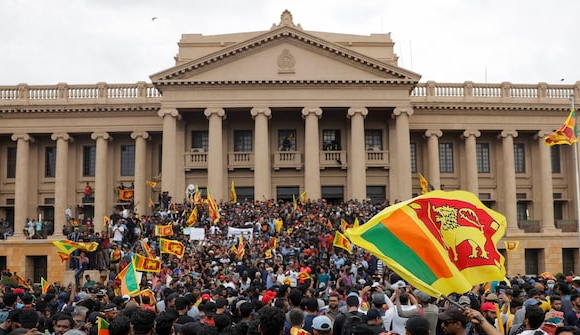
Sri Lanka’s 2022 Aragalaya movement grew amid shortages of fuel, food and medicine, long power cuts and soaring inflation. Protesters eventually entered the presidential residence and occupied the Presidential Secretariat.
The unrest forced President Gotabaya Rajapaksa to flee and resign. The episode demonstrated how a government can lose control when economic suffering and public distrust become nationwide.
Bangladesh: A Quota Protest Expanded Into a Political Revolt
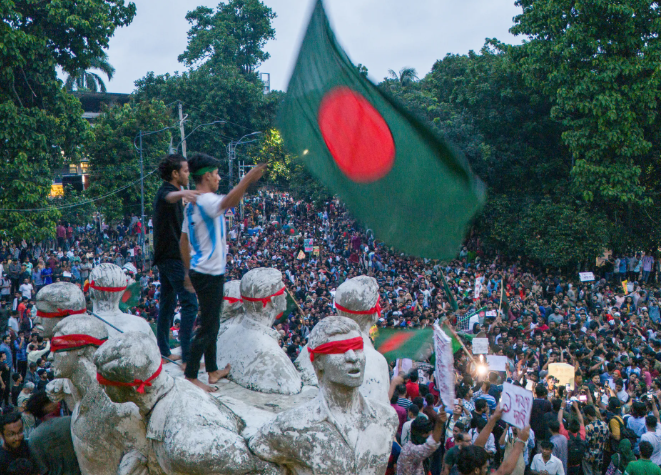
Bangladesh’s 2024 movement began with students demanding reform of quotas in government employment. After deaths, arrests and a wider crackdown, the agitation expanded beyond its original issue.
The movement developed into a nationwide challenge to Prime Minister Sheikh Hasina and ultimately contributed to her departure from office.
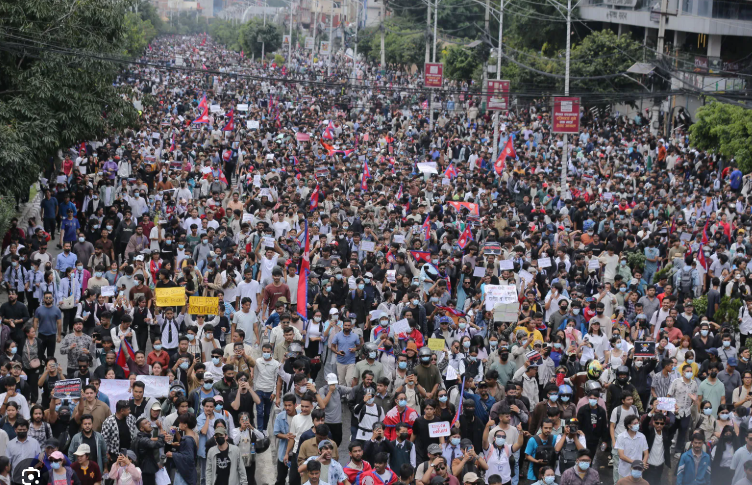
Nepal: Gen Z Mobilisation Shook the Political Establishment
Nepal’s 2025 Gen Z protests were triggered by restrictions on major social-media platforms and growing anger over corruption and nepotism.
The demonstrations expanded rapidly, led to the resignation of Prime Minister K P Sharma Oli and forced the creation of an interim government.
Sri Lanka, Bangladesh and Nepal showed that governments can underestimate youth movements when they treat initial grievances as temporary unrest. India’s CJP agitation remained constitutional and negotiated, but its speed and reach offered a reminder that digital-era protests can change political conditions very quickly.
Why India’s Movement Remained Different
The CJP agitation did not seek to overthrow the government. Its demands were specific: ministerial accountability, withdrawal of cases, relief for affected families and reform of the examination system.
The organisers ended the protest after negotiations and asked supporters to disperse peacefully. That distinction is important.
The regional comparisons show what can happen when crises remain unresolved. They do not prove that India was on the verge of a similar collapse.
A Tactical Retreat or Genuine Course Correction?
The government can present the settlement as proof that it listened to students and acted when confidence in the examination system was at risk.
Critics will describe the same decision as damage control undertaken only after the movement became politically dangerous.
Both interpretations capture part of the political reality. The resignation created accountability at the ministerial level while also preventing the confrontation from continuing through Parliament and into the 2027 election cycle.
The real test will be implementation: whether cases are withdrawn, families receive meaningful relief and examination reforms produce a more secure and credible system.
The government ended the immediate crisis by accepting the protesters’ central demands.
The CJP movement demonstrated that a digitally connected generation can turn a technical examination controversy into a national political challenge within weeks.
The warning to every government and political party is clear: youth frustration can no longer be dismissed as temporary online anger.
Dharmendra Pradhan’s resignation brought the agitation to an end, but the political impact may continue.
The movement showed that a decentralised youth campaign without a traditional party structure could force negotiations, secure political accountability and compel the national establishment to reassess the power of Gen Z.