📅 July 11, 2026 | By Pulse India News Desk
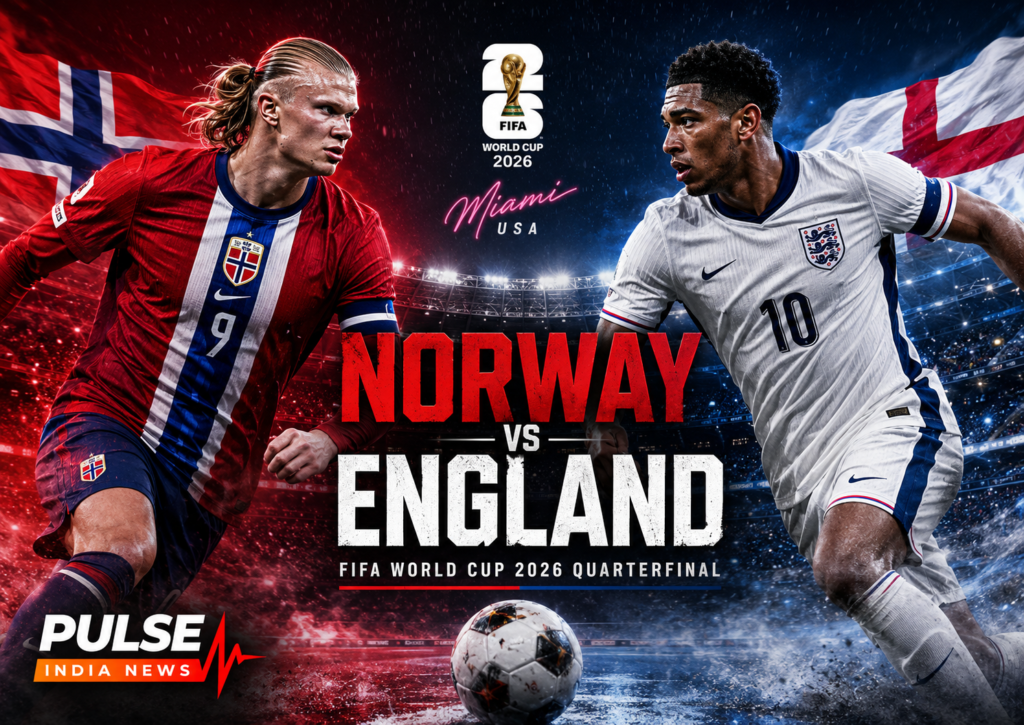
Norway face England in a historic FIFA World Cup 2026 quarterfinal at Miami Stadium, with a place in the final four at stake. The heavyweight knockout clash brings together Erling Haaland and Harry Kane, two of world football’s most feared finishers, after both nations survived dramatic Round of 16 battles.
| Match | Norway vs England |
| Competition | FIFA World Cup 2026™ – Quarterfinal |
| Venue | Miami Stadium, Miami, Florida |
| Kick-off | Sunday, July 12, 2026 – 2:30 AM IST |
| Norway Formation | 4-3-3 |
| England Formation | 4-2-3-1 |
| Main Storyline | Erling Haaland vs Harry Kane |
| Semifinal Opponent | Argentina or Switzerland |
| Prediction | Norway 1-2 England |
Norway vs England: Haaland Meets Kane In A Historic World Cup Quarterfinal
Norway have become one of the defining stories of the FIFA World Cup 2026. Ståle Solbakken’s side followed a strong group-stage campaign with consecutive 2-1 knockout victories over Ivory Coast and five-time world champions Brazil.
The victory over Brazil transformed Norway from dangerous outsiders into genuine semifinal contenders. Their combination of physical strength, disciplined defending, direct transitions and elite finishing has made them extremely difficult to control.
England’s route has been far less comfortable. Thomas Tuchel’s team required two late Harry Kane goals to overcome DR Congo before surviving a chaotic 3-2 Round of 16 battle against co-hosts Mexico.
That victory demonstrated England’s resilience, but it also exposed defensive and possession-related vulnerabilities that Norway will attempt to exploit through Martin Ødegaard’s passing, Antonio Nusa’s carrying ability and Haaland’s movement behind the defensive line.
The tactical contest may ultimately depend on which team can provide its superstar striker with the better service. Haaland has been Norway’s devastating penalty-box weapon, while Kane continues to combine finishing with creativity, leadership and link play for England.
- Norway eliminated Brazil 2-1 in one of the biggest shocks of the tournament.
- England defeated Mexico 3-2 despite playing a significant period with ten men.
- Norway are competing in their first World Cup quarterfinal.
- England are attempting to reach the semifinals for the first time since 2018.
- Erling Haaland enters as Norway’s leading scorer and primary attacking weapon.
- Harry Kane remains England’s captain, finisher and attacking reference point.
- Martin Ødegaard and Jude Bellingham will contest the central creative spaces.
- Norway’s height makes them especially dangerous from corners and free-kicks.
- England possess greater squad depth and more tactical options from the bench.
- Norway’s compact defensive structure is designed to create direct counter-attacking opportunities.
- England must protect the space behind their advancing full-backs.
- The winner will face Argentina or Switzerland in the semifinals.
📋 Confirmed Playing XIs & Formations
Goalkeeper: Ørjan Nyland
Defenders: Julian Ryerson, Kristoffer Ajer, Torbjørn Heggem, David Møller Wolfe
Midfielders: Patrick Berg, Sander Berge, Martin Ødegaard
Forwards: Antonio Nusa, Erling Haaland, Alexander Sørloth
Team Note: Norway’s nominal 4-3-3 can become a compact 4-5-1 without possession. Nusa and Sørloth are expected to recover into midfield before breaking forward quickly when Norway regain the ball.
Goalkeeper: Jordan Pickford
Defenders: Ezri Konsa, John Stones, Marc Guéhi, Nico O’Reilly
Defensive Midfielders: Elliot Anderson, Declan Rice
Attacking Midfielders: Noni Madueke, Jude Bellingham, Anthony Gordon
Striker: Harry Kane
Team Note: England will operate in a 4-2-3-1 with Bellingham positioned behind Kane. Rice and Anderson provide protection and progression, while Madueke and Gordon offer speed on the outside.
📌 Formation View
🚨 Team News & Availability
England have been forced to manage several fitness and availability concerns during the buildup to the quarterfinal.
Jarell Quansah is unavailable following his dismissal against Mexico, while England’s medical team has carefully monitored players carrying fatigue or minor physical issues after an exhausting Round of 16 contest.
The selection of John Stones alongside Marc Guéhi gives England experience in central defence, but Norway are likely to test the pairing with direct runs, aerial pressure and Haaland’s acceleration behind the line.
Norway’s preparations were initially disrupted by illness concerns inside the camp, but the squad entered the final phase of preparation with its leading players available.
That continuity allows Solbakken to retain the structure that produced the landmark victory over Brazil rather than redesigning his system for England.
🔎 Norway Team Review
🧤 Goalkeeper
Ørjan Nyland provides experience behind Norway’s defence. England are likely to press him during short buildup sequences, so his decision-making under pressure will be important.
Norway may not insist on playing through England’s press. Nyland can bypass the first line by targeting Sørloth, Haaland or the spaces around England’s full-backs.
🛡️ Defence
Kristoffer Ajer and Torbjørn Heggem must manage Kane’s tendency to move away from the penalty area. One defender may follow Kane while the other protects the space behind.
Julian Ryerson brings aggression and energy on the right, while David Møller Wolfe faces the difficult assignment of controlling Madueke’s acceleration and changes of direction.
Norway’s back four will defend narrow when England circulate the ball centrally. This protects the penalty area but may leave crossing opportunities for England’s wide players.
⚙️ Midfield
Patrick Berg provides the positional discipline that allows Norway’s other midfielders to move forward. He will be responsible for protecting the zone in front of Ajer and Heggem.
Sander Berge gives Norway size, ball-carrying ability and defensive reach. His physical battle with Rice and Anderson could determine whether Norway can escape pressure.
Martin Ødegaard is Norway’s main creator. He will search for early passes behind England’s defensive line and attempt to release Haaland before the Three Lions can settle into a compact shape.
⚡ Attack
Antonio Nusa provides Norway’s most explosive carrying threat. His ability to receive wide, beat the first defender and attack the penalty area gives Norway another route beyond simply passing to Haaland.
Alexander Sørloth offers height, physical pressure and a second penalty-box target. His positioning can prevent England’s defenders from concentrating entirely on Haaland.
Erling Haaland remains the central threat. Norway do not require long periods of possession when one well-timed pass can release him into space.
🔎 England Team Review
🧤 Goalkeeper
Jordan Pickford must remain alert even during England’s longer periods of possession. Norway can move from a deep defensive position to a shooting opportunity in only a few passes.
Pickford’s long distribution may also help England bypass Norway’s midfield pressure and attack second balls around Kane and Bellingham.
🛡️ Defence
John Stones gives England composure in possession and the ability to step forward from central defence. However, advancing too aggressively could leave space for Haaland to attack.
Marc Guéhi will need to match Norway’s physical intensity, particularly when Sørloth moves into his zone.
Ezri Konsa and Nico O’Reilly must balance attacking support with defensive responsibility. Norway will target the channels behind them whenever possession changes.
⚙️ Midfield
Declan Rice is England’s most important defensive midfielder in this matchup. His positioning can prevent Ødegaard from receiving and turning into open space.
Elliot Anderson adds energy, pressure and progressive passing. England need him to move the ball quickly enough to prevent Norway’s defensive block from becoming comfortable.
Jude Bellingham provides the connection between midfield and attack. His late runs into the penalty area can create the extra number England need against Norway’s narrow defence.
⚡ Attack
Noni Madueke can attack Møller Wolfe directly and force Norway’s left side deeper. His ability to beat a defender may become important when England’s central passing routes are blocked.
Anthony Gordon brings direct running from the opposite wing. England will want him to attack the space behind Ryerson before Norway’s defence resets.
Harry Kane remains both England’s finisher and creative reference point. His movement into midfield can draw Norway’s centre-backs forward and open spaces for Bellingham, Gordon and Madueke.
🌟 Haaland vs Kane: The Battle Of The Elite Number Nines
The quarterfinal places two of the world’s most accomplished strikers at the centre of the tactical narrative.
Erling Haaland is Norway’s devastating final-action player. He stretches the pitch vertically, dominates central defenders physically and requires very few touches to decide a match.
Harry Kane offers a broader creative role. He can lead the line, drop between midfield and defence, switch play and create chances for runners moving beyond him.
The comparison is therefore not simply about goals. Haaland gives Norway the most dangerous depth threat in the match, while Kane helps England construct attacks as well as finish them.
| Category | Erling Haaland | Harry Kane |
|---|---|---|
| Team | Norway | England |
| Primary Role | Penalty-box finisher and depth runner | Finisher, creator and link player |
| Main Strength | Acceleration, power and clinical finishing | Movement, passing and complete striking play |
| Best Supply Route | Ødegaard passes and Nusa transitions | Bellingham combinations and wide deliveries |
| Key Defensive Opponents | Stones and Guéhi | Ajer and Heggem |
| Biggest Threat | One pass behind England’s high line | Dropping deep before attacking the box |
⚔️ Key Tactical Battle
| Area | Norway | England |
|---|---|---|
| Defensive Shape | Compact 4-5-1 block | 4-2-3-1 with aggressive counter-press |
| Midfield Control | Berg protects while Ødegaard creates | Rice and Anderson provide balance |
| Transition Threat | Haaland, Nusa and Sørloth | Gordon, Madueke and Bellingham |
| Aerial Strength | Major weapon at both ends | Kane, Stones, Guéhi and Rice |
| Creative Leader | Martin Ødegaard | Jude Bellingham |
| Leading Finisher | Erling Haaland | Harry Kane |
| Squad Depth | Strong first XI but fewer alternatives | Multiple high-level attacking options |
| Main Vulnerability | Can become too dependent on direct attacks | Space behind full-backs and loss of control |
📊 Tournament Results: How They Reached The Quarterfinal
| Stage | Norway | England |
|---|---|---|
| Group Stage – Match 1 | Won 4-1 vs Iraq | Won 4-2 vs Croatia |
| Group Stage – Match 2 | Won 3-2 vs Senegal | Won 2-0 vs Panama |
| Group Stage – Match 3 | Lost 1-4 vs France | Drew 0-0 vs Ghana |
| Round of 32 | Won 2-1 vs Ivory Coast | Won 2-1 vs DR Congo |
| Round of 16 | Won 2-1 vs Brazil | Won 3-2 vs Mexico |
Norway’s Route: Norway began with impressive victories over Iraq and Senegal before suffering a heavy defeat against France. They responded strongly in the knockout rounds, defeating Ivory Coast and producing a historic 2-1 victory over Brazil.
England’s Route: England defeated Croatia and Panama before a goalless draw against Ghana. Their knockout campaign has tested their resilience, with narrow victories over DR Congo and Mexico.
📈 Comparative Tournament Overview
| Feature | Norway | England |
|---|---|---|
| Matches Played | 5 | 5 |
| Wins | 4 | 4 |
| Draws | 0 | 1 |
| Losses | 1 | 0 |
| Goals Scored | 12 | 11 |
| Goals Conceded | 9 | 5 |
| Primary Style | Compact defending and direct transitions | High-intensity pressing and direct attacking |
| Main Physical Strength | Height and aerial power | Athleticism and bench depth |
| Key Playmaker | Martin Ødegaard | Jude Bellingham |
| Leading Attacker | Erling Haaland | Harry Kane |
| Defining Knockout Result | 2-1 vs Brazil | 3-2 vs Mexico |
⚔️ Head-to-Head History
Total Meetings: 12
England Wins: 7
Norway Wins: 2
Draws: 3
First Major Tournament Meeting: This FIFA World Cup 2026 quarterfinal
Last Meeting: England won 1-0 in an international friendly at Wembley in 2014.
Norway’s Two Victories: Both arrived in World Cup qualifying matches, in 1981 and 1993.
⭐ Players To Watch
⭐ Erling Haaland: Norway’s most dangerous finisher and the central figure in their transition game.
⭐ Martin Ødegaard: Must find passing angles before England’s midfield pressure closes around him.
⭐ Antonio Nusa: Norway’s most explosive ball carrier in wide and transitional situations.
⭐ Sander Berge: Provides physical power and helps Norway escape pressure through midfield.
⭐ Harry Kane: England’s captain, primary scorer and most accomplished link player.
⭐ Jude Bellingham: Can decide the game through late runs, pressing and moments of individual quality.
⭐ Declan Rice: Must prevent Norway from finding Ødegaard and Haaland through the centre.
⭐ Noni Madueke: His one-on-one ability can stretch Norway’s compact defensive block.
⚔️ Key Battles To Watch
Erling Haaland vs John Stones: Stones must judge when to step forward and when to protect the space behind England’s defence.
Alexander Sørloth vs Marc Guéhi: Sørloth’s strength and aerial presence can prevent Guéhi from concentrating only on Haaland.
Martin Ødegaard vs Declan Rice: Rice will attempt to block Norway’s most important creative passing route.
Harry Kane vs Kristoffer Ajer: Ajer must decide whether to follow Kane into midfield or remain connected to the defensive line.
Jude Bellingham vs Patrick Berg: Berg’s positioning will be tested by Bellingham’s movement between midfield and defence.
Antonio Nusa vs Ezri Konsa: Nusa will attempt to attack the outside channel before England can organise their defensive shape.
Noni Madueke vs David Møller Wolfe: England will try to create repeated one-on-one situations on their right side.
Anthony Gordon vs Julian Ryerson: Gordon’s speed will test Ryerson’s positioning whenever England switch play quickly.
🧠 How Norway Can Win
1. Protect The Central Zone: Norway cannot allow Bellingham and Kane to combine freely between the lines.
2. Release Haaland Early: The best moment to attack England is immediately after possession changes, before Rice and the centre-backs can reorganise.
3. Use Sørloth As A Second Target: Direct passes toward Sørloth can create second-ball opportunities for Ødegaard, Nusa and Haaland.
4. Attack Set-Pieces: Norway’s height gives them a genuine route to goal from corners and wide free-kicks.
5. Remain Patient: Norway do not need to dominate possession. They need to remain organised and wait for England to leave an exploitable space.
🧠 How England Can Win
1. Control Norway’s Transitions: England must maintain protection behind the ball whenever the full-backs or midfielders advance.
2. Deny Ødegaard Time: Preventing Norway’s captain from turning will reduce the quality of service reaching Haaland.
3. Move Norway Side To Side: Quick switches can stretch Norway’s narrow block and create isolation opportunities for Madueke and Gordon.
4. Use Kane’s Movement: Kane can draw a centre-back out of position before Bellingham or a winger attacks the space he creates.
5. Exploit Bench Depth: England have the attacking alternatives to raise the tempo if Norway begin to tire after the hour mark.
Expected Nature Of The Match
England are expected to see more of the ball, particularly during the opening phase. Rice, Anderson and Stones will attempt to circulate possession before finding Bellingham between Norway’s midfield and defensive lines.
Norway should defend in a compact structure, with Nusa and Sørloth dropping alongside the midfield three. Their objective will be to make central progression difficult and encourage England to play predictable passes toward the wings.
When Norway regain possession, Ødegaard will immediately search for Haaland, Nusa or Sørloth. England’s defensive line must therefore remain prepared even when the Three Lions appear to be in complete control.
The game may become increasingly open after the first goal. An England lead would force Norway to take greater risks, while a Norway goal could make Solbakken’s compact counter-attacking structure even more dangerous.
Opening Phase
England should attempt to establish control through Rice and Anderson while Bellingham moves into the spaces around Berg.
Madueke and Gordon will hold width to stretch Norway’s midfield line and prevent the full-backs from defending too narrowly.
Norway’s first priority will be defensive stability. Their opening attacks are likely to be direct, with Sørloth challenging for aerial balls and Haaland attacking the second phase.
The first duel between Haaland and England’s centre-backs may reveal whether Tuchel wants his defensive line to hold a deeper position or compress the pitch aggressively.
Set-Piece Threat
Norway’s physical profile makes every corner and wide free-kick a major event. Haaland, Sørloth, Ajer, Heggem and Berge give Solbakken several powerful aerial targets.
England also possess strong aerial defenders, but they must avoid conceding unnecessary fouls in the wide channels.
At the opposite end, Rice’s delivery and the movement of Kane, Stones, Guéhi and Bellingham can test Norway’s marking organisation.
Miami Conditions And Game Management
The match will be played in Miami, where heat, humidity and the possibility of disruptive summer weather can influence the rhythm of a high-intensity knockout fixture.
Both teams will need to manage energy carefully. England’s attempt to press aggressively could become harder to sustain as the match progresses, while Norway’s compact block may require long periods of concentration and defensive movement.
Substitutions after the hour mark could therefore become decisive. England’s greater attacking depth provides Tuchel with more options to change the structure, increase width or add another striker.
Par Score
Norway have scored in four of their five tournament matches, while England have found the net in four of five.
Both teams possess elite finishers, but the high stakes of a quarterfinal may initially encourage a more controlled approach.
England are likely to require at least two goals to feel secure because Norway can threaten through transitions and set-pieces even during periods of limited possession.
🔮 Match Prediction
Norway have already demonstrated that reputation and possession do not intimidate them. Their victory over Brazil was built on tactical discipline, physical courage and clinical finishing.
Haaland gives Norway the most dangerous individual transition threat in the match, while Ødegaard has the passing quality to punish England if their midfield structure becomes stretched.
England, however, possess more tactical alternatives and greater depth across the squad. Kane can influence the match in several different ways, Bellingham provides decisive penalty-area movement and the wide attackers can force Norway to defend across the entire pitch.
The quarterfinal may remain extremely close for a long period. Norway should create opportunities and have a realistic chance of scoring, particularly from a transition or set-piece.
England’s deeper bench and ability to introduce fresh attacking quality could ultimately become the difference during the final half-hour.
Norway possess the physical strength, tactical discipline and elite finishing required to threaten England throughout the quarterfinal. However, England’s superior squad depth, attacking variety and knockout experience should gradually create a narrow advantage.
Likely Outcome: England advance to the semifinals
Alternative Score: Norway 2-3 England after extra time
Key Battle: Erling Haaland vs John Stones and Marc Guéhi
Player To Watch: Jude Bellingham ⭐
Norway X-Factor: Haaland attacking the space behind England’s defence
England X-Factor: Harry Kane dropping deep to release Bellingham and the wingers
Norway Winning Route: Defend compactly, release Ødegaard quickly and attack England through Haaland, Nusa and set-pieces
England Winning Route: Control central transitions, move Norway’s block from side to side and use superior bench depth after the hour mark
FIFA World Cup 2026 Norway vs England England vs Norway Norway Football England Football World Cup Quarterfinal Erling Haaland Harry Kane Martin Odegaard Jude Bellingham Declan Rice Antonio Nusa Thomas Tuchel Stale Solbakken Norway vs England Prediction Norway Playing XI England Playing XI Haaland vs Kane World Cup Preview FIFA World Cup Knockouts