📅July 11, 2026 | By Pulse India News Desk
The Centre says maintaining multiple petrol grades is impractical, reaffirming E20 as the country’s long-term fuel strategy despite ongoing concerns over mileage and compatibility.
India has firmly ruled out offering motorists a choice between pure petrol, E10 (10% ethanol blend), and E20 (20% ethanol blend), putting an end to speculation that older vehicles could once again have access to lower ethanol-blended fuels.
The decision means E20 petrol will continue to be the standard fuel available at retail fuel stations across the country, with the government emphasizing that introducing multiple fuel grades would create major logistical and financial challenges.
No Separate Fuel Choices for Consumers
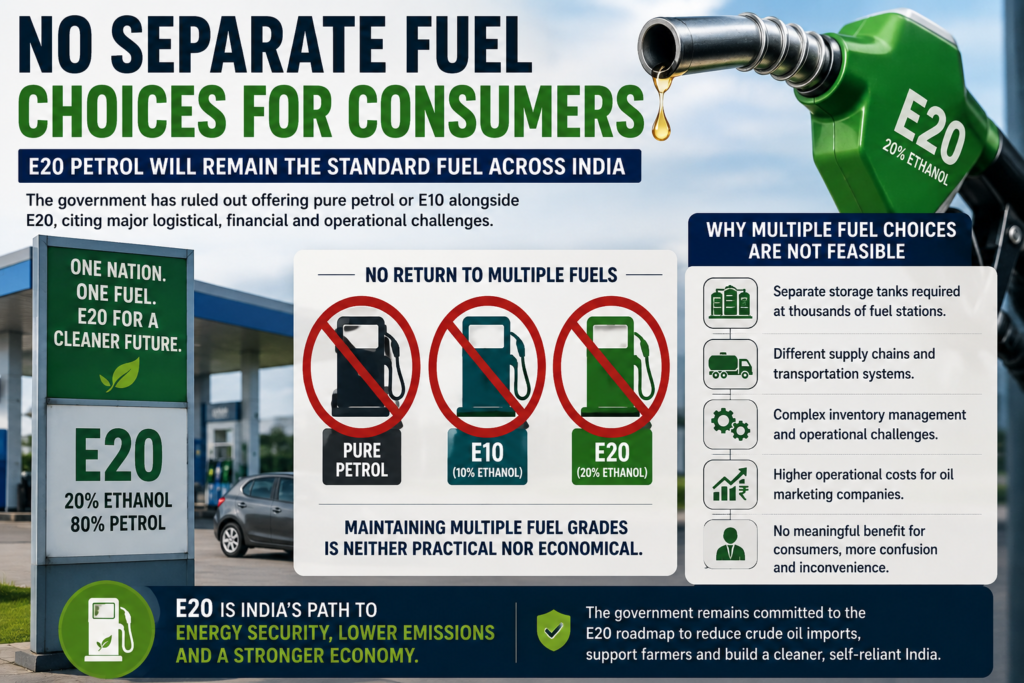
Responding to growing public debate over ethanol-blended fuel, the government clarified that maintaining separate supplies of pure petrol, E10, and E20 across India’s vast network of fuel stations is neither economically viable nor operationally practical.
Officials noted that the country’s fuel distribution system has already undergone significant upgrades to support higher ethanol blending, and introducing multiple petrol grades would require additional storage tanks, separate transportation infrastructure, and complex supply chain management.
According to the government, such a move would substantially increase operational costs for oil marketing companies while reducing efficiency at fuel stations.
Why India Is Sticking With E20
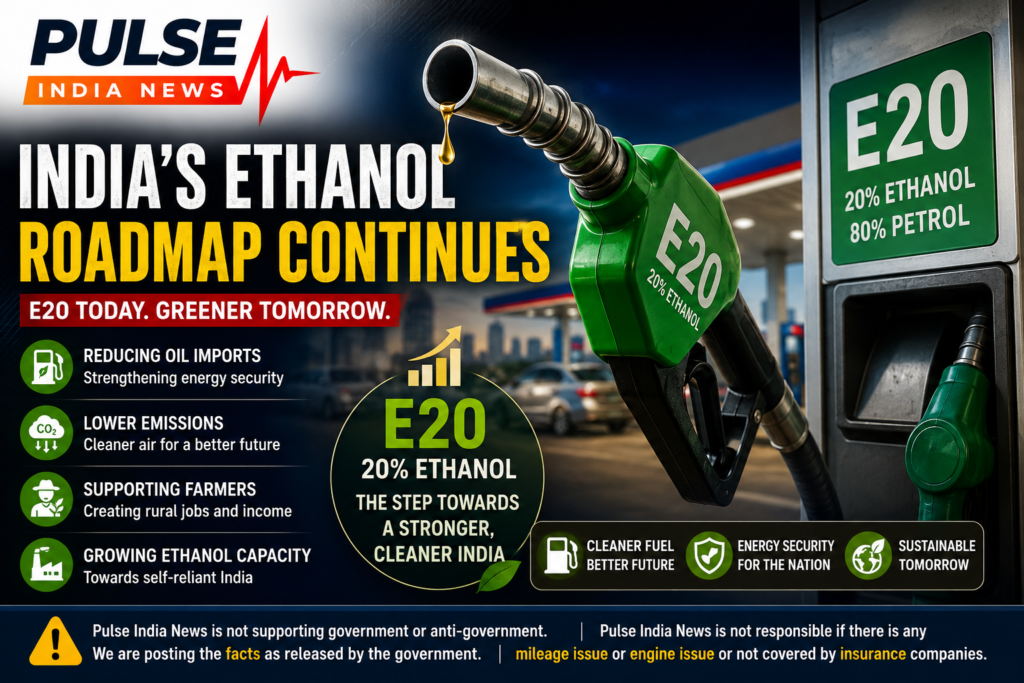
The decision is part of India’s broader strategy to reduce dependence on imported crude oil while supporting domestic ethanol production.
India is spending a massive US$121.8 billion (₹10.5 lakh crore approximately) on Crude oil imports per year.
The government believes higher ethanol blending offers several long-term benefits, including:
- Lower crude oil imports
- Improved energy security
- Reduced greenhouse gas emissions
- Increased demand for domestically produced ethanol from sugarcane and grain-based industries
- Better income opportunities for farmers
Officials say these strategic benefits outweigh the concerns raised by some motorists regarding fuel efficiency.
Mileage Concerns Continue
While supporting the transition to E20, the government has acknowledged that some vehicles may experience a 3–5% reduction in fuel economy because ethanol contains less energy per litre than conventional petrol.
Drivers of older vehicles have also expressed concerns about long-term compatibility, particularly regarding rubber seals, fuel hoses, and engine components that were originally designed for lower ethanol blends.
However, authorities maintain that modern vehicles manufactured for E20 compatibility are capable of operating safely on the fuel without significant reliability issues.
What About Older Vehicles?
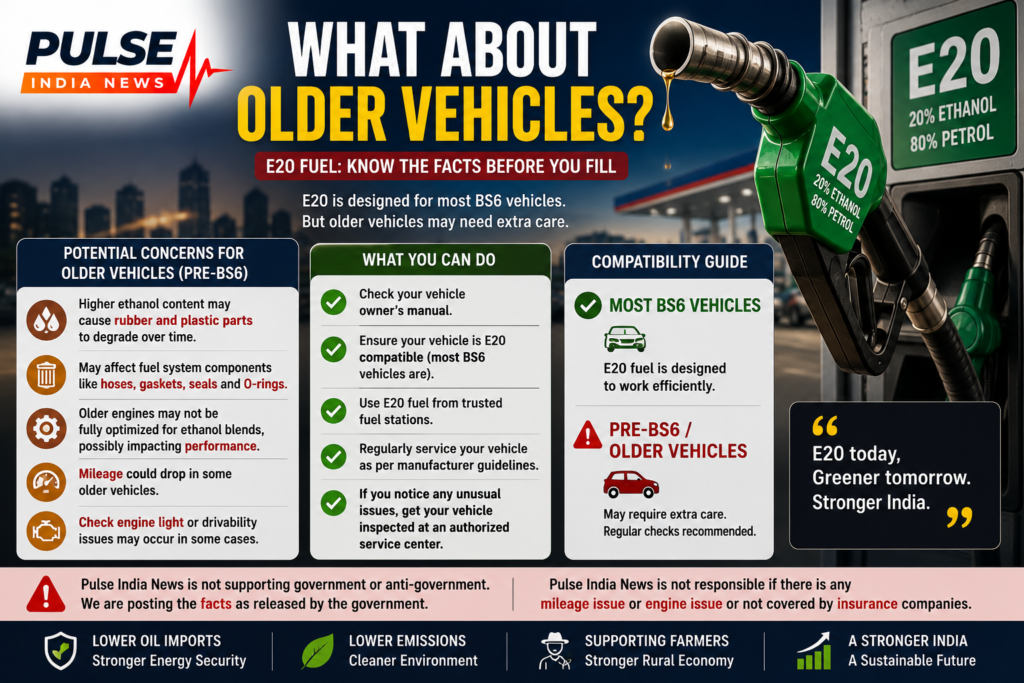
One of the biggest questions remains the impact on millions of older petrol vehicles currently on Indian roads.
Automobile manufacturers have progressively introduced E20-compatible engines, but many vehicles sold before the transition were originally certified for E10 fuel.
Industry experts advise owners of older vehicles to:
- Follow manufacturer recommendations
- Keep up with scheduled maintenance
- Monitor fuel system components for wear during routine servicing
Despite these concerns, the government has made it clear that it does not intend to reintroduce pure petrol or E10 as separate retail options.
What Consumers Are Saying
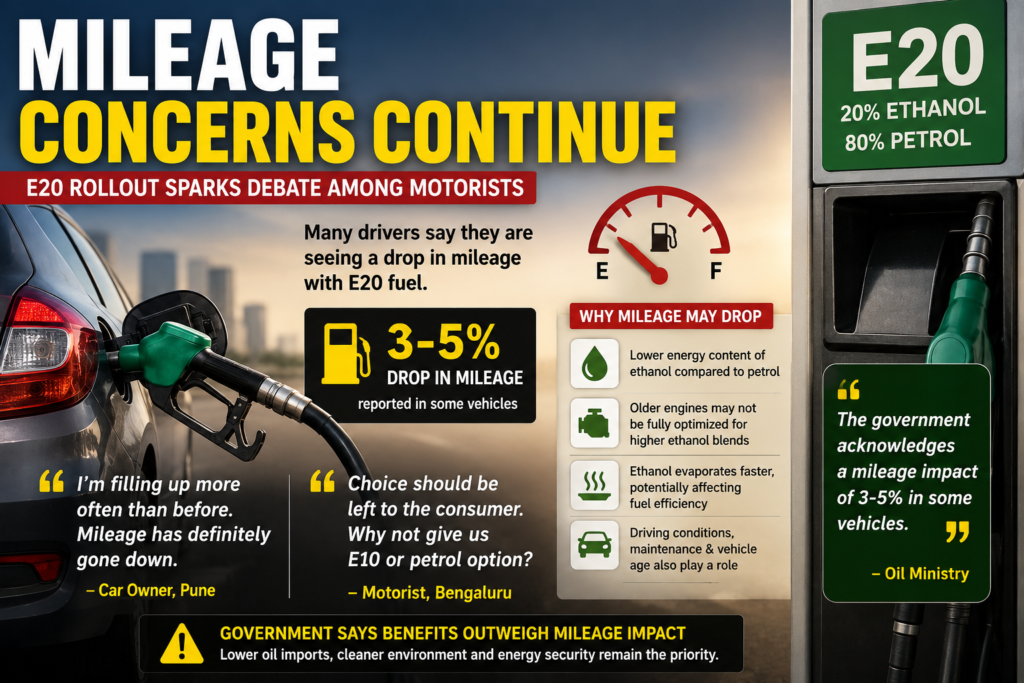
The government’s decision to continue with E20 as the only standard petrol has triggered mixed reactions among motorists, with many welcoming India’s energy security goals but questioning the lack of consumer choice.
Many vehicle owners have expressed the following concerns:
- “Why can’t consumers choose?” Several motorists argue that owners of older vehicles should have the option of buying pure petrol or E10 if they believe it is better suited to their engines.
- Mileage worries: Drivers say they have noticed a slight reduction in fuel efficiency after switching to E20, making fuel expenses higher despite petrol prices remaining unchanged. The government acknowledges that some vehicles may see a 3–5% drop in mileage.
- Engine compatibility concerns: Owners of vehicles manufactured before widespread E20 compatibility remain worried about the long-term impact on fuel lines, rubber components and engine performance, although the government says E20 is safe for compatible vehicles.
- No price advantage: Some consumers expected E20 to be cheaper because ethanol is blended with petrol, but were disappointed that retail prices remain largely unchanged. The government says ethanol production and distribution also involve significant costs.
At the same time, some consumers support the policy, saying that reducing India’s dependence on imported crude oil is essential if it strengthens energy security, supports Indian farmers and reduces exposure to volatile global oil prices.
The debate now centres on one key question: Should India continue with a single nationwide E20 fuel policy, or should motorists—especially owners of older vehicles—be given the freedom to choose between pure petrol, E10 and E20? That discussion is expected to continue even as the government has ruled out offering multiple petrol grades.
India’s Ethanol Roadmap Continues
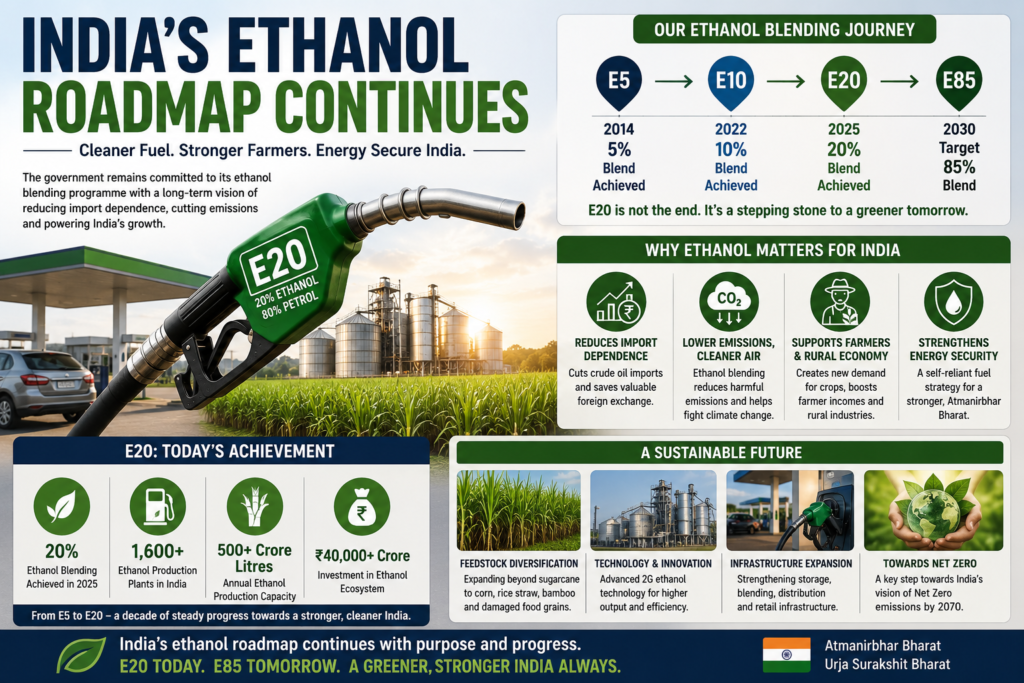
India has rapidly increased ethanol blending over the past few years as part of its clean energy and energy security goals. The government considers the E20 rollout a major milestone in reducing fossil fuel dependence while strengthening the domestic biofuel sector.
Officials say the country’s investments in ethanol production, fuel storage, and distribution infrastructure are designed around E20, making a reversal both costly and impractical.
What This Means for Consumers
For motorists, the message is straightforward:
- E20 petrol will remain the standard fuel across India.
- Pure petrol and E10 will not be offered as parallel choices at fuel stations.
- Owners of E20-compatible vehicles are expected to continue using the fuel without issue.
- Drivers of older vehicles should consult their manufacturers regarding long-term compatibility and maintenance.
As India accelerates its transition toward cleaner transportation fuels, the government’s latest clarification signals that the country’s ethanol blending programme is now entering its long-term implementation phase rather than remaining an experimental policy.
With E20 set to become the nationwide norm, India’s fuel future appears firmly tied to biofuel-driven energy security rather than a return to conventional petrol.
Editorial Disclaimer
Pulse India News does not support either the government or any anti-government campaign in relation to the E20 petrol policy. This article has been published only to present the facts, statements and information released by the government, industry sources and consumers.
Pulse India News is not responsible for any reduction in mileage, engine performance issue, fuel-system damage, repair cost, warranty rejection or insurance claim denial that may arise from the use of E20 petrol. Vehicle owners should verify fuel compatibility with their manufacturer, authorised service centre, warranty provider and insurance company before making any decision.