📅April 23, 2026 | By Pulse India News Desk
🔴 Top Line
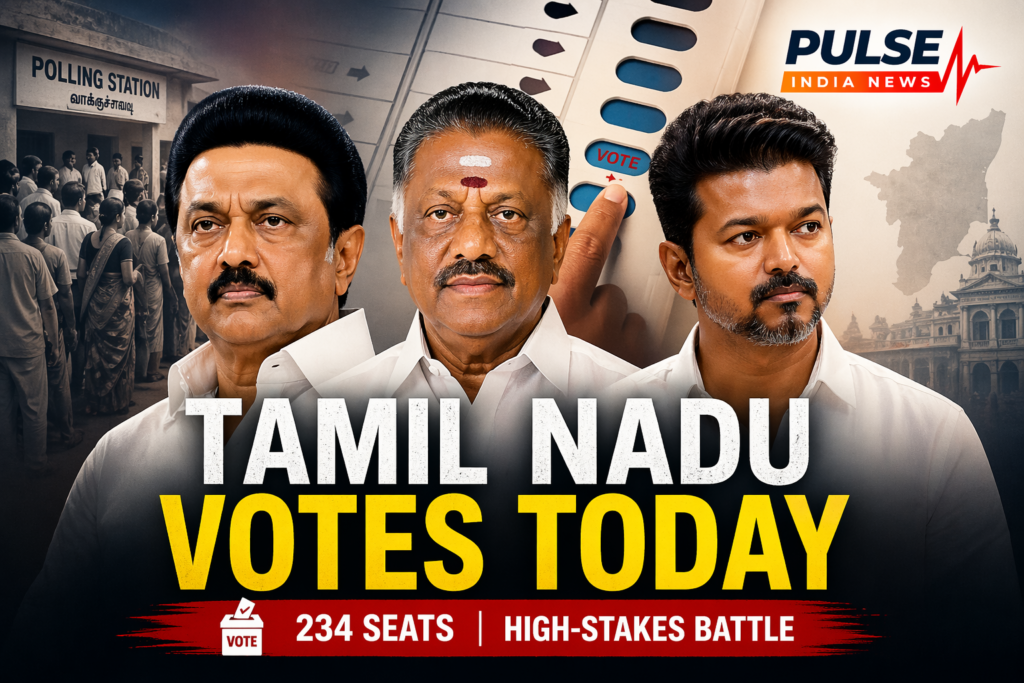
Tamil Nadu heads into a crucial political battle today as voting begins across all 234 assembly constituencies, with over 5.6 crore voters set to decide the state’s future government. The election is being seen as a high-stakes contest between the ruling establishment seeking a second term and a determined opposition aiming for a comeback.
From early morning, long queues were seen at polling booths across cities like Chennai, Coimbatore and Madurai, reflecting strong voter enthusiasm. With tight contests expected in several key constituencies, the outcome could significantly shape the political direction of Tamil Nadu for the next five years.
“If you don’t vote, you lose the right to question those who govern.”
— Public awareness message
📊 What’s Happening Today?
🗳️ How Voting Works
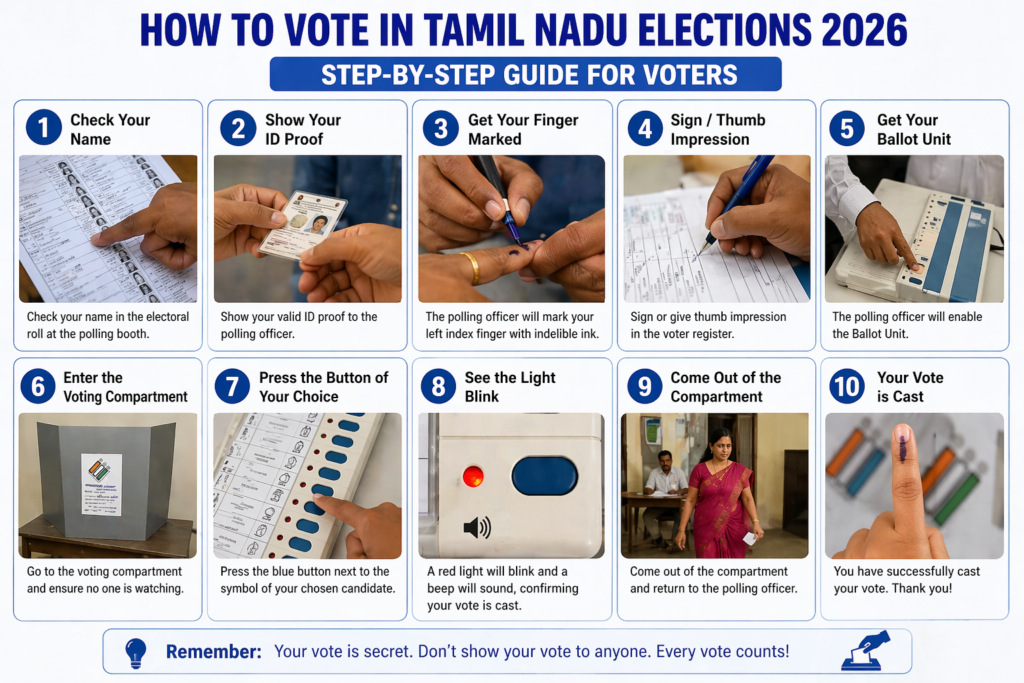
At polling booths, voting follows a clear and structured process to ensure smooth participation. Voters are required to complete identity verification using an approved document such as a voter ID card, Aadhaar card, passport or driving licence. After verification, polling officials apply indelible ink on the voter’s finger, following which the voter proceeds to cast their vote on the Electronic Voting Machine (EVM).
👉 Voter slips are usually distributed by Booth Level Officers (BLOs) or local election staff in advance.
👉 If you have not received your slip, you can check your details online here:
https://electoralsearch.eci.gov.in/
👉 You can also visit your polling station help desk to find your booth and serial number.
⚔️ Key Political Battle
The Tamil Nadu assembly election is being viewed as a multi-cornered contest, with the ruling DMK-led Secular Progressive Alliance seeking a second consecutive term under Chief Minister M.K. Stalin. The opposition space is led by the AIADMK, which is contesting as part of the NDA, aiming to stage a political comeback after its defeat in 2021.
At the same time, the entry of new players, including actor-politician Vijay’s party, has added an additional layer of complexity to the electoral battle. While the contest remains largely centred around the traditional Dravidian rivals, the presence of emerging forces could influence vote shares in closely fought constituencies.
👉 The outcome of this contest is expected to hinge on factors such as governance record, alliance arithmetic and voter turnout across key regions.
📊 Current Seats by Party in Tamil Nadu Assembly
Before the 2026 election, the outgoing Assembly’s commonly cited party-wise baseline is led by the DMK with 133 seats, followed by the AIADMK with 66. Congress holds 18 seats, while PMK has 5. BJP and VCK have 4 seats each, and CPI and CPI(M) hold 2 seats each. Total: 234 seats.
Massive Seizures During Election Checks
During election enforcement checks, large quantities of valuables including gold, cash, liquor, drugs, and other items are being seized across Tamil Nadu. Authorities have intensified surveillance at check-posts, toll plazas, and border areas to prevent illegal movement of money and goods during the election period.
In a recent case, officials seized 13.85 kilograms of gold in Chennai. In another incident, cash worth ₹2.49 crore was confiscated. Additionally, in Coimbatore, gold worth approximately ₹170 crore was reportedly seized. Overall, valuables worth more than ₹310 crore have been seized so far as part of strict election monitoring measures.
Officials clarified that individuals transporting valuables must carry valid documents. Without proper proof, such items will be seized as part of election code enforcement.
Liquor Seizures Rise
Along with cash and gold, authorities are also cracking down on illegal liquor distribution. During the election period, liquor worth around ₹5.5 crore has been seized across the state.
Police have conducted raids at several locations, including warehouses and unauthorized storage points. In some cases, liquor bottles, raw materials, and distribution equipment were confiscated.
In one major operation, police seized around ₹10 lakh worth of liquor stock. In another instance, about 6 grams of drugs were recovered during vehicle checks, indicating strict monitoring of illegal activities.
🔵 DMK Drops 60 Sitting MLAs in Major Candidate Shake-Up
In a significant pre-election move, the DMK has dropped around 60 sitting MLAs, signalling a major internal reshuffle ahead of the polls. The decision is being seen as an attempt by the party leadership to counter anti-incumbency and bring in fresh faces across key constituencies. By denying tickets to several incumbents, the ruling party is aiming to strengthen its electoral prospects while addressing local dissatisfaction reported in some segments.
Political observers say the move reflects a calculated strategy to balance experience with renewal, while also sending a message of accountability within the party. However, replacing a large number of sitting legislators could also pose challenges, including managing internal dissent and ensuring smooth coordination at the grassroots level during campaigning.
🎬 Vijay Enters the Political Scene
Actor Vijay, who has announced his entry into politics, has also become a key talking point in this election. He is contesting in all 234 constituencies. Alongside established parties, new entrants like Vijay’s party are expected to influence vote shares in several regions.
Political analysts believe that the presence of new parties could impact traditional voting patterns. This may lead to vote division, especially in closely contested constituencies.
⚔️ Focus on AIADMK
The AIADMK is making strong efforts to regain power after its defeat in the 2021 elections. The party is focusing heavily on strengthening its base and addressing governance issues raised by voters.
AIADMK leaders have intensified their campaigns, highlighting administrative experience and past achievements. The party is aiming to capitalize on anti-incumbency sentiment and present itself as a stable alternative.
🎁 Freebies Take Centre Stage in Tamil Nadu Poll Battle
Freebies have once again emerged as a key electoral strategy in the Tamil Nadu assembly elections, with almost all major parties announcing welfare schemes to attract voters. From cash assistance and subsidised goods to promises of financial support for women and youth, political parties are competing aggressively through welfare-driven campaigns.
The ruling DMK and the opposition AIADMK, along with other parties, have rolled out a range of schemes aimed at different voter segments. Analysts note that while such promises are often positioned as social welfare measures, they also play a significant role in influencing voter behaviour, especially in rural and economically weaker sections.
👉 However, the growing dependence on freebies has also sparked debate over fiscal sustainability and long-term economic impact, even as parties continue to rely on them as a crucial tool to secure electoral advantage.
🎁 Top Freebie Promises by Party
| Party | Key Promise 1 | Key Promise 2 | Key Promise 3 |
|---|---|---|---|
| DMK | ₹8,000 appliance coupon for housewives | Expansion of student breakfast scheme | Women-focused welfare pitch |
| AIADMK | Free refrigerators for women ration-card holders | Three free LPG cylinders | Free rations / crop-loan waiver pitch |
| TVK | Collateral-free education loans | Unemployment allowance for graduates | Youth-centric financial support promises |
| Other Parties | Targeted welfare for local voter groups | Subsidy-driven promises | Region- and caste-specific benefit schemes |
📉 Economic Impact of Freebies: A Growing Debate
The increasing reliance on freebies in Tamil Nadu’s electoral politics has triggered a broader debate on their long-term economic impact. While such schemes are often positioned as welfare measures aimed at supporting low-income households, economists caution that expanding commitments without corresponding revenue growth could place additional pressure on the state’s finances.
Supporters argue that welfare schemes have historically played a key role in improving social indicators in the state, including education, nutrition and women’s empowerment. Direct benefits such as cash transfers and subsidised services can provide immediate relief to families facing rising costs of living, particularly in rural and economically weaker sections.
However, critics point out that competitive freebie announcements during elections often lead to an escalation in spending promises, which may not always be backed by sustainable fiscal planning. Over time, this could result in higher budget deficits, increased borrowing and reduced allocation for long-term infrastructure and development projects.
The debate ultimately reflects a larger policy question – how to balance welfare delivery with fiscal discipline. As Tamil Nadu heads into another election cycle, the outcome could influence not only political dynamics but also the future direction of economic policy in the state.
🧠 Final Analysis
The Tamil Nadu assembly election has evolved into a high-stakes and multi-layered political contest, shaped by a mix of traditional rivalries, emerging players and aggressive campaign strategies. While the core battle continues to revolve around the DMK and AIADMK, the presence of new political entrants and shifting voter dynamics has added an element of unpredictability to the outcome.
Welfare promises and freebies have dominated the campaign narrative, reflecting the continued importance of social support schemes in influencing voter sentiment. At the same time, strict election monitoring, large-scale cash seizures and heightened security measures indicate the intensity of the electoral process across the state.
The ruling DMK is seeking to retain power by highlighting its governance record, while the opposition AIADMK is banking on anti-incumbency and renewed campaign efforts to regain ground. The role of smaller parties and new entrants could prove crucial in closely contested constituencies, particularly where vote margins are expected to be narrow.
Ultimately, the outcome will depend on voter turnout, alliance strength and regional voting patterns. Beyond the immediate political result, this election is also likely to influence the future direction of welfare policies, economic priorities and political alignments in Tamil Nadu.
Related News
- Tamil Nadu Elections 2026: Voting Begins Across 234 Seats – Full Coverage
- DMK Drops 60 Sitting MLAs: What It Means for the Election Battle
- Ghatak UCAV Explained: India’s Stealth Drone for Future Warfare
- Freebies in Elections: Why Welfare Promises Dominate Campaigns
- How EVM Voting Works in India: A Simple Guide for Voters